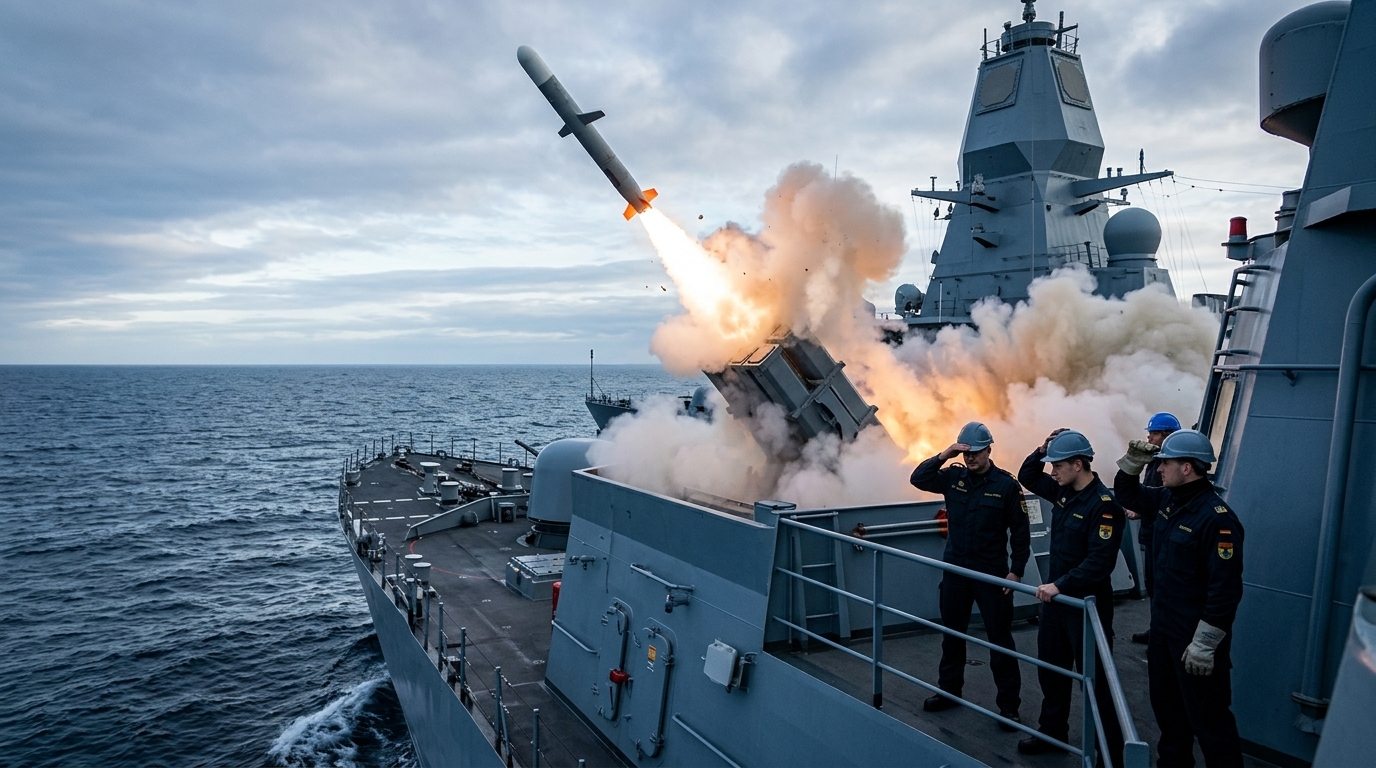
The German government's announcement regarding the acquisition and deployment of US Tomahawk missiles on its soil marks one of the most significant turning points in Berlin's post-war defense policy. After decades of strategic restraint, Germany is now openly acknowledging that Europe's security architecture has been irreparably damaged, necessitating a return to the logic of 'deterrence through strength' against Russia.
The Deterrence Gap and the Collapse of the INF Treaty
The root of the current crisis lies in the collapse of the Intermediate-Range Nuclear Forces (INF) Treaty in 2019. This treaty, signed in 1987 by Reagan and Gorbachev, banned an entire category of weapons: ground-launched missiles with ranges between 500 and 5,500 kilometers. For three decades, this pact provided Europe with relative security, removing the threat of a surprise attack that could level European capitals within minutes.
However, the development of the Russian 9M729 (SSC-8) missile system changed the calculus. The West accused Moscow of violating the treaty, leading to its ultimate termination. Since then, Europe has found itself in a 'capability gap.' While Russia now possesses missiles capable of striking Berlin, Paris, or Warsaw from Russian territory, European powers lacked comparable ground-based conventional deterrent systems. The decision to deploy Tomahawks is intended to 'bridge' this exact gap, providing NATO with the ability to respond to Russian provocations without having to immediately resort to nuclear weapons.
Zeitenwende: From Theory to Practice
The term 'Zeitenwende' (historical turning point), coined by Chancellor Olaf Scholz following the invasion of Ukraine, finds its full expression in the Tomahawk case. This is not merely an equipment purchase; it is a profound shift in the psychology of the German political elite. For years, Germany relied on diplomacy and economic interdependence as guarantees of peace. The harsh reality of the war in Ukraine demonstrated that deterrence requires credible military power.
The deployment of Tomahawk missiles, alongside SM-6s and developing hypersonic weapons, is set to begin in 2026. This provides Germany and its allies with the time needed to develop their own European solutions. Germany's participation in the ELSA (European Long-Range Strike Approach) initiative, alongside France, Italy, and Poland, aims to create a European cruise missile. Until then, however, reliance on US technology remains the only path to meeting immediate defense requirements.
Internal Reactions and the Shadow of the Cold War
The decision was not made without political cost. In Germany, memories of the 'Euromissile Crisis' of the early 1980s remain vivid. At that time, hundreds of thousands of protesters took to the streets against the deployment of Pershing II missiles. Today, although public opinion is more aware of the Russian threat, voices within the SPD (Social Democrats) and on the fringes of the political spectrum (AfD and BSW) still warn of a new arms race that could lead to nuclear escalation.
Defense Minister Boris Pistorius has taken on the difficult task of convincing German citizens that the presence of these weapons does not make Germany a target, but rather protects it. The argument is simple: if an aggressor knows they will face a devastating counter-strike, they are less likely to attack. This is classic deterrence theory, returning to the forefront of European diplomacy in the most resonant way possible.
Geopolitical Implications and the US Role
This move also strengthens the transatlantic bond during a period of uncertainty regarding future US commitment to NATO. By showing its willingness to host US strategic weapons, Germany sends a message to Washington that it is ready to shoulder its share of the costs and risks of collective defense. Simultaneously, it serves as a clear warning to the Kremlin that Europe will not remain a passive observer of Russian military build-ups in Kaliningrad and other parts of western Russia.
In conclusion, Germany's acquisition of Tomahawks signals the end of illusions about a 'peaceful Europe' without the need for robust armaments. Berlin, despite its internal friction, is choosing the path of realism, investing in a deterrent power it hopes it will never have to use. The success of this strategy will be judged by Europe's ability to transform this temporary 'umbrella' into a permanent, autonomous defense architecture.