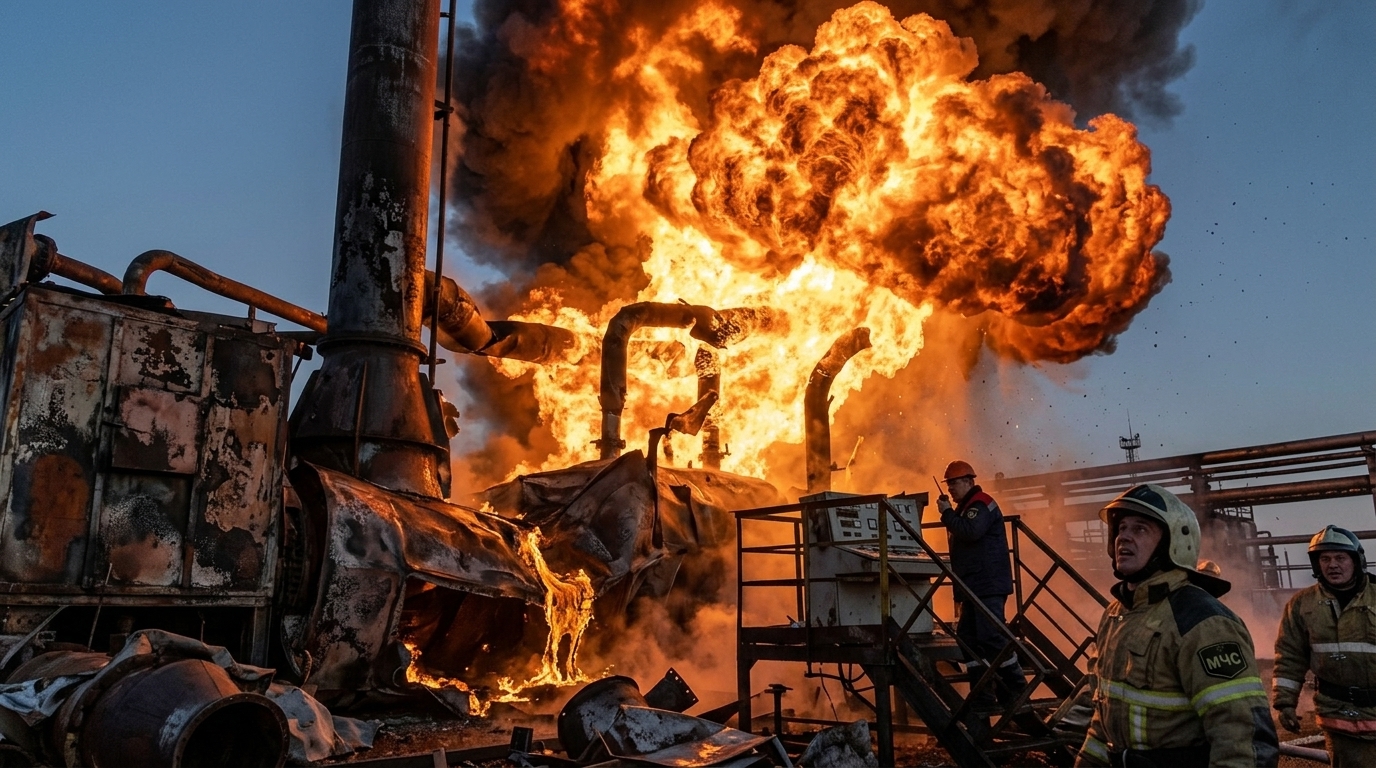
The fire that erupted in the early hours at the Ilsky oil refinery in Russia's southern Krasnodar region is more than just another entry in the daily war reports. It represents the continuation of a systematic and technologically evolving campaign targeting the heart of the Russian economy and its military supply chain. The Ilsky refinery, a pivotal fuel production hub, was engulfed in flames following a drone (UAV) strike, while almost simultaneously, the city of Taganrog in the Rostov region was placed on high alert and evacuated, suggesting a broader coordinated operation.
The Ilsky Refinery as a Strategic Target
The Ilsky complex is vital for the energy supply of southern Russia and, consequently, for fueling the military forces operating in Ukraine. Its capacity to process millions of tons of crude oil annually makes it a primary objective. These attacks aim not only to cause immediate physical damage but to trigger a 'domino effect' on domestic fuel prices and erode public confidence in national air defense systems.
Analysts suggest that the use of long-range drones allows for the bypassing of traditional defensive lines. These drones, often built at a low cost but equipped with sophisticated navigation systems, fly at low altitudes to evade radar, targeting critical nodes such as distillation columns. Repairing such infrastructure often requires Western technology, which is now difficult to procure due to international sanctions.
The Taganrog Evacuation and the Psychology of War
The news of Taganrog's evacuation adds a new dimension to the escalation. Taganrog, a port on the Sea of Azov, serves as a critical logistics hub. The forced removal of citizens suggests either the threat of a mass strike or the failure of local defense systems to guarantee safety. For the Kremlin, such incidents are a communication nightmare, as they bring the reality of war from the front lines directly into Russian cities.
- Undermining Russian production of refined petroleum products.
- Increasing logistical support costs for Russian armed forces.
- Forcing the redeployment of air defense systems from the front to protect industrial sites.
- Social unrest stemming from evacuations and general insecurity.
Technological Asymmetry and the International Context
Ukraine, while often maintaining official silence regarding operations on Russian soil, has made it clear that energy infrastructure constitutes a legitimate target. This strategy has caused friction with Washington, which fears a spike in global oil prices. However, for Kyiv, dismantling the Russian economic engine is seen as the only way to force Moscow into a retreat.
"The drone war has turned refineries into modern castles under siege. Whoever controls the skies above the fuel tanks also controls the speed of the tanks on the battlefield," a military analyst noted.
In conclusion, the attack on Ilsky and the turmoil in Taganrog signal a new phase where the geographical boundaries of the conflict are blurring. Russia is now tasked with protecting a vast array of infrastructure against an 'invisible' and inexpensive enemy, even as its economic resilience is tested by falling exports and the ballooning costs of the war.