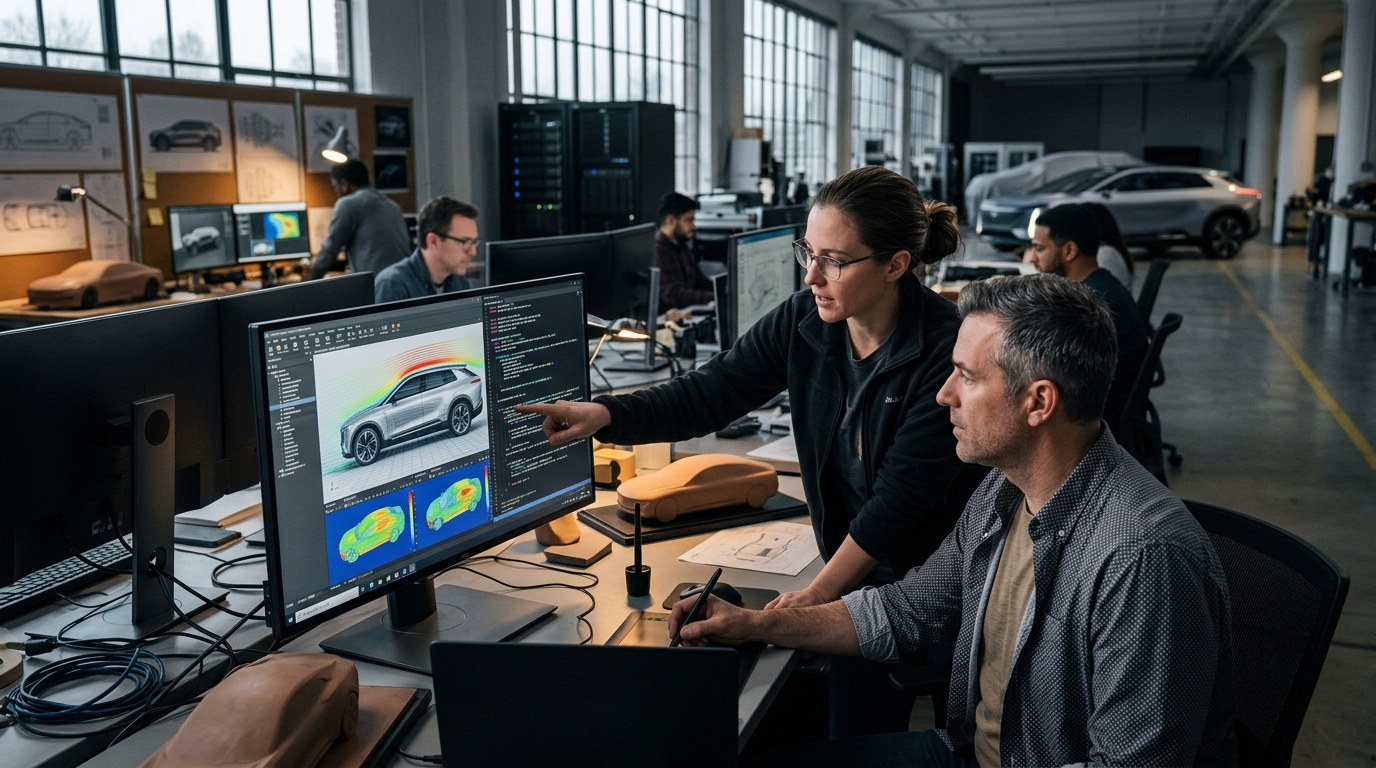
In the heart of Detroit, where the smell of oil and the rhythmic thud of stamping presses once defined the destiny of global transportation, a new, silent revolution is unfolding. General Motors (GM), one of the industry's most storied giants, is no longer building cars solely with steel and clay, but with algorithms and neural networks. The recent revelation that the company is utilizing Artificial Intelligence (AI) to dramatically accelerate the design process is not merely a technical update; it is the hallmark of a new era for industrial production.
Speed as a Competitive Advantage in the EV Era
For decades, developing a new car model required five to seven years of meticulous labor. Today, faced with mounting pressure from Tesla and the rapid rise of Chinese electric vehicle (EV) manufacturers, that timeframe is considered obsolete. GM is leveraging AI to compress these cycles into less than two years. The use of Generative AI allows engineers to input parameters such as weight, structural integrity, and cost, with the system generating thousands of potential design solutions in minutes.
This process, known as 'generative design,' enables the creation of components that are lighter and stronger than anything the human mind could conceive in isolation. For electric vehicles, where every gram of weight directly impacts battery range, this optimization is critical. GM reports that through AI, they have managed to reduce the weight of certain components by up to 40% while simultaneously improving aerodynamic efficiency.
From Artist to Curator: The Designer's New Role
One of the primary anxieties surrounding the introduction of AI is the potential erosion of human creativity. However, GM’s designers appear to be embracing the technology rather than fearing it. Instead of spending hundreds of hours on manual sketches and revisions, creators now function as 'curators.' The AI proposes shapes, volumes, and textures, and the human designer selects those that resonate with the brand’s aesthetic identity.
- AI can simulate how light interacts with body curves at different times of the day with absolute precision.
- It allows for the immediate testing of interior materials in Virtual Reality (VR), drastically reducing the need for physical prototypes.
- The human-machine collaboration leads to 'organic' shapes reminiscent of natural structures, offering a fresh aesthetic language.
As company executives state, AI does not replace the designer's 'eye'; it liberates it from technical constraints. "AI gives us the ability to explore 100% of the creative space, instead of the 5% we were limited to previously," a design lead in Detroit noted recently.
Challenges and the Future of the Automobile
Despite the palpable enthusiasm, the road ahead is not without obstacles. Training AI models requires massive datasets, and ensuring the intellectual property of designs remains a legal minefield. Furthermore, there is a legitimate risk that future cars might begin to look identical, as algorithms tend to converge toward the same aerodynamically optimal solutions.
"The challenge is not to let the AI design the car, but to use it to highlight the brand's soul in ways we never imagined possible," GM management emphasizes.
In conclusion, General Motors' move signals a deeper shift in global capitalism: the speed of information is now directly translated into the speed of production. In a rapidly changing world, a company's ability to adapt through technology will determine whether it remains a leader or becomes another exhibit in a museum of industrial history.