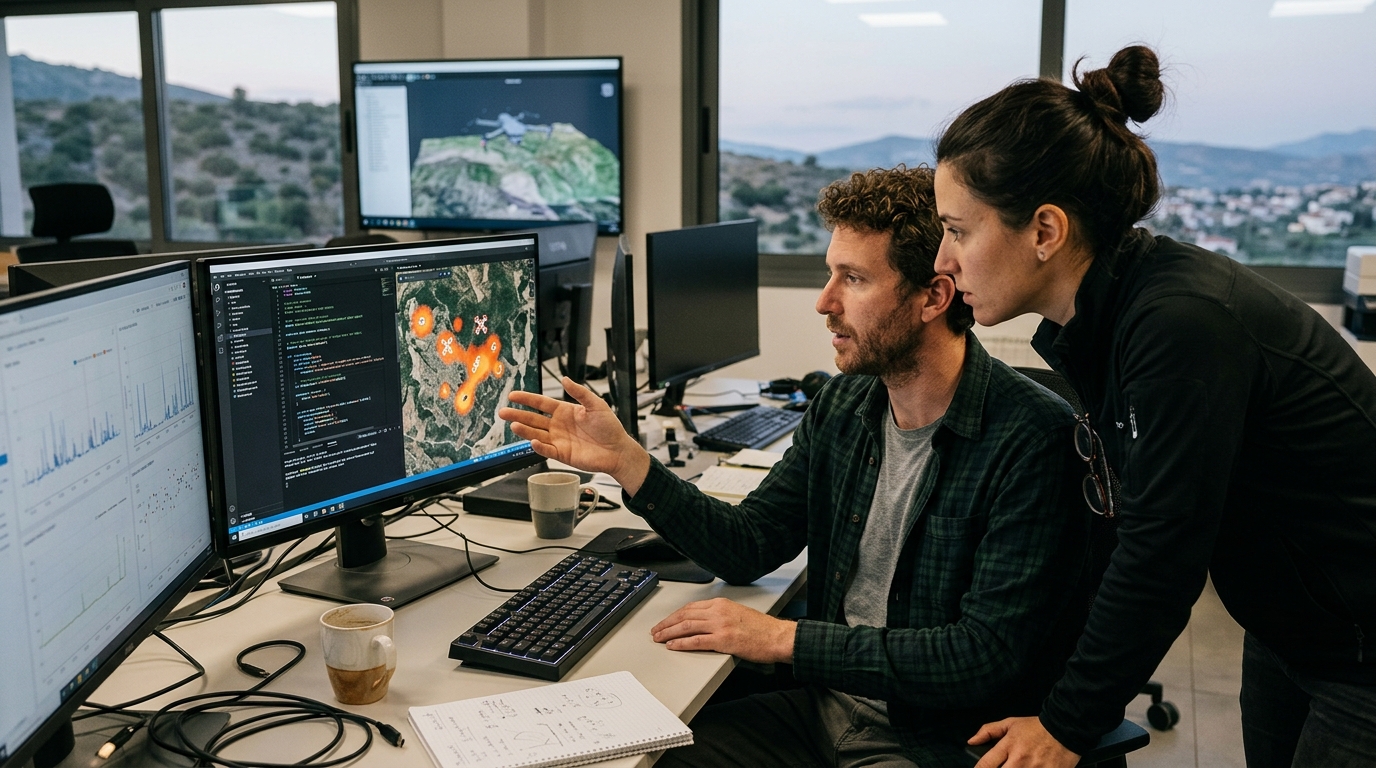
As the climate crisis transforms Mediterranean summers into a perpetual test of survival, the traditional approach to firefighting is undergoing a radical metamorphosis. It is no longer just about the bravery of men and women on the ground; it is about a complex orchestration of data, algorithms, and unmanned systems. In Cyprus and Greece, the integration of drones and Artificial Intelligence (AI) into the fight against wildfires is no longer a science fiction scenario, but an imperative necessity that is already yielding results.
The recent mobilization of volunteer groups in collaboration with state agencies highlights a critical shift: an emphasis on prevention and early detection. The "golden hour" of firefighting—the first few minutes after an outbreak—is now the arena where technology makes the difference between a contained fire and an uncontrollable catastrophe.
The Eyes in the Sky: Drones and Real-Time Surveillance
Drones (UAVs) have evolved from simple recording tools into sophisticated surveillance platforms. Equipped with high-definition thermal cameras, they can patrol inaccessible forest areas, identifying thermal signatures invisible to the human eye, especially at night or through thick smoke. This capability allows authorities to pinpoint the exact source of a fire before it reaches the treetops.
Furthermore, the use of drone swarms allows for the coverage of vast geographical areas at a minimal cost compared to manned aircraft. These systems stream live footage to command centers, enabling commanders to make decisions based on real-time data rather than assumptions. This technology is particularly critical for the safety of firefighters themselves, as drones can map escape routes and warn of sudden changes in wind direction.
AI: The General Behind the Operations
If drones are the eyes, Artificial Intelligence is the brain. Modern machine learning algorithms analyze vast amounts of data in seconds: from fuel moisture and wind speed to ground topography. These predictive models can simulate the evolution of a fire for hours ahead, allowing for the preemptive movement of forces to key locations.
AI is also used for the automated analysis of images from surveillance cameras mounted on towers. Instead of relying on a human observer who may become fatigued or distracted, software recognizes smoke as soon as it appears on the horizon, sending automated alerts to the nearest units. This automation dramatically reduces response time, which in the case of forest fires is the most critical factor for success.
The Human Element: Empowering Volunteers through Technology
Despite technological progress, the human factor remains irreplaceable. The innovation lies in how volunteers are integrated into this digital ecosystem. Through specialized mobile applications, volunteers can act as "living sensors," reporting outbreaks with precise geographical coordinates and photos.
Training volunteers in drone operation and providing access to shared operational data centers creates a new culture of civil protection. Local communities are no longer passive spectators but active members of a protection network. This "democratization" of technology allows small communities to possess surveillance capabilities that were previously the sole domain of military organizations.
Challenges and the Future of Fire Protection
The challenge remains the organization and institutional strengthening of these efforts. Technology alone cannot extinguish fires if it is not accompanied by proper forest management and adequate funding. Furthermore, there is a need for unified communication protocols between different AI systems and ground forces.
In the future, we expect to see autonomous firefighting drones capable of dropping retardant liquid with surgical precision, as well as ground robotic vehicles that will enter areas too dangerous for humans. The battle against wildfires is a race against time and climate change, and in this race, technology is our strongest ally.