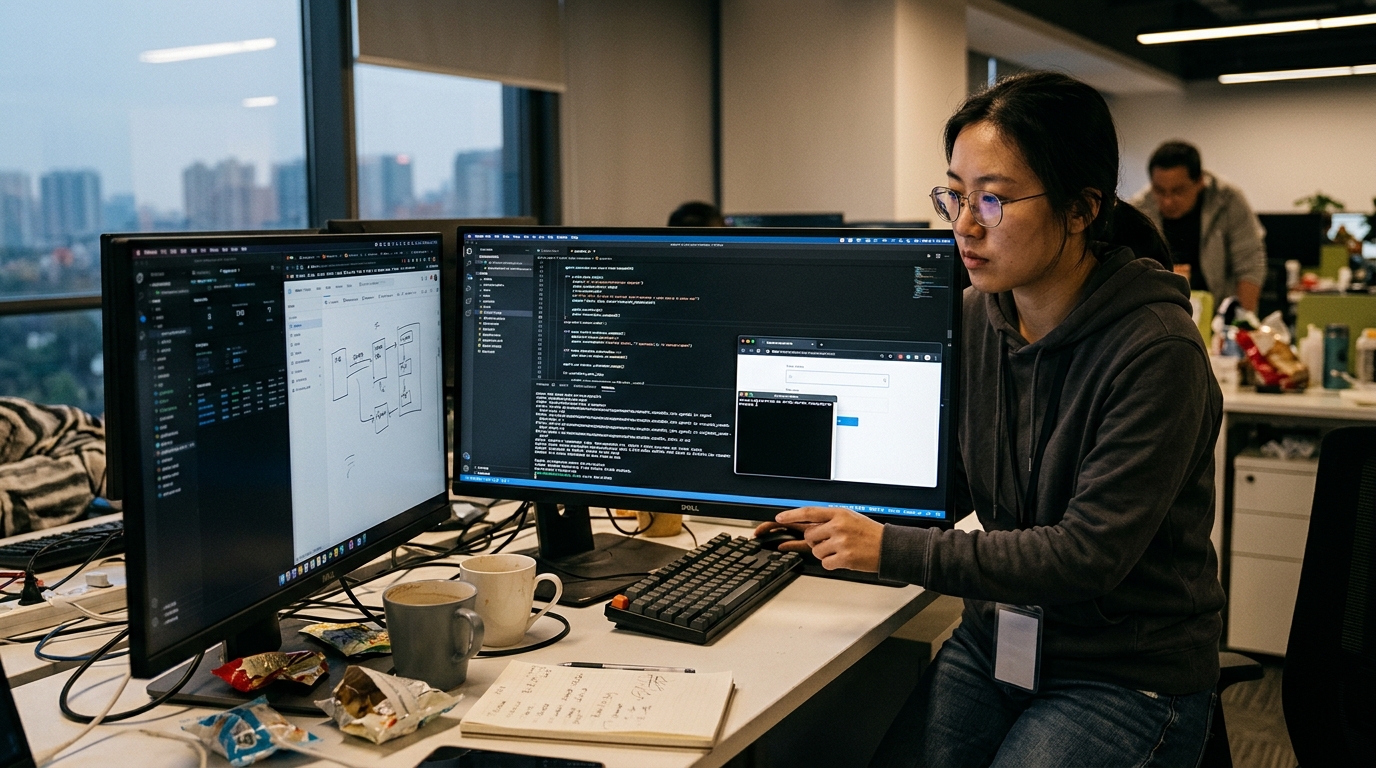
In less than three years, the software development landscape has undergone a structural shift unseen since the dawn of the internet. Today, in 2026, the use of Artificial Intelligence (AI) tools is no longer an option for developers; it is a fundamental requirement. According to recent analyses and industry reports, a growing percentage of software engineers explicitly state that they would not accept a job offer at a company that bans or restricts the use of code assistants like GitHub Copilot, Cursor, or Claude.
The Psychology of Productivity and the Death of Drudgery
The root cause of this shift is not laziness, as an old-school critic might hastily claim. Instead, it is the elimination of the cognitive load caused by repetitive tasks, known in the industry as "boilerplate code." Developers now use AI to handle syntax, generate unit tests, and write documentation, allowing themselves to focus on high-level architecture and complex problem-solving.
"Coding without AI in 2026 is like trying to dig a tunnel with a spoon when there's an excavator sitting right next to you," a senior systems architect recently remarked. The "flow state" is now achieved much faster, as AI acts as an indefatigable pair-programmer that suggests solutions in real-time, drastically reducing the time spent searching Stack Overflow or sifting through outdated manuals.
The New Labor Ethic and Corporate Pressure
Companies that remain hesitant due to data security concerns or intellectual property issues are facing a harsh reality: a massive brain drain. Top-tier developers feel "handicapped" without their tools. This has led to a global overhaul of corporate policies. Organizations are being forced to invest in private, on-premise Large Language Models (LLMs) to satisfy their employees' need for speed while safeguarding corporate secrets.
- Speed Boost: Studies show tasks are completed up to 40% faster.
- Burnout Reduction: AI takes over the most tedious aspects of the job.
- Skill Democratization: Junior developers level up significantly faster.
The Risks of Dependency and the Quality Paradox
However, this new era is not without its perils. Over-reliance on AI can lead to a gradual atrophy of fundamental problem-solving skills. There is also the issue of the "illusion of knowledge," where a developer might accept an AI-generated solution without fully understanding it, potentially introducing security vulnerabilities or technical debt that will surface later.
"AI produces code, but humans must produce meaning. If we lose the ability to judge what is right, we are no longer engineers, but mere machine operators."
The challenge for the future is not the acceptance or rejection of AI—that battle has already been won. The real challenge lies in training a new generation of developers who know how to direct AI with critical thinking, maintaining control over quality and security in a world moving at the speed of light.