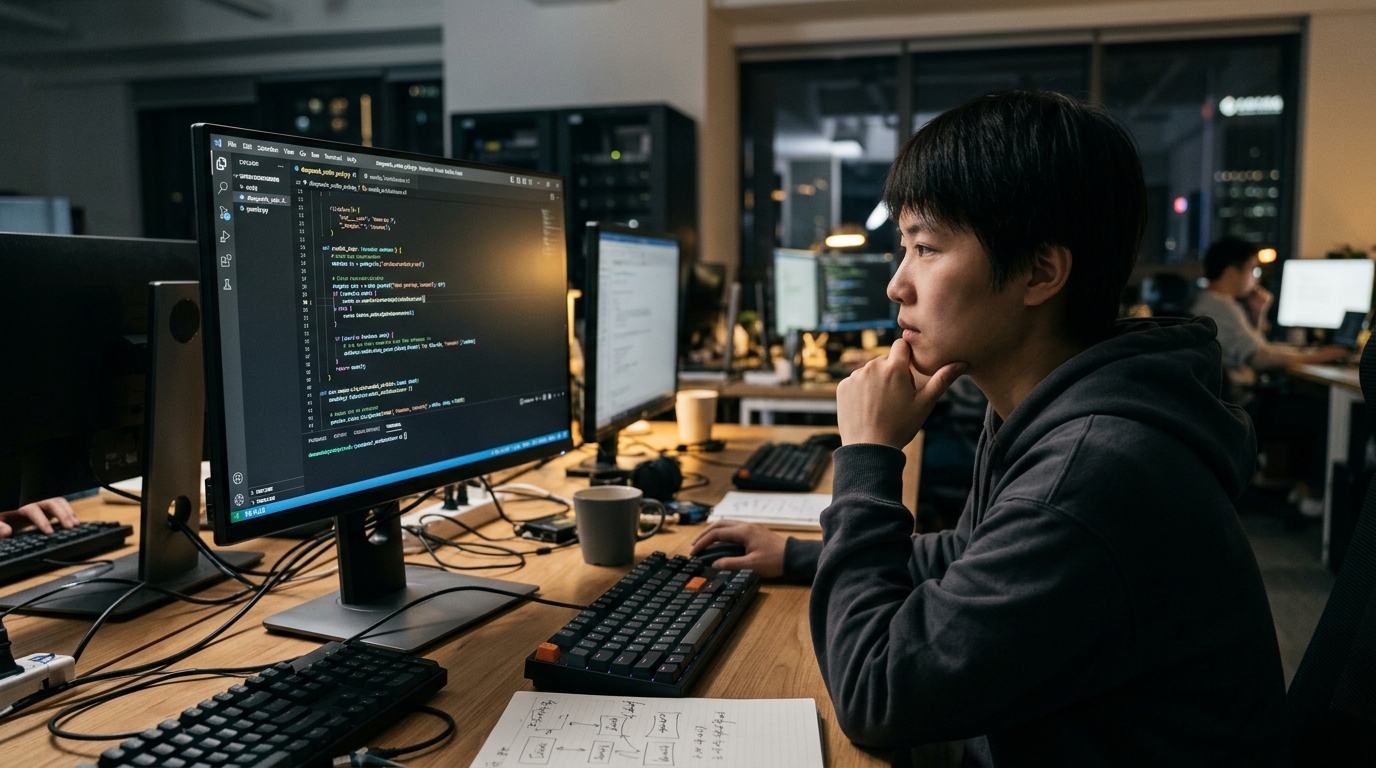
The global AI stage is no longer a unipolar world dominated solely by Silicon Valley. Following the meteoric rise of its DeepSeek-V3 and R1 models, the Chinese AI lab DeepSeek is now setting its sights on one of the most critical sectors of artificial intelligence: autonomous coding. The announcement of the development of "DeepSeek Code" comes as a direct challenge to Anthropic’s Claude Code, marking a new phase in the competition of "agents"—tools that don't just suggest code, but actively write, test, and debug it.
From Chatbots to Autonomous Agents
Until recently, the use of AI in programming was primarily focused on autocomplete features or chatting with a bot to solve specific snippets of logic. Tools like GitHub Copilot and ChatGPT changed the workflow, but they remained largely passive. Anthropic’s Claude Code, recently released, shifted the paradigm by offering a Command Line Interface (CLI) tool capable of executing commands, reading entire repositories, and proposing comprehensive changes to complex systems.
DeepSeek, recognizing the strategic importance of this shift, aims to provide an alternative that combines high-tier performance with drastically lower costs. DeepSeek Code is expected to leverage the company’s Mixture-of-Experts (MoE) architecture, which allows powerful models to run using a fraction of the computational resources required by its American rivals. This is not merely a technical detail; it is an economic disruption that threatens the profit margins of giants like Microsoft and Google.
Open Weights and the Efficiency Advantage
One of DeepSeek’s strongest competitive advantages is its commitment to open-weights models. While Claude Code is a closed, proprietary system within Anthropic’s ecosystem, DeepSeek has consistently released models that allow enterprises to integrate technology into their own infrastructure without the fear of vendor lock-in. This makes DeepSeek Code particularly attractive to developers and corporations seeking greater control over their proprietary data and security protocols.
Furthermore, DeepSeek’s ability to train models at costs reportedly ten times lower than OpenAI has sent shockwaves through the industry. If DeepSeek Code can match the reasoning capabilities of Claude 3.5 Sonnet while maintaining DeepSeek’s signature pricing, the market for developer tools could be upended within months. Developers are no longer just looking for the smartest model; they are looking for the one that offers the best performance-to-price ratio, especially for large-scale enterprise projects where token costs can escalate rapidly.
Geopolitical Implications and the Future of Engineering
The rise of DeepSeek is more than a technological feat; it is a political statement. At a time when the United States is actively restricting China’s access to advanced semiconductors, DeepSeek has demonstrated that algorithmic innovation can compensate for hardware limitations. DeepSeek Code represents the tip of the spear in this effort, proving that China can lead in developing AI software that defines global productivity standards.
However, this evolution also raises profound questions about the future of the software engineering profession. If tools like DeepSeek Code and Claude Code can handle 80% of routine coding, debugging, and architectural scaffolding, what remains for the human developer? DeepSeek’s narrative focuses on "empowerment" rather than replacement, but the sheer velocity at which these agents are evolving suggests that the labor market will have to adapt faster than ever. The battle between Anthropic and DeepSeek is, in reality, a battle for who will own the "operating system" of future software creation.