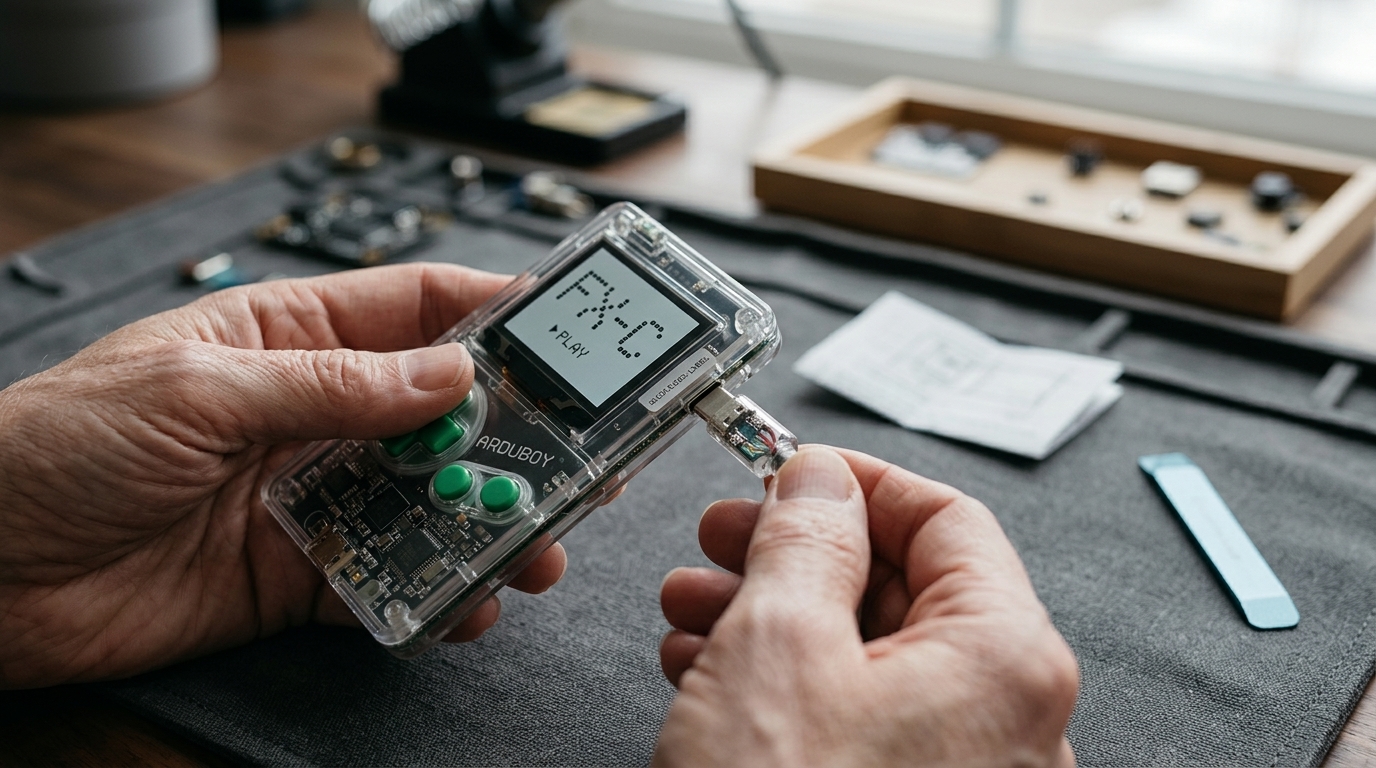
In an era where the gaming industry seems locked in an escalating arms race for raw processing power, the Arduboy FX-C emerges as a quiet, deliberate counter-revolution. While behemoths like the Steam Deck and the ASUS ROG Ally attempt to cram the performance of a high-end desktop into a chassis that barely qualifies as portable, the Arduboy FX-C moves in the opposite direction. It is a device that doesn’t demand your attention through 4K textures or haptic feedback, but through its absolute, almost ascetic, simplicity.
The Arduboy FX-C represents the latest evolution of Kevin Bates’ original vision: a credit-card-sized game console powered by the Arduino ecosystem. This new 'FX-C' iteration introduces two critical upgrades that fundamentally shift the user experience: the integration of a USB-C port, bringing it in line with modern connectivity standards, and the inclusion of the FX flash chip. This chip effectively ends the era of 'one game at a time,' allowing users to store and switch between over 250 games pre-loaded on the device.
The Elegance of Constraints
One might ask why anyone would bother with a 1.3-inch monochrome OLED screen in 2026. The answer lies in the psychology of play and the vibrant heart of the open-source community. The Arduboy is not merely a toy; it is an educational manifesto and an aesthetic statement. Its inherent limitations—a 128x64 resolution, an ATmega32u4 processor, and a lack of color—force game developers to strip away the superficial and focus on the core: mechanics, logic, and pure engagement.
Much like a poet working within the strict confines of a sonnet, Arduboy developers create miniature masterpieces within a few dozen kilobytes. The FX-C library now spans hundreds of titles, ranging from classic arcade homages to surprisingly deep RPGs and mind-bending puzzles. Because the entire ecosystem is open-source, the user is never just a passive consumer. You can peek under the hood of any game, see how the code functions, and modify it to your liking, learning C++ and embedded systems logic in the process.
Design and Portability: The Ultimate 'Everyday Carry'
The design of the FX-C remains faithful to the series' roots. Measuring only a few millimeters thick and featuring a sandwich construction of metal and high-grade polycarbonate, the device feels remarkably premium for its size. The buttons, despite their tactile micro-switches, offer a satisfying click that allows for a level of precision one wouldn't expect from such a slim profile.
“The Arduboy FX-C doesn’t compete with your smartphone; it competes with those idle gaps in your day—the minutes spent waiting for a coffee or riding the subway—where you crave something tactile and immediate,” notes a long-time community member.
The shift to USB-C is more than just a convenience for charging. It signals the Arduboy's maturation as a developer's tool. Connecting the device to a PC for flashing new sketches or developing custom software is now faster and more reliable. Furthermore, the battery life, though small in capacity, lasts for several hours of continuous play, as the power draw from the OLED screen and the 8-bit processor is negligible compared to modern mobile hardware.
The Cultural Impact of Retro-Minimalism
In a world where social media algorithms are engineered to hijack our dopamine receptors for hours on end, the Arduboy FX-C offers a 'finite' experience. There are no push notifications, no micro-transactions, and no internet connectivity to distract you from the task at hand. It is a solitary, yet deeply meaningful, interaction with code and logic.
The success of the Arduboy FX-C highlights a broader trend toward technological minimalism. As users begin to experience 'digital fatigue' from bloated, multi-purpose devices, objects that do one thing—but do it exceptionally well and with style—are gaining a new kind of social currency. The FX-C isn't just a 'time killer'; it is a reminder that technology can be elegant, accessible, and, above all, human-centric.
Conclusion: A Tool for the Modern Stoic
The Arduboy FX-C is a rare example of a tech product that doesn’t try to be essential, and that is precisely why it becomes so cherished. It is a creative tool disguised as a distraction. Whether you are a programmer looking to test your mettle in a constrained environment or a gamer seeking the purity of 8-bit logic, the FX-C is an investment in the essence of digital joy. At the end of the day, you might forget it’s in your pocket, but the moment you pull it out, it serves as a poignant reminder of why we fell in love with technology in the first place.