For decades, the number "130" has been the holy grail of European motorways. A fixed, immutable limit designed to balance the need for rapid transit with road safety. However, as we move through 2026, this static approach appears increasingly anachronistic. Artificial Intelligence (AI) is permeating our infrastructure, transforming asphalt from a passive material into an intelligent, dynamic network that "thinks" and reacts in real-time.
The Shift from Static to Dynamic Limits
The fundamental weakness of traditional speed limits is their rigidity. A 130 km/h limit may be safe on a sunny day with empty lanes, but extremely hazardous during a sudden storm or heavy traffic congestion. Conversely, maintaining lower limits on certain sections when conditions allow for more leads to unnecessary delays and economic inefficiency.
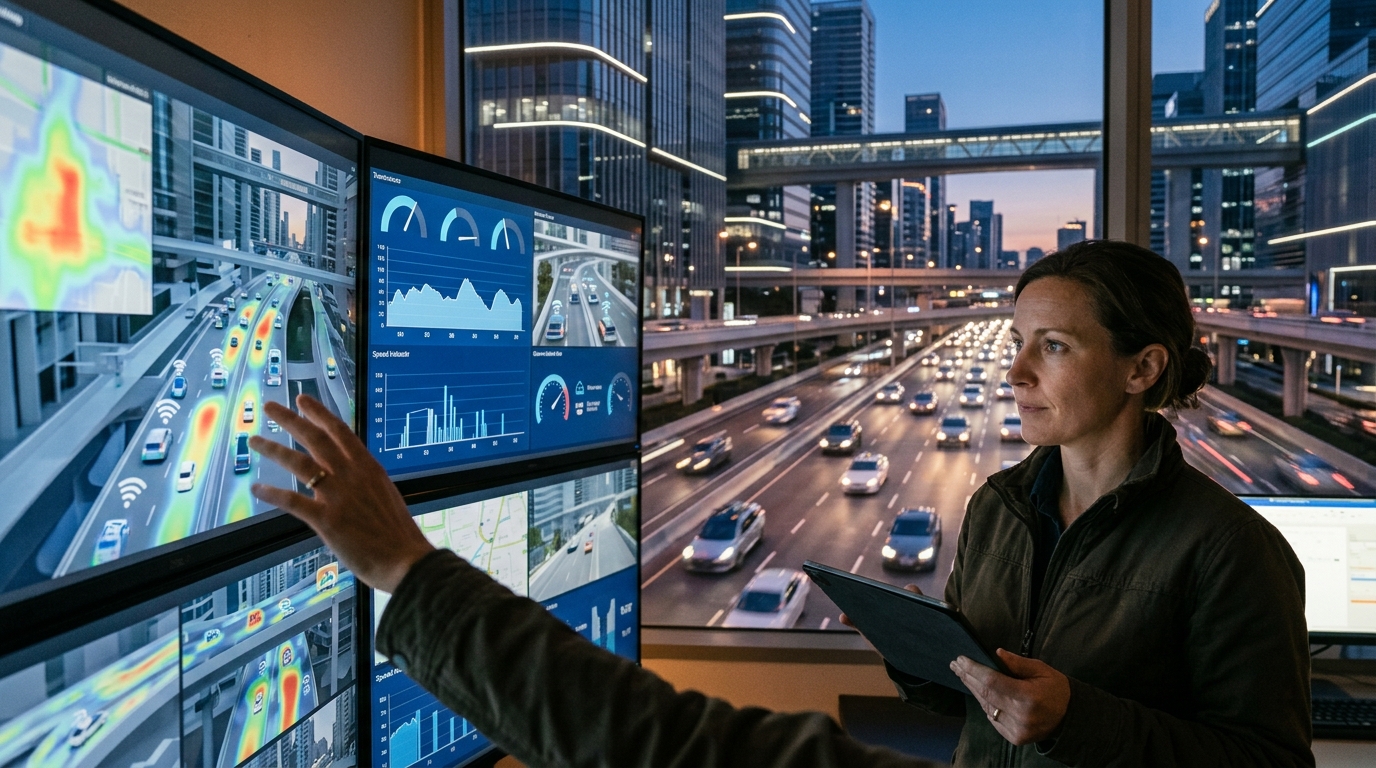
AI systems currently being piloted in countries like Germany, the Netherlands, and France utilize a mesh of IoT sensors, high-definition cameras, and Vehicle-to-Everything (V2X) data. This data feeds machine learning algorithms that analyze:
- Traffic density and the likelihood of "braking waves."
- Micro-climatic weather conditions (fog, ice, heavy rain).
- Real-time air quality and pollutant emissions.
- The presence of obstacles or accidents miles ahead.
The result is Variable Speed Limits (VSL). AI can determine that the safe limit for the next 10 kilometers is 100 km/h to prevent a traffic jam predicted to occur in 15 minutes, or allow an increase in speed when the road is clear, optimizing throughput.
Prediction Over Reaction: Algorithmic Governance
The true revolution lies not in simply changing a digital sign, but in the power of prediction. Traditional traffic managers reacted to events that had already occurred. AI, however, acts preemptively. By recognizing driving patterns indicative of fatigue or aggression across a large number of drivers, the system can gradually reduce the flow speed, preventing the so-called "accordion effect."
"We are no longer controlling speed to punish, but to orchestrate movement. AI is the conductor of a highway that never stops," says an official from the European Road Safety Authority.
Furthermore, integrating AI into infrastructure allows for better management of autonomous and semi-autonomous vehicles. When the network "knows" a Tesla or Volvo with Autopilot enabled is approaching, it can communicate directly with the car's software, adjusting its speed without driver intervention, ensuring perfectly synchronized flow.
Environmental Footprint and Sustainability
Beyond safety, abolishing the fixed 130 km/h limit has deep ecological motivations. Moving at a constant speed, even if slightly lower, consumes significantly less energy than constant stop-and-go. AI can calculate the "green speed" – the velocity that minimizes CO2 emissions for the total volume of vehicles at any given time.
In urban and peri-urban areas, AI-driven speed reduction when pollution levels exceed certain thresholds is already a reality. Expanding this model to motorways means the speed limit becomes a tool of environmental policy, adjusting based on the air quality breathed by adjacent communities.
The Challenges: Ethics, Privacy, and Legal Frameworks
Naturally, the transition to an "algorithmic highway" is not without its hurdles. The first question is trust. Will drivers accept obeying a limit that changes every few kilometers for no apparent – to the human eye – reason? Algorithmic transparency is crucial.
Then there is the issue of liability. If an AI system suggests a 140 km/h limit as safe and an accident occurs due to slickness the algorithm failed to detect, who is responsible? The software developer, the state that installed it, or the driver who trusted the display? The EU legal framework is still in the consultation phase regarding these issues.
Finally, the continuous monitoring of vehicle speed and behavior raises serious privacy concerns. Turning roads into a vast surveillance network, where every move is recorded and analyzed, requires strict safeguards to protect citizens' personal data, ensuring AI is used for safety and not for unjustified state control.
Conclusion
The end of the fixed 130 km/h limit does not necessarily mean the end of fast driving. On the contrary, it marks the beginning of an era where speed is the result of an intelligent equation. Artificial Intelligence promises roads where accidents trend toward zero, pollution is curtailed, and travel times are predictable. The challenge for society is to find the balance between technological efficiency and human freedom behind the wheel.