
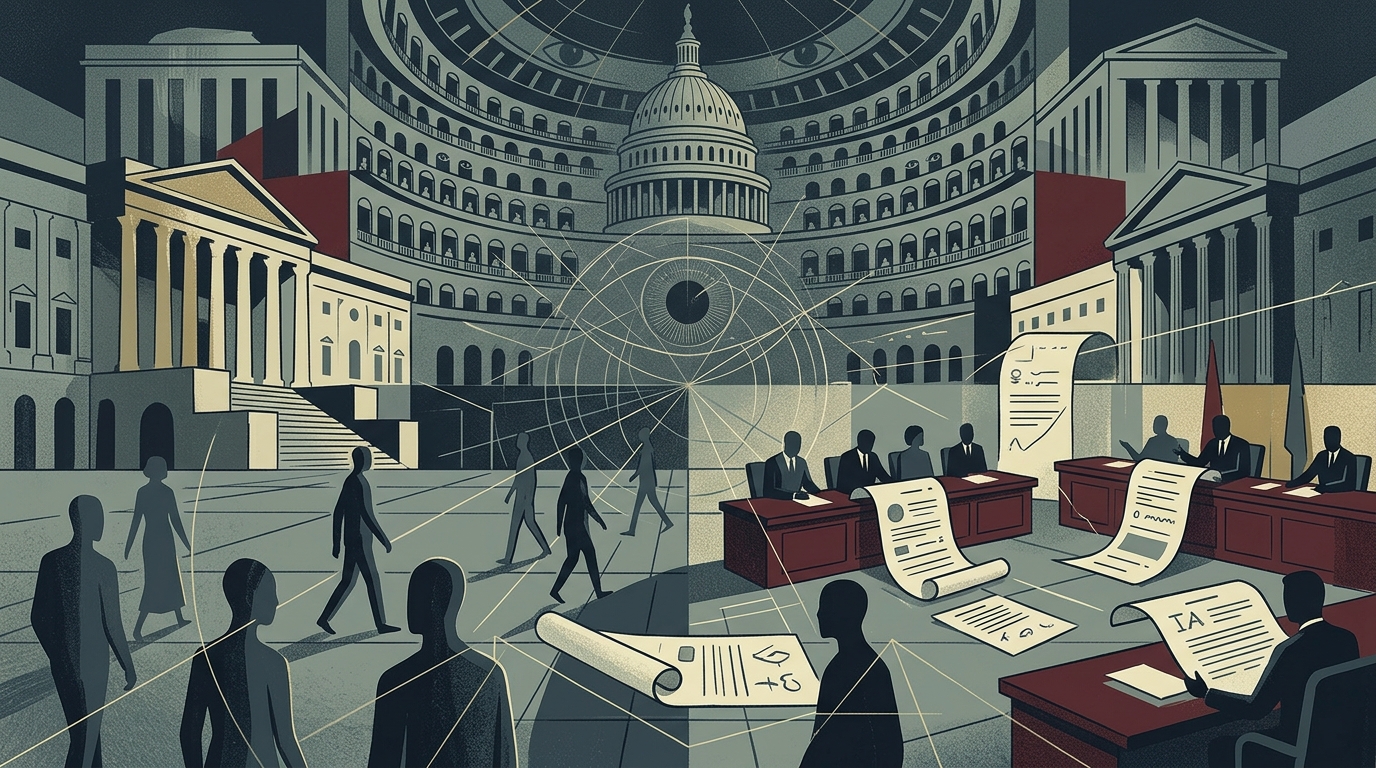
In ancient Athens, the rule of law was predicated on visibility. My own reforms, the Seisachtheia, were inscribed on wooden tablets known as kyrbeis, placed in the Agora for every citizen to behold. The principle was simple: for a law to be just, its enforcement must be transparent and its boundaries known. Today, as we witness the 'grand return' of 1,000 AI-powered cameras to the Greek road network, we find ourselves at a similar constitutional crossroads. This is not merely a logistical upgrade for the Hellenic Police; it is a fundamental shift in the social contract between the state and the citizen.
The Social Contract of the Algorithm
The deployment of automated systems to govern public behavior—specifically the enforcement of traffic laws and highway speed limits—presents a dual-edged sword. On one hand, the state has a moral and political obligation to protect the lives of its citizens. In a nation where road safety has historically been a point of contention, the promise of an AI-driven 'watchman' that never tires and cannot be bribed is seductive. It promises a level of isonomia—equality before the law—where the status of the driver or the luxury of the vehicle offers no shield against a citation.
However, as a political analyst, I must ask: at what cost does this efficiency come? When we move from human policing to persistent AI vigilance, we transition from reactive enforcement to a state of constant surveillance. The 'Sentinel' approach, as seen in recent benchmarking frameworks for persistent AI vigilance, suggests a future where the gaze of the state is omnipresent. This shifts the presumption of innocence toward a paradigm of constant monitoring, a move that requires rigorous democratic oversight to ensure it does not bleed into broader civil liberty infringements.
The Fragility of Algorithmic Objectivity
A critical concern in this transition is what recent research identifies as the 'fragile objectivity' of AI judges. When we delegate the power to penalize to an algorithm, we assume a level of stability and impartiality that may be illusory. If an LLM-based judge or a vision-processing system can be manipulated or exhibits instability in its decision-making, the legal standing of its 'verdicts' becomes precarious. For the 1,000 cameras on Greek roads to be democratically legitimate, they must be subject to the highest standards of the EU AI Act, particularly the provisions regarding 'high-risk' AI systems.
"Justice is a machine that, when it begins to run without human friction, risks becoming an instrument of cold calculation rather than social harmony."
We must ensure that there is a 'human-in-the-loop' mechanism that is not merely a rubber stamp. A citizen’s right to contest a decision must be met with a transparent explanation of how the AI reached its conclusion. Without this, we risk replacing the Agora with a 'Black Box'—a governance structure where decisions are made by unreadable code, inaccessible to the very people it governs.
A Framework for Digital Governance
To navigate this technological stasis, I propose a three-pillar framework for the implementation of AI policing in Greece and the wider European Union:
- Algorithmic Transparency: The criteria used by AI cameras to identify infractions must be public and audited by independent third-party bodies to prevent bias and error.
- Proportionality of Data: Surveillance data must be purged according to strict timelines, ensuring that 'traffic safety' does not become a pretext for the mass harvesting of movement data.
- Judicial Recourse: The legal system must be updated to handle appeals against AI-generated evidence, ensuring that the burden of proof remains with the state, not the citizen.
In conclusion, while the 'Digital Wager' of Greece is a necessary step toward modernization, we must remember that the strength of a democracy is measured not by the efficiency of its policing, but by the robustness of its protections for the individual. As we accelerate beyond the 130 km/h limit of traditional governance, let us ensure our democratic institutions have the brakes necessary to prevent a slide into digital authoritarianism.