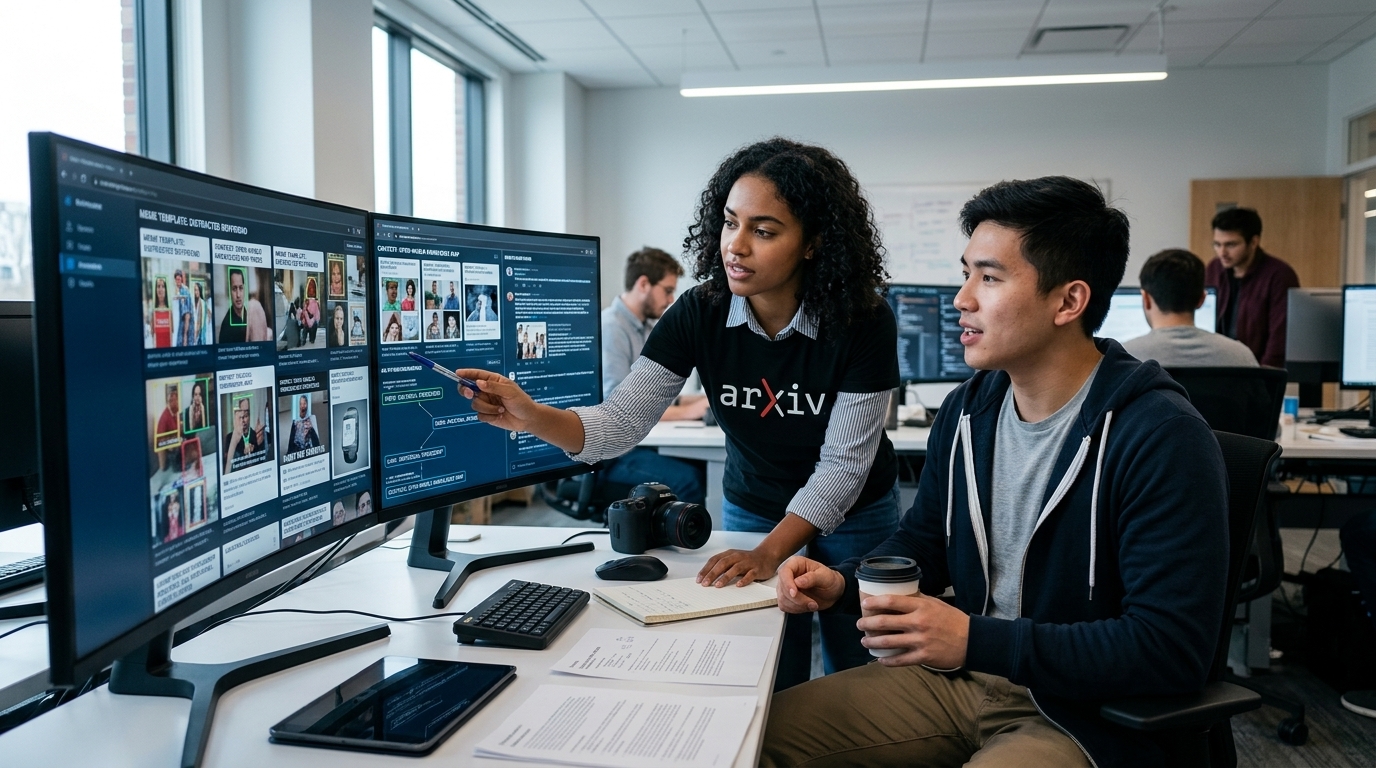
In the lightning-fast world of the internet, a meme can be born, spread, and fade into obscurity within a matter of hours. For humans, interpreting these digital symbols is often intuitive, fueled by a constant stream of information from news cycles, social media, and pop culture. For Artificial Intelligence, however, memes represent one of the most formidable challenges to date. New research published on ArXiv (2606.05316) titled "I Know What You Meme, Even If it Emerged Today" proposes a radical solution: Open-World Knowledge Acquisition (OWKA).
The fundamental issue with current Large Language Models (LLMs) is that their knowledge is effectively frozen in time. A model that finished its training six months ago has no concept of a political scandal that broke yesterday or a new TikTok trend that recontextualized a specific image. Memes are inherently multimodal and rely on what linguists call "contextual dependency." Without the correct background, an image of a politician paired with a caption about a fruit might seem nonsensical, when it is actually a sharp piece of social commentary.
The Architecture of Dynamic Understanding
The research team proposes a system that does not rely solely on the model's parametric knowledge—what it learned during training—but instead has the capability to "mine" information from the real world in real-time. This is achieved through a process that integrates image analysis with live web retrieval. When the system encounters a new meme, it identifies the entities depicted, searches for recent events associated with them, and synthesizes an interpretative framework.
This "Open-World" approach is transformative. Instead of the model attempting to guess a meaning based on stale data, it functions more like an investigative journalist. It asks: "Who is this in the picture? What has happened in the last 24 hours involving them? How does the caption relate to current headlines?" This dynamic process allows the AI to remain relevant, even if the meme was created mere minutes before the analysis took place.
"Memes are not just funny pictures; they are compressed cultural information. A machine's ability to understand them in real-time is the ultimate test for artificial social intelligence."
Multimodality and Semantic Gaps
One of the primary hurdles addressed in the research is the "semantic gap" between visual information and text. Often in memes, the text and the image are in a state of dissonance or ironic contrast. For instance, the famous image of a dog in a room on fire with the caption "This is fine" requires an understanding of irony and situational awareness. Utilizing external knowledge sources allows the model to grasp the "vibe" or the underlying sentiment rooted in the current social atmosphere.
The researchers employed advanced Retrieval-Augmented Generation (RAG) techniques, specifically tailored for visual stimuli. The system doesn't just look for keywords; it attempts to understand the relationship between visual symbols and contemporary narratives. This means AI is beginning to acquire a form of "digital empathy"—or at least a highly accurate simulation of understanding human humor and satire.
Societal Implications and Content Moderation
The significance of this advancement extends far beyond simply getting a joke. In the realm of content moderation, memes are frequently used to spread hate speech or disinformation in ways that traditional filters fail to detect. A meme that appears harmless on the surface may carry a coded message that only those familiar with a specific fringe subculture can decipher.
With Open-World Knowledge Acquisition, social media platforms could identify dangerous content based on current events before it goes viral. Simultaneously, new avenues open up for sentiment analysis. Businesses and political analysts will be able to understand not just what people are saying, but how they feel, through the visual symbols they choose to share. This provides a more nuanced map of the public consciousness than text-based analysis alone.
Conclusion: Toward Culturally Aware AI
The research "I Know What You Meme" marks a shift from static intelligence to cultural alertness. As our communication becomes increasingly visual and ephemeral, the need for AI that "lives" in the present becomes imperative. Bridging the gap between computational power and human culture is no longer a distant dream but a technical reality evolving day by day. The next step will be the ability of AI not only to understand but to creatively participate in this ongoing digital dialogue, respecting the subtle nuances of the human spirit.