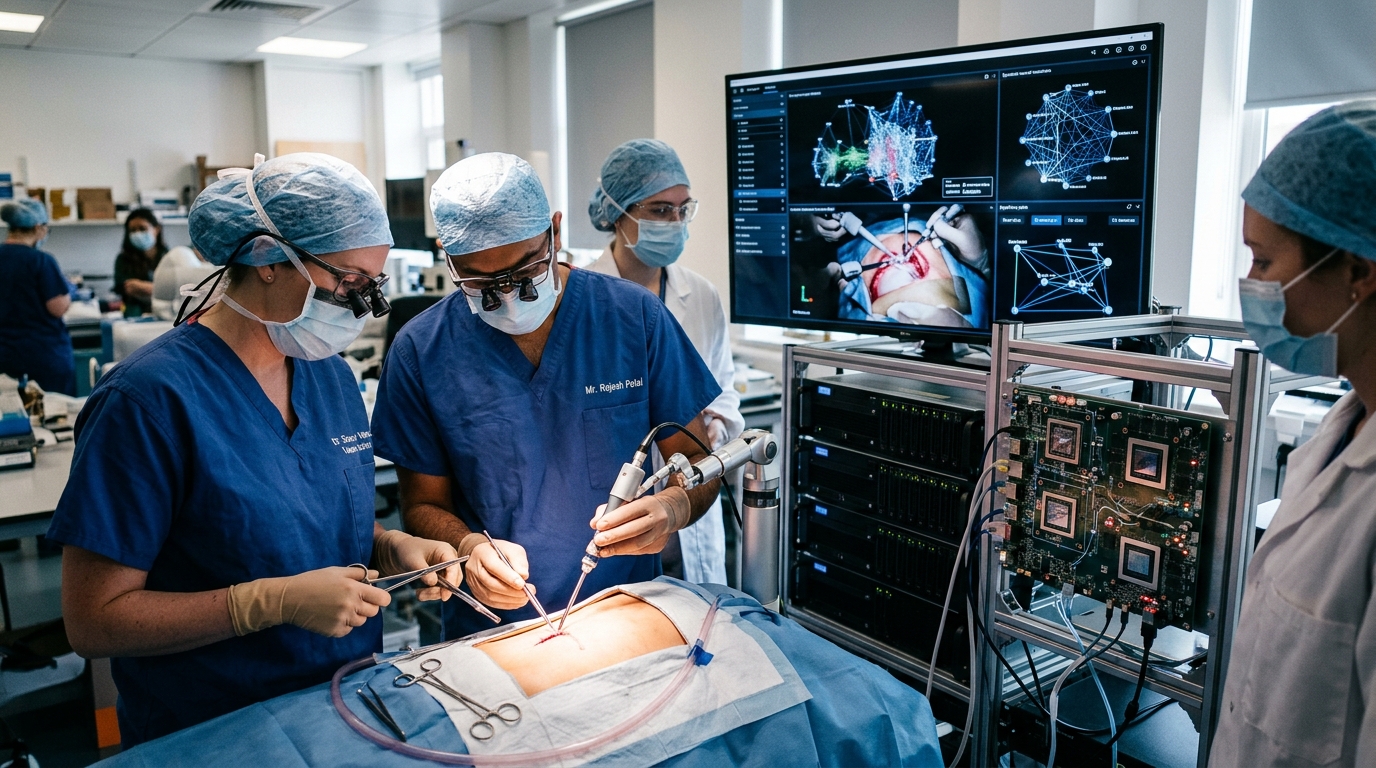
In an operating theatre in London, the atmosphere is familiar: the rhythmic beeping of monitors, the sterile glare of overhead lights, and the intense focus of the surgical team. However, there is a new presence in the room. It doesn’t wear scrubs, it doesn't hold a scalpel, but it "sees" more than any human possibly could. For the first time in the United Kingdom, Artificial Intelligence (AI) is directly involved in the surgical process, signaling a transformative era for medical science and the National Health Service (NHS).
From Diagnostics to Active Guidance
Until recently, AI's role in medicine was largely retrospective or diagnostic—analyzing X-rays, MRIs, and predicting disease onset. What is unfolding now in British hospitals is a fundamental shift. These are "intraoperative support systems," where machine learning algorithms analyze live video feeds from laparoscopic or robotic surgical cameras in real-time.
The AI is capable of identifying critical anatomical structures—such as arteries, nerves, and vital organs—that might be obscured by tissue or fluids. The system overlays digital markers onto the surgeon's screen, providing a real-time warning if they are approaching a high-risk zone. "It’s like having a master consultant who has witnessed millions of similar procedures whispering in your ear," noted one of the lead surgeons involved in the pilot program.
The Technology Behind the 'Smart' Scalpel
The system relies on computer vision networks trained on tens of thousands of hours of surgical footage. A primary challenge in the UK was minimizing latency. For AI to be useful during surgery, analysis must occur in milliseconds. The integration of 5G networks within hospitals and edge computing has finally made this near-instantaneous feedback a reality.
- Organ Recognition: AI distinguishes tumor boundaries with precision that often eludes the naked eye.
- Complication Prediction: The system can predict potential hemorrhages seconds before they occur by analyzing micro-movements of the instruments.
- Training and Data: The data harvested is used to train the next generation of surgeons through high-fidelity simulations.
"This isn't about replacing the surgeon; it's about augmenting our human capabilities. AI removes the variability and human error that stems from fatigue and cognitive load," says Dr. Sarah Jenkins, a specialist in robotic surgery.
Ethical Dilemmas and the Legal Landscape
Despite the technological triumph, AI’s entry into the operating room raises profound questions. Who is liable if the AI provides a faulty suggestion? The legal framework in the UK is still playing catch-up. Currently, accountability rests solely with the surgeon, who retains the final authority to follow or override the algorithm’s prompts.
Furthermore, there is the issue of transparency. "Black box" algorithms often cannot explain the reasoning behind a specific suggestion. For the medical community, the demand for "Explainable AI" (XAI) is non-negotiable before this technology becomes a standardized fixture in every hospital across the nation.
Impact on the NHS and the Road Ahead
The NHS is currently grappling with record-breaking surgical backlogs. The adoption of AI promises to not only shorten procedure times but also significantly reduce readmission rates due to complications. If a surgery is performed more "intelligently," patient recovery is accelerated, and the financial burden on the healthcare system is drastically lightened.
Looking forward, we anticipate a transition from AI-guided surgery to semi-autonomous surgery, where robots might perform routine tasks, such as suturing, under human supervision. The breakthrough in the UK is the first step toward a future where medical care is not dependent on the luck of which surgeon is on call, but on a global network of digital intelligence protecting every patient.