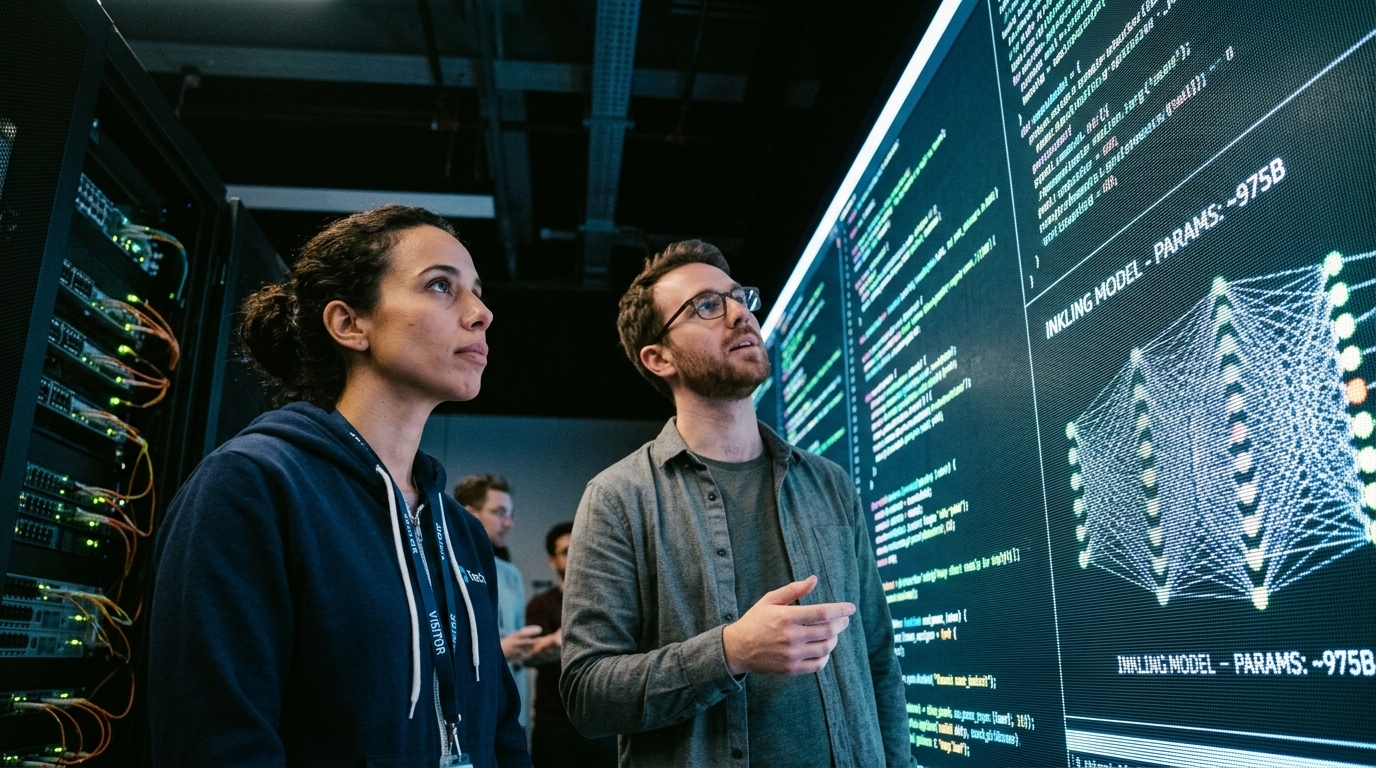
In an era where the AI race seemed to hinge exclusively on the scale of computational resources and billions of dollars in GPUs, DeepSeek V4 has arrived to shatter the status quo. The latest announcement from the Chinese AI powerhouse is not merely an incremental improvement; it is a structural shift in how we perceive the production of high-level reasoning. By achieving complex mathematical proofs and breaking multiple records across industry benchmarks, the DeepSeek V4 system demonstrates that intelligence can be both deeper and dramatically more affordable.
The Architecture of Efficiency
The centerpiece of the announcement that sent shockwaves through the tech community is the 500x cost advantage over dominant Silicon Valley models. While Western giants continue to invest in ever-larger dense models that require entire nuclear plants for power, DeepSeek V4 relies on a sophisticated Mixture-of-Experts (MoE) architecture. This approach allows the model to activate only the necessary "neural pathways" for each specific task, drastically reducing the computational power required during inference.
However, the innovation doesn't stop at architecture. DeepSeek V4's agent system employs an "iterative self-correction" method that mimics the workflow of a professional mathematician. Instead of attempting to guess the correct answer in a single pass, the system decomposes the problem into logical modules, generates code in formal verification languages like Lean 4, and checks the correctness of each step in real-time. This tight integration between generative AI and formal logic systems is what enables V4 to solve problems previously deemed insurmountable for large language models (LLMs).
Mathematics as the Final Frontier
Why is mathematics so significant in this context? In the world of AI, mathematics is considered the ultimate benchmark for "pure reasoning." Unlike text generation or image creation, where quality is often subjective, a mathematical proof is either objectively correct or fundamentally flawed. DeepSeek V4's ability to produce formally verified proofs signifies that the model has moved beyond the stage of data "parroting" and entered the realm of understanding the structural rules of logic.
The model's performance in International Mathematical Olympiad (IMO) level competitions suggests we are nearing a tipping point. DeepSeek V4 didn't just solve the problems; it did so with an elegance and speed that leaves models costing hundreds of times more to train in the dust. This sets a new standard for scientific research, cryptography, and software engineering, where precision is a matter of vital importance and zero-tolerance for error is the norm.
Geopolitical and Economic Implications
The success of DeepSeek V4 is more than a technological feat; it is a geopolitical statement. At a time when the U.S. is imposing strict restrictions on the export of advanced AI chips to China, Chinese researchers are responding with algorithmic supremacy. If you can produce the same output with 1/500th of the cost, hardware restrictions become significantly less effective. DeepSeek has proven that clever engineering can compensate for a lack of raw brute-force computing power.
From an economic perspective, the collapse in the cost of "reasoning" will have a ripple effect across industries. Businesses that previously found the integration of advanced AI cost-prohibitive are now seeing a door swing wide open. The potential for mass, automated code verification and mathematical modeling at a negligible cost could accelerate innovation in sectors ranging from pharmaceuticals to aerospace engineering.
"DeepSeek V4 didn't just win the race; it changed the track on which the race is run. Efficiency is the new superpower in the age of intelligence."
Conclusion: The Democratization of High-Level Intelligence
As we move into the second half of 2026, DeepSeek's message is clear: the era of profligate spending in AI is coming to a close. DeepSeek V4 serves as the blueprint for how artificial intelligence will be integrated into daily scientific practice. We no longer need silicon "deities" that cost billions to maintain; we need tools that are precise, reliable, and accessible. The mathematical rigor offered by V4, combined with its economic dominance, lays the groundwork for a new renaissance in digital creation, where the limit will not be the budget, but the human imagination directing these powerful agents.