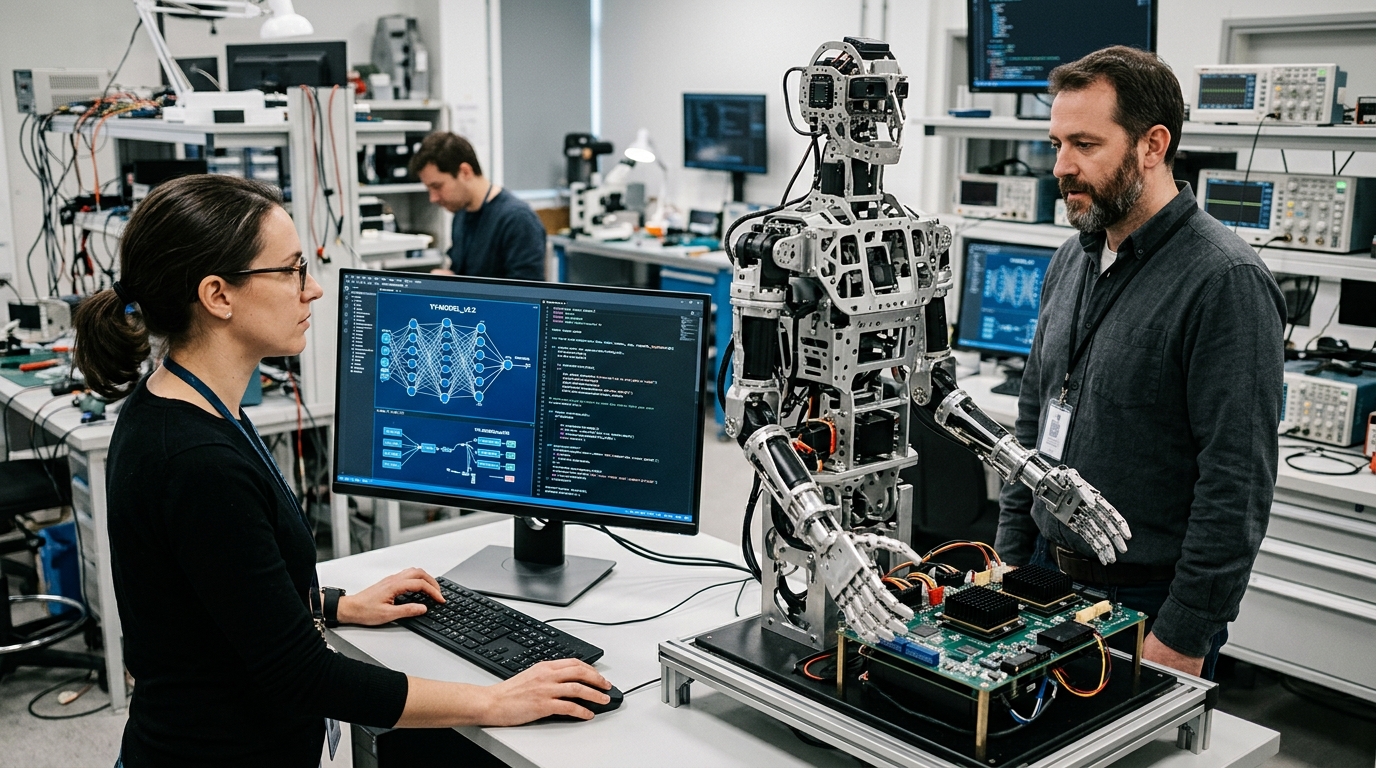
In the rapidly shifting landscape of artificial intelligence, the battle for supremacy is no longer fought solely in the realm of algorithms, but in the raw material that fuels them: data. YY Group Holding Limited (NASDAQ: YYGH), a company traditionally associated with manpower outsourcing and business process services, has announced a bold strategic pivot that places it at the epicenter of the humanoid robotics revolution. Their new strategy for scalable AI training data is more than a business move; it is an acknowledgment that the physical intelligence of machines requires an unprecedented volume of human guidance.
Robotics: The New Frontier of Data Acquisition
While Large Language Models (LLMs) like GPT-4 were trained on vast swaths of internet text, the next generation of AI—Embodied AI—faces a much steeper climb. Robots do not just need to "think" or "speak"; they must interact with the physical world. This necessitates multimodal data that integrates visual inputs, depth sensors, haptic feedback, and complex kinematics.
YY Group’s strategy targets this exact bottleneck. By leveraging its extensive global workforce network, the company is transforming into a "digital conduit," where thousands of human annotators will train models to understand the subtle nuances of human dexterity or navigation in unstructured environments, such as warehouses or domestic settings. The company argues that its infrastructure allows for the rapid scaling of data production, which remains the primary hurdle for industry leaders like Tesla (Optimus) or Figure AI.
The Convergence of Human Labor and Machine Learning
The move by YY Group highlights a profound irony of our era: to make machines autonomous, more human labor is required than ever before. The process of Reinforcement Learning from Human Feedback (RLHF) is now expanding from text to physical motion. YY Group is developing specialized annotation tools that allow workers to "teach" robots how to handle fragile objects or react to unpredictable human movements.
- Quality over Quantity: The company emphasizes data precision, as training errors in robotics can lead to physical damage or safety hazards.
- Global Scalability: With a presence across diverse geographic regions, YY Group can provide data that reflects different environments and cultural interaction norms.
- Technological Integration: Utilizing AI-assisted labeling to verify the accuracy of human-generated data, ensuring a high-fidelity feedback loop.
Market Implications and the NASDAQ Perspective
The market has received the announcement with cautious optimism as YYGH attempts to rebrand itself from a low-margin manpower provider to a high-value technology infrastructure firm. Analysts point out that demand for robotics training data is expected to grow by 40% annually through 2030. However, competition from established giants like Scale AI is fierce.
YY Group’s advantage lies in its operational expertise in managing large-scale workforces—a feat that purely tech-focused firms often struggle to execute efficiently. If they can demonstrate that their data significantly reduces model training time-to-market, the stock could see a major re-rating as it becomes a proxy for the broader robotics and automation market.
Ethical Challenges and the Future of Work
Beyond the financial metrics, YY Group’s strategy raises significant questions about the future of labor. We are witnessing the rise of a new "digital proletariat," where workers in developing economies train the very machines that may eventually displace their roles in the global economy. Ensuring fair wages and ethical working conditions within this data value chain will be critical for the company's long-term sustainability, especially under the scrutiny of the EU AI Act and global ESG standards.
"Data is not just information; it is experience transferred from human to machine. YY Group aims to be the translator of that experience."
In conclusion, YY Group is no longer just selling man-hours; it is selling the ability for a machine to perceive and act upon the world. In a global economy facing demographic aging and labor shortages, their strategy for scalable AI data may prove to be one of the most pivotal pivots of the decade.