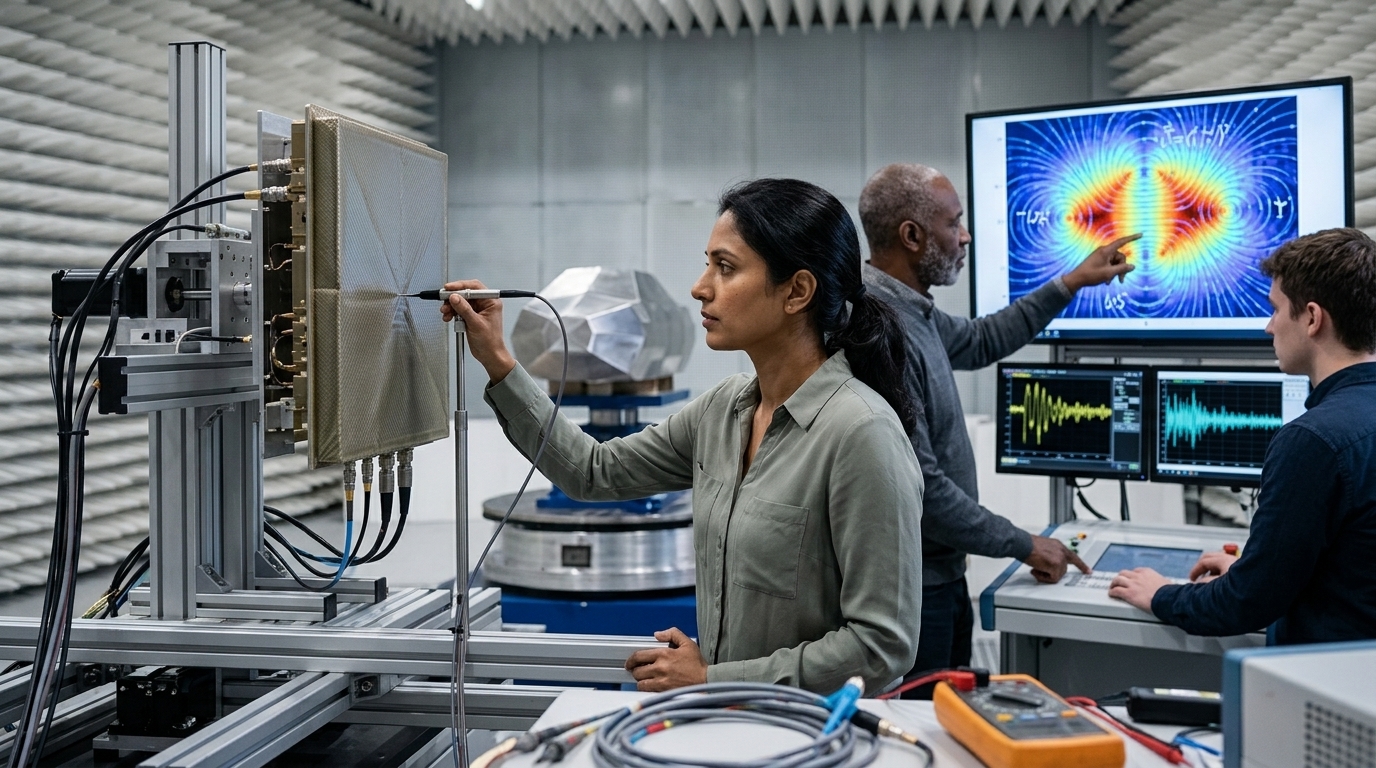
In the rapidly evolving landscape of machine learning, the ability of models to generate "realistic" data is often conflated with a genuine understanding of underlying physical phenomena. A recent study published on ArXiv (2605.00018) poses a critical question to the AI community: When we transform Motion Capture (MoCap) data into radar micro-Doppler spectrograms, is the model learning the physics of electromagnetic radiation, or is it merely a sophisticated data "parrot"?
The Challenge of the Micro-Doppler Signature
Radar technology has become a central pillar for privacy-preserving applications, such as monitoring the elderly in their homes or detecting pedestrians for autonomous vehicles. Unlike cameras, radar does not "see" images; instead, it records the return of waves bouncing off moving bodies. This creates the "micro-Doppler" signature, a complex pattern reflecting the subtle movements of body limbs.
The problem lies in data scarcity. Collecting real, synchronized MoCap and radar data is a laborious and expensive process. As a solution, researchers have turned to deep learning models that can synthesize artificial radar data from existing motion libraries. However, the visual plausibility of a spectrogram does not guarantee its physical validity. As the researchers note, "a model may produce something that looks like radar to the human eye, but fails miserably when used to calculate real physical quantities like velocity or phase shift."
A New Interpretability Framework
The research team introduces a groundbreaking physics-based interpretability framework that moves away from traditional metrics (like MSE error) and focuses on data consistency with Maxwell’s equations and kinematic principles. The study proposes two complementary metrics that analyze the relationship between body geometry and the energy reflected back to the sensor.
- Kinematic Consistency Metric: Measures whether changes in the spectrogram correspond to the actual accelerations of the body joints.
- Electromagnetic Fidelity Metric: Evaluates whether the signal intensity follows the rules of Radar Cross Section (RCS) and distance-based attenuation.
"The ability of a model to generalize to real-world scenarios depends on whether it has internalized the constraints of physics. Without this, AI remains a fragile tool," the study states.
Why This Matters for the Future
The significance of this research extends far beyond the laboratory. Imagine an autonomous driving system that relies on synthetic radar data to train for accident avoidance. If the training model has learned incorrect "physics," the vehicle might misinterpret the speed of a cyclist at a critical moment. Similarly, in digital health, a sensor detecting falls in the elderly must be perfectly accurate to avoid false alarms or, worse, missing a real emergency.
The shift toward "Physics-Informed Machine Learning" (PIML) represents the next major challenge. The research shows that while current MoCap-to-radar models are impressive at generating images, they often violate fundamental principles when conditions deviate from the narrow confines of training data. Integrating physical constraints directly into the neural network architecture seems to be the only path toward creating reliable systems.
Conclusions and Outlook
The study concludes that "black-box informatics" is reaching its limits. The need for models that are explainable and physically consistent is imperative. The two new metrics proposed provide a roadmap for developers, allowing them to "audit" their models not just for how beautiful the results look, but for how true they are. In the age of AI, truth remains anchored in the laws of the universe, and our mission is to ensure our machines respect them.