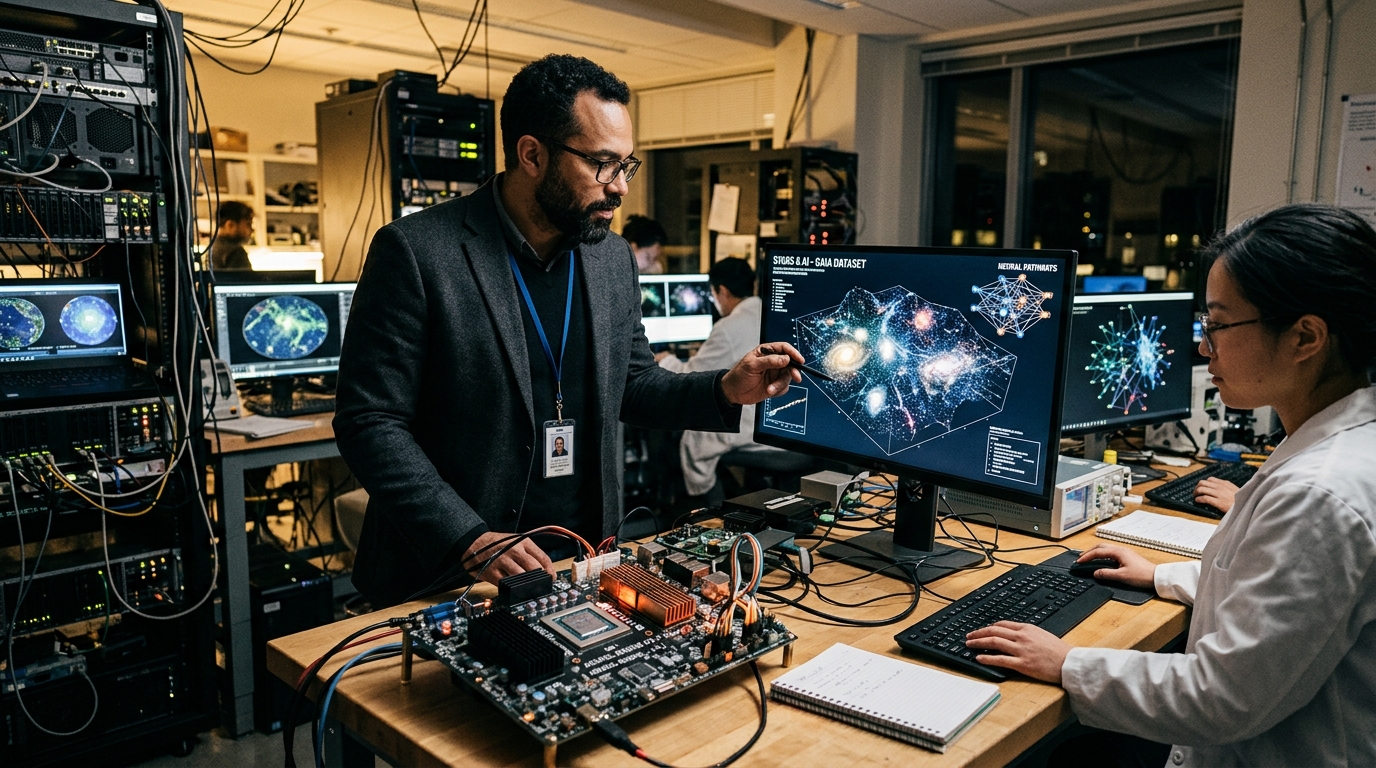
The alignment of Large Language Models (LLMs) with human preferences has become the "holy grail" of contemporary artificial intelligence. From the early days of Reinforcement Learning from Human Feedback (RLHF) to the rise of Direct Preference Optimization (DPO), the core objective remains unchanged: to ensure AI understands not just language, but our underlying values. However, a new research paper titled TUR-DPO: Topology- and Uncertainty-Aware Direct Preference Optimization (arXiv:2605.00224) is set to redefine this field by introducing two critical parameters previously overlooked: the geometric structure of data and the inherent uncertainty of human judgment.
The Problem with "Flat" Optimization
Standard DPO, which largely replaced the complex Proximal Policy Optimization (PPO), operates on a straightforward premise: if presented with two responses, A and B, and a human prefers A, the model should increase the probability of A and decrease that of B. While effective, this approach is contextually "blind." It treats every preference pair as an isolated, absolute truth, ignoring the fact that human preferences are often noisy, subjective, and deeply interconnected.
The researchers behind TUR-DPO argue that this simplification leads to models prone to overfitting on erroneous or ambiguous data. When a trainer provides an unclear preference, traditional DPO attempts to force it into the model's weights, potentially disrupting the model's broader internal coherence. This is where topology and uncertainty come into play.
Topology: Mapping the Latent Landscape
The first major innovation of TUR-DPO is Topology-Awareness. In the high-dimensional latent space where LLMs operate, responses are not just isolated points; they are part of a broader geometric structure. TUR-DPO analyzes how different responses relate to one another topologically. If a preferred response lies within a region of the latent space that is already consistent and "healthy," the model places higher trust in it.
Conversely, if a preference appears as an outlier that contradicts its structural neighborhood, the system identifies it as potentially problematic. Consequently, the learning process becomes a careful reshaping of the model's topological map rather than a linear probability boost. This ensures that the AI maintains internal logical consistency, avoiding the erratic behavioral shifts often seen after intensive alignment phases.
Uncertainty: Acknowledging Human Fallibility
The second pillar, Uncertainty-Awareness, is a pragmatic admission: humans disagree and make mistakes. In traditional datasets, if 60% of people prefer A and 40% prefer B, the model receives conflicting signals that can lead to gradient instability.
TUR-DPO incorporates mechanisms that quantify the uncertainty of each preference sample. Utilizing probabilistic modeling, the system weights the importance of each training example. When a preference is clear and unanimous, the model learns aggressively. When the preference is marginal or contested, TUR-DPO applies a more conservative update, preventing catastrophic interference with the model's existing knowledge base. This dynamic adjustment makes training significantly more robust against noisy labels.
Conclusions and Future Implications
The emergence of TUR-DPO marks a shift from brute-force optimization toward a more nuanced, mathematically grounded approach to alignment. Research results indicate that models trained with this method exhibit superior generalization, fewer hallucinations, and a more natural conversational flow.
- Stability: Reduced fluctuations during the training process.
- Quality: Enhanced performance on benchmarks requiring subtle judgment.
- Efficiency: The ability to learn effectively from smaller, more complex datasets.
As we move toward Artificial General Intelligence (AGI), the ability of systems to navigate the uncertainty of the human world will be the ultimate success factor. TUR-DPO is not merely an algorithm; it is a step toward an AI that "understands" that truth is rarely binary, but rather a complex topological map of varying shades of gray.