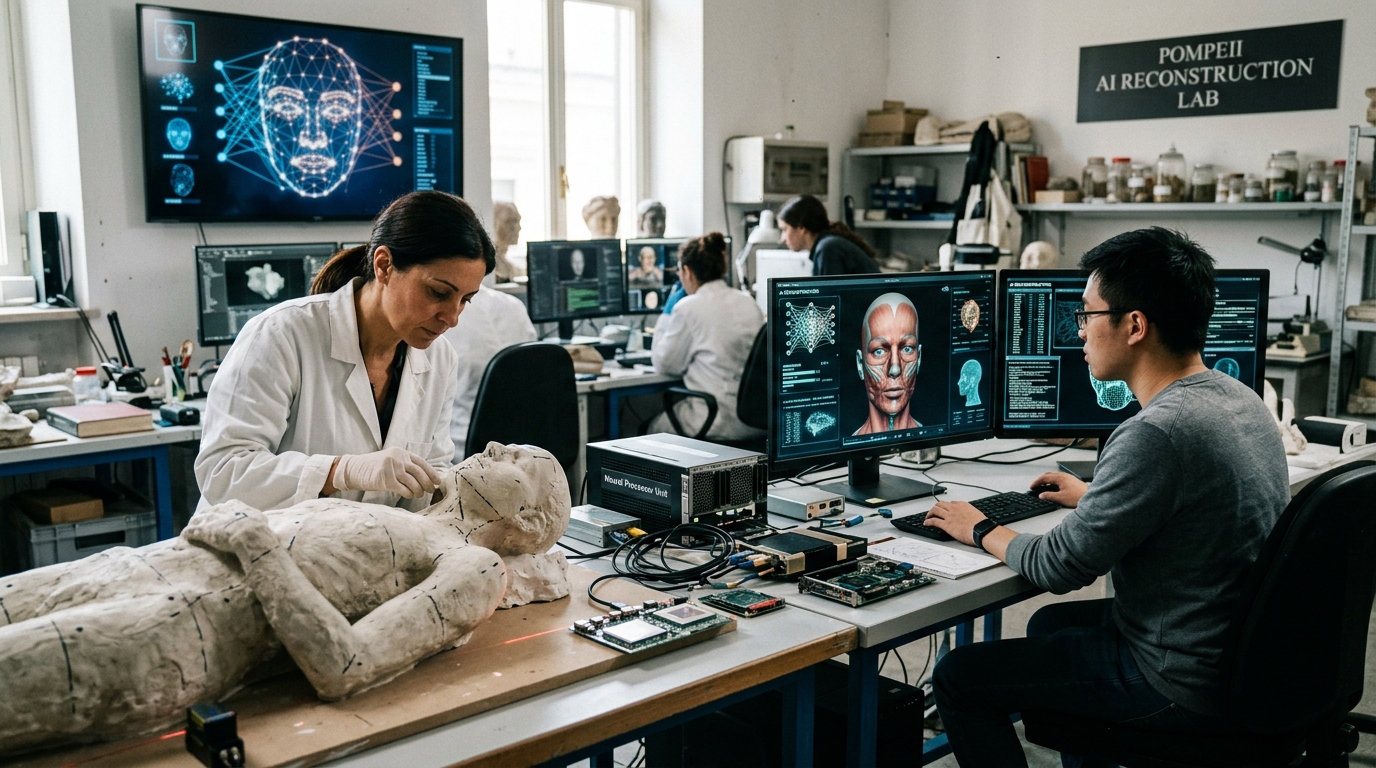
Pompeii, the city frozen in time beneath layers of volcanic ash from Mount Vesuvius in 79 AD, continues to yield staggering revelations. However, this time, the headline isn't about a new trench or a hidden fresco, but a technological breakthrough. Archaeologists and computer scientists have collaborated to give a face to one of the thousands who perished on that fateful day, utilizing sophisticated Artificial Intelligence (AI) algorithms and high-precision 3D scanning.
The Science Behind the Digital Persona
The process began with the analysis of a skull found in remarkable condition during recent excavations in the Regio V district. Researchers used high-resolution photogrammetry to create an exact digital twin of the remains. Subsequently, the AI took over the most complex task: estimating soft tissue thickness, muscle structure, and skin texture.
Unlike traditional forensic facial reconstruction methods, which often rely on statistical averages and the subjective interpretation of artists, the AI model was trained on thousands of CT scans of modern individuals with similar cranial structures. "This is not a simple artistic rendering," explains one of the project leads. "It is a probabilistic approach based on biometric data, allowing us to view a human being who lived two millennia ago with an intimacy that is truly awe-inspiring."
The Man Behind the Tragedy
The subject, a man estimated to be between 35 and 40 years old, appears to have belonged to Pompeii's middle class. His features—prominent cheekbones, a slightly asymmetrical nose, and a gaze that the AI managed to render with chilling detail—transform an archaeological find into a human narrative. DNA analysis, integrated into the algorithm, also provided insights into his eye and hair color, as well as his likely ancestry, confirming the multicultural mosaic of the Roman Empire.
"Technology allows us to bridge the gap of centuries. We are no longer looking at skeletons, but at our fellow citizens from the past," the archaeological team states.
The use of AI in archaeology is not limited to aesthetics. It assists scientists in understanding living conditions, diets, and diseases of the era. In the case of this specific man, dental wear and bone lesions, as analyzed by the system, suggest a life of activity but also access to a relatively varied and nutritious diet.
Ethical Questions and the Future of Memory
However, the "resurrection" of the dead through technology brings ethical dilemmas. Is it appropriate to reconstruct the faces of those who died so tragically for educational or tourism purposes? Some academics raise concerns about the "spectacularization" of death, while others argue that this approach enhances empathy and respect for history.
In Pompeii, where plaster casts of victims have been one of the world's most poignant sights for decades, AI offers a new dimension. Instead of anonymous, white figures writhing in pain, we now have the opportunity to see the face of calm before the storm. The future of archaeology appears increasingly digital, transforming museums from repositories of objects into spaces for a living encounter with the past.
As algorithms become more precise and DNA data more accessible, it is likely that in the near future, we will be able to virtually "walk" through the streets of Pompeii, surrounded by digitally reconstructed residents telling their stories. AI is not just discovering the past; it is making it present.