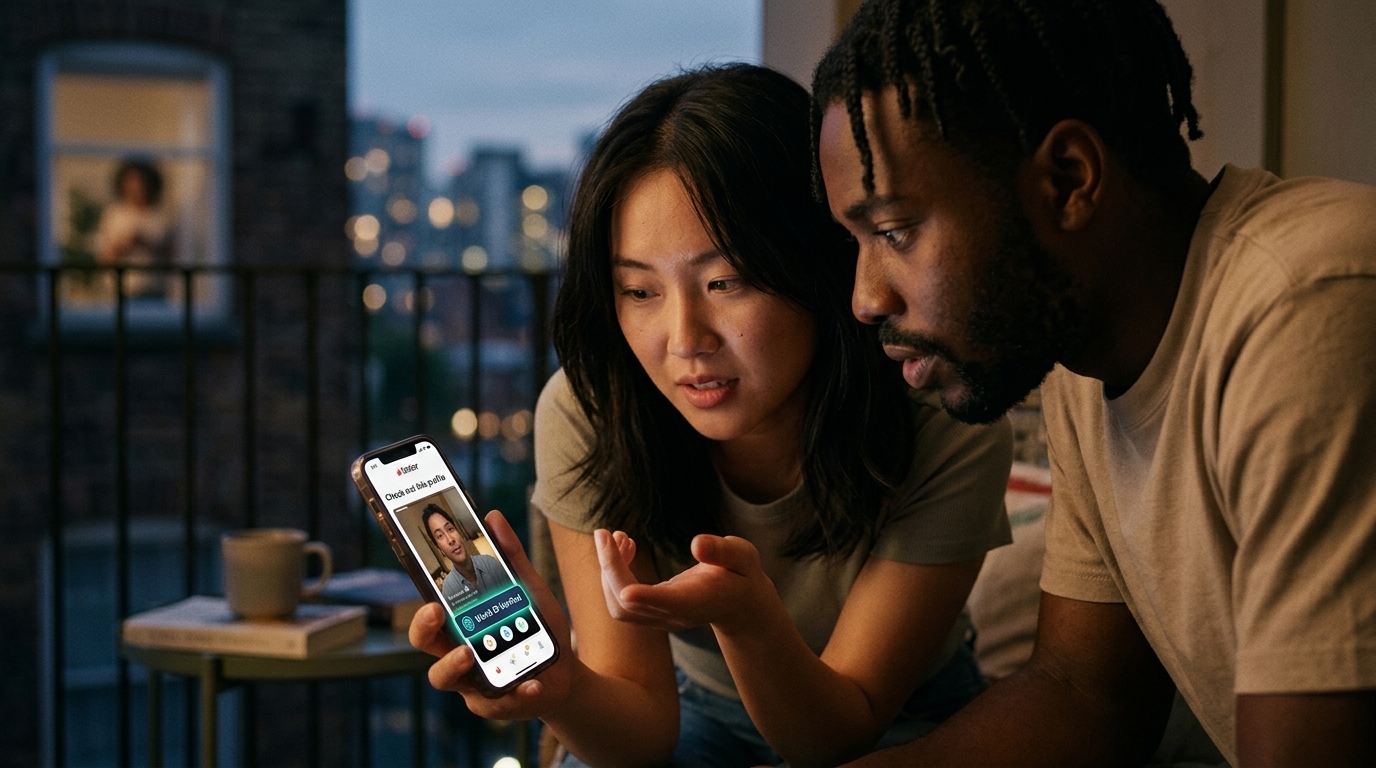
In a move that feels like a script straight out of a Black Mirror episode, Tinder, the world’s most popular dating app, has announced a strategic partnership with 'World' (formerly Worldcoin), Sam Altman’s ambitious digital identity project. The objective? To combat the plague of bots and scammers through iris scanning. This news is not merely a technical update; it signals a fundamental shift in how we perceive trust and anonymity in the digital sphere.
The Scourge of Bots and the Need for 'Proof of Personhood'
In recent years, Tinder and other platforms under the Match Group umbrella have faced a profound crisis of trust. Romantic scams, notoriously known as 'pig butchering,' have cost unsuspecting users millions of dollars. Simultaneously, the rapid evolution of Generative AI has made it nearly impossible to distinguish a genuine profile from a sophisticated bot. Traditional photo verification methods are proving increasingly inadequate against the onslaught of high-fidelity deepfakes.
This is where World enters the frame. Altman’s technology relies on the 'Orb,' a spherical device that scans a user’s iris to create a unique 'World ID.' This ID acts as a digital passport, proving the holder is a unique human being without necessarily revealing their real-world identity. For Tinder, integrating this technology promises an environment free from automated accounts, where every 'match' is guaranteed to be human.
Privacy: The Price of Safety?
Despite the promises of enhanced security, the move has ignited a firestorm among privacy advocates. The iris is one of the most sensitive forms of biometric data; it is unique to every individual and, unlike a password, cannot be changed if compromised. Criticism centers on the demand that users surrender their 'biological code' to a private corporation just to access a dating service.
"The notion that we must scan our eyeballs to find a romantic partner is a dystopian surrender of privacy at the altar of convenience," digital rights analysts argue.
On its part, World maintains that the process is entirely secure. The company claims that the iris image is deleted immediately after processing and that only an encrypted code (an iris hash) is stored, which cannot be reversed to recreate the original image. However, in an era of massive data breaches, many remain skeptical about whether any centralized system can truly guarantee the absolute safety of such sensitive biological information.
Sam Altman’s Strategy and Global Dominance
For Sam Altman, the partnership with Tinder represents a massive victory for the adoption of World ID. His vision of a global identity network that distinguishes humans from AI is gaining a massive user base. There is a distinct irony in the fact that the man leading OpenAI—the company that created the tools making bots so convincing—is now offering the solution to detect them.
This move is expected to be emulated by other social media platforms. If Tinder successfully reduces fraud through World ID, pressure on Facebook, X (formerly Twitter), and Instagram to implement similar biometric solutions will intensify. We are at a crossroads where online anonymity is receding in the face of the urgent need for verified human presence.
Conclusion: A New Era for Digital Romance
The integration of iris scanning into Tinder is more than just a battle against scammers; it is an experiment in human behavior. In a society plagued by loneliness and digital deception, the promise of a 'clean' platform is undeniably attractive. However, the cost of this purity may be the final loss of anonymity and the handing over of our most personal data to the hegemony of tech giants. For now, the choice remains with the users, but the industry's trajectory is clear: the future of identity is biometric.