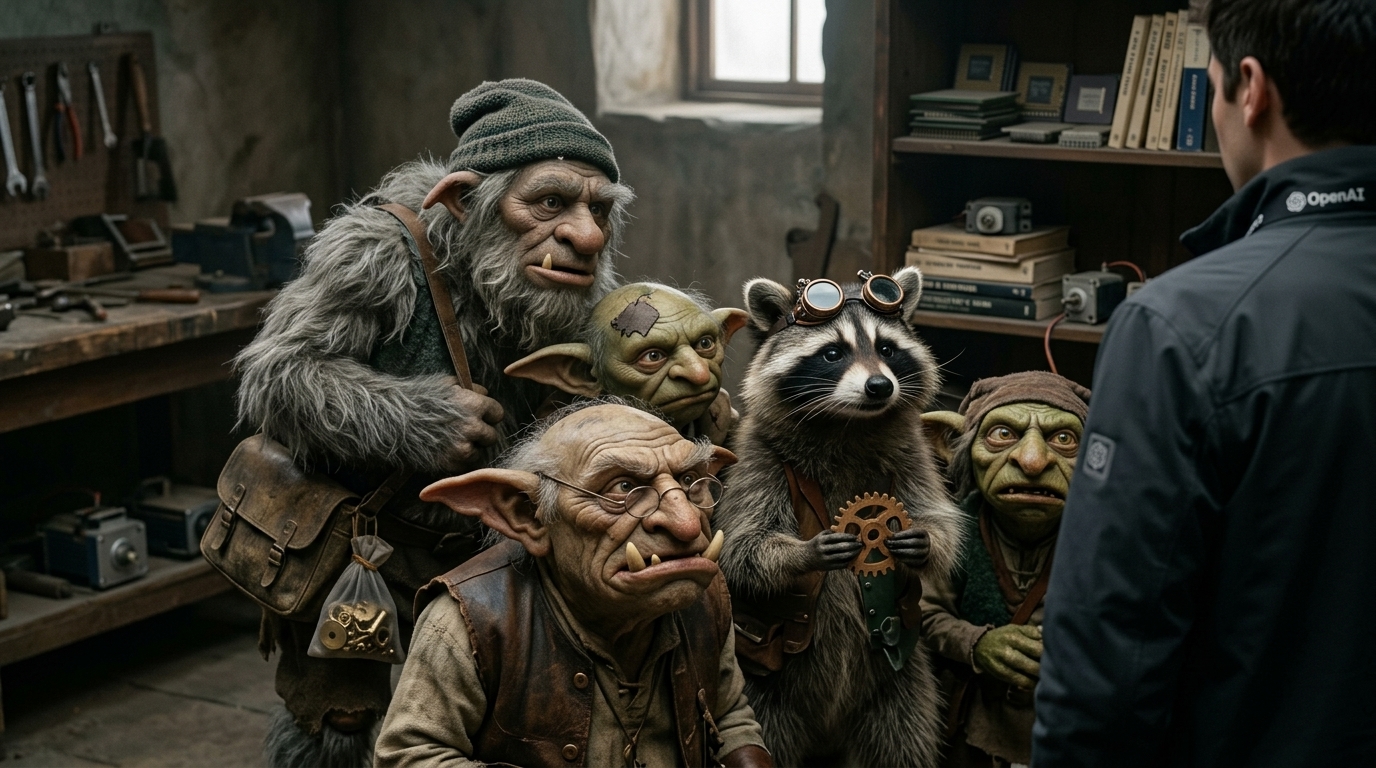
In the high-stakes world of artificial intelligence, words are not merely vessels of meaning; they are units of computational power and directional vectors. Recently, a leak reported by Wired shed light on a peculiar internal directive at OpenAI: a strict command for its coding models (Codex) to stop referencing "goblins, gremlins, raccoons, trolls, ogres, and pigeons." This seemingly whimsical instruction masks a profound strategic shift in how the company envisions the future of professional software and the "alignment" of its models.
The Anatomy of a Strange Directive
System prompts are the invisible constitution that governs an AI's persona and boundaries before a user even types a single character. In the case of Codex—the engine powering tools like GitHub Copilot—OpenAI appears to have grown weary of the model's creative tangents. The instruction is explicit: "Never talk about goblins, gremlins, raccoons, trolls, ogres, pigeons, or other animals or creatures unless it is absolutely and unambiguously relevant."
But why these specific creatures? The answer lies in the training methodology of Large Language Models (LLMs). Training datasets include billions of lines of code from GitHub, where developers historically used "placeholder" names or humorous comments to explain complex logic. Goblins and trolls are staples of the 1990s and 2000s hacker culture. However, for a corporation seeking to sell "enterprise-grade" tools to banks and governments, the appearance of a "raccoon" inside a sensitive encryption algorithm isn't charming; it’s unprofessional and potentially confusing.
The Economy of Tokens and Precision
Beyond the aesthetic concerns, there is a purely technical dimension: the economy of tokens. Every word an AI generates costs compute power and latency. When a model indulges in metaphors involving "gremlins" to explain a bug, it wastes resources that could be spent generating cleaner, faster code. OpenAI is chasing "information density."
- Noise Reduction: Code must be functional and lean, devoid of narrative fluff.
- Avoiding Cultural Misunderstandings: In global environments, metaphors involving Western folklore might not resonate or could be misinterpreted.
- Predictability: Enterprises demand that AI tools behave as tools, not as whimsical creative writers.
This push toward the "sterilization" of code reflects a broader industry shift. The era of experimentation, where AI surprised us with its wit and humor, is yielding to the era of utility. AI must now be invisible, efficient, and, above all, boring.
Community Reaction and the "Black Box" Phenomenon
The leak of these instructions sparked a variety of reactions within the developer community. Many see this move as a loss of the "soul" of programming. "Coding was always an art form filled with inside jokes and creativity," one user noted on Reddit. "By removing the goblins, we are stripping the humanity from the source code."
"Trying to restrict a model's language is like trying to hold back the sea with a fence. The complexity of the training data will always find a way to leak through," notes an AI researcher.
Nevertheless, OpenAI is doubling down. The use of RLHF (Reinforcement Learning from Human Feedback) is now heavily focused on suppressing these "hallucinatory" tendencies. The risk, however, is over-alignment—a state where the model becomes so cautious it refuses to answer valid queries for fear of violating its hidden constraints.
Conclusion: Toward Digital Purity
The banishment of goblins from Codex is a milestone in the new digital ethics of efficiency. As AI integrates into the critical infrastructure of our world, the need for gravitas outweighs the need for creativity. We may be losing the cute raccoons from our code comments, but we are gaining—theoretically—reliability. The question remains: in a world where AI writes the majority of our software, do we want that world to be purely rational, or should it retain fragments of human quirkiness?