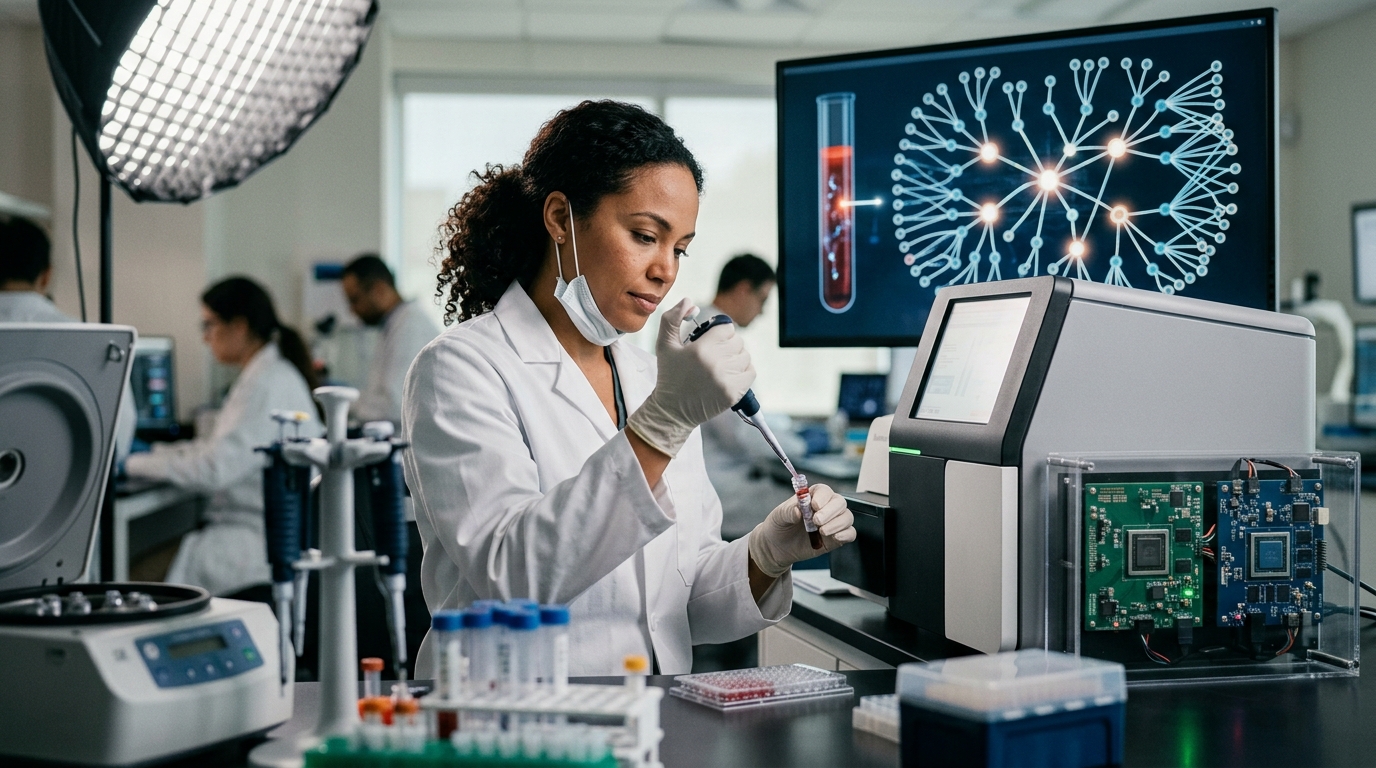
The fight against cancer is entering a new digital frontier, where the boundary between biology and data science is becoming increasingly blurred. For decades, cancer diagnosis has relied on invasive tissue biopsies—methods that, while effective, carry inherent risks, cause patient discomfort, and often occur only after symptoms have manifested. The emergence of "liquid biopsy," a blood test that detects circulating tumor DNA (ctDNA), promised a revolution. However, the persistent hurdle has been accuracy: how do you find a "needle" of cancerous DNA in a "haystack" of billions of healthy cells? The answer is increasingly being found in Machine Learning (ML).
The Challenge of Biological Noise
The primary obstacle to the widespread adoption of liquid biopsies is not a lack of sequencing power, but the overwhelming volume of "noise" in biological data. Our blood contains cell-free DNA (cfDNA) derived from normal processes such as healthy cell death or aging. Furthermore, a condition known as Clonal Hematopoiesis of Indeterminate Potential (CHIP) can introduce mutations that mimic cancer, leading to devastating false positives. This is where Artificial Intelligence steps in as a critical filter.
According to recent research highlighted by Newswise and other leading medical institutions, new machine learning models are being trained to recognize not just mutations, but "fragmentomics"—the specific patterns in which DNA breaks apart. Cancer cells release DNA into the bloodstream in different sizes and patterns compared to healthy cells. AI algorithms can analyze millions of these fragments simultaneously, identifying subtle statistical deviations that the human eye, or even traditional statistical models, would find impossible to detect.
Fragmentomics: A New Language for Diagnosis
The innovation of these AI models lies in their holistic approach. Instead of searching for a single genetic "smoking gun," they analyze the overall geometry of DNA in the plasma. Machine learning allows researchers to examine exactly where DNA is cleaved. In cancer, the chromatin structure changes, leaving a distinct signature in the blood. New AI models are now achieving sensitivities nearing 90% for certain early-stage cancers, while keeping false positive rates below 1%.
This is a game-changer for clinical practice. A false positive in a screening test can lead to unnecessary, invasive procedures and immense psychological trauma. The ability of AI to filter out biological noise makes liquid biopsy a viable tool for mass population screening—a concept that was considered science fiction only a few years ago. By identifying cancer at Stage I or II, when it is often curable, AI-powered liquid biopsies could fundamentally alter survival rates across the globe.
From the Laboratory to the Clinic
The application of these models extends beyond initial diagnosis. Monitoring treatment response is another area where AI excels. By analyzing sequential blood tests during chemotherapy or immunotherapy, an AI model can predict whether a tumor is shrinking or developing resistance much earlier than a traditional CT scan. This enables oncologists to pivot their strategies in real-time, offering true "precision medicine" tailored to the molecular evolution of the patient's specific cancer.
However, significant challenges remain regarding accessibility and data integrity. Training these models requires massive datasets from diverse populations to prevent algorithmic bias. If a model is trained exclusively on data from one demographic, its accuracy may plummet when applied to others. International collaboration and open-data initiatives are essential to ensure that the AI revolution in oncology is equitable and benefits all of humanity, regardless of geography or ethnicity.
The Future: A Universal Blood Test?
The ultimate goal is the creation of a Multi-Cancer Early Detection (MCED) test. Imagine a routine annual check-up where a simple blood draw, analyzed by AI, could screen for dozens of cancer types before symptoms even appear. Current results indicate we are approaching this milestone. The integration of machine learning into liquid biopsies is not merely a technical upgrade; it is a paradigm shift that transforms diagnosis from a reactive discovery into a proactive, data-driven science. As we move forward, the challenge shifts from the laboratory to healthcare policy: how will we integrate these powerful tools into public health systems in a way that is both sustainable and ethically sound?