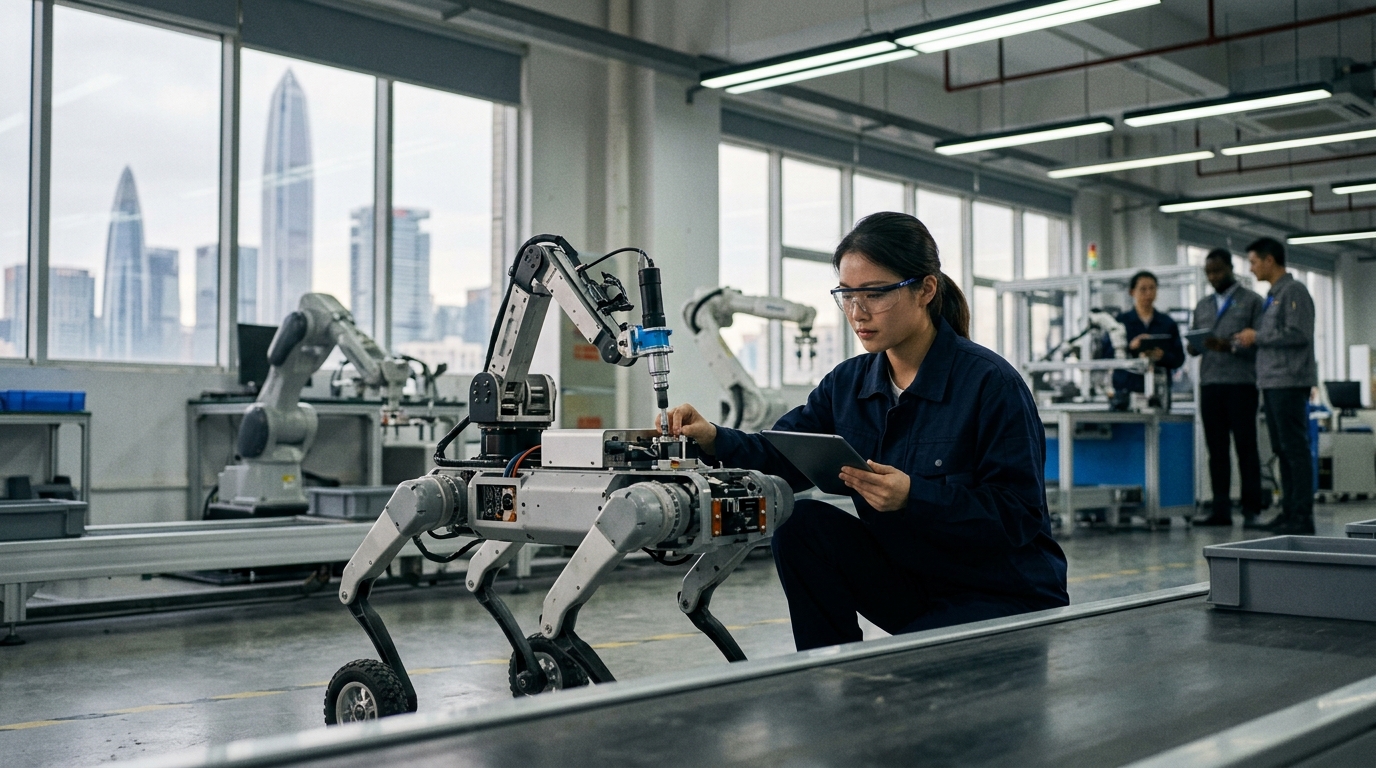
For years, China’s image in the field of Artificial Intelligence was inextricably linked to viral videos of humanoid robots performing tai-chi or serving tea at technology expos in Beijing and Shanghai. However, a profound structural shift is currently taking place within the world’s second-largest economy. What many analysts are calling "the end of humanoids" does not signal the abandonment of the technology, but rather the death of the anthropomorphic illusion. China is moving from "spectacle robotics" to "Embodied AI," aimed at the very survival of its industrial base.
The Anthropomorphic Bubble and Harsh Reality
The first phase of humanoid development in China was characterized by a frantic competition to see which company could build a robot that looked most like a human. Companies like UBTECH and Unitree Robotics showcased models with intricate fingers, facial expressions, and gaits that closely mimicked human anatomy. However, the market began to realize that anthropomorphism is a costly luxury with minimal added value in production. The maintenance costs of complex joints and low energy autonomy rendered these "wonders" unsustainable for practical use.
The current pivot, encouraged by China’s Ministry of Industry and Information Technology (MIIT), focuses on functionality. New models being developed are no longer trying to "look" human, but to "function" in environments designed for humans. This distinction is subtle but critical: the focus is shifting from aesthetics to the ability of algorithms to perceive physical space and manipulate objects with millimeter precision, regardless of whether the robot has two or four legs, or if its head resembles a screen.
The Strategy of Embodied AI
China is now investing heavily in what is known as Embodied AI. This is the marriage of Large Language Models (LLMs) with physical robot bodies. Instead of pre-programmed movements, these robots "learn" through reinforcement learning in virtual environments before being deployed in the real world. Beijing has set a goal for mass production of such systems by 2025, with the prospect of them becoming the "engine" of economic growth by 2027.
- Supply Chain Optimization: China holds 40% of the world's industrial robot installations, providing a massive database for training new models.
- Production Costs: Through vertical integration, Chinese companies aim to bring the cost of a humanoid below $30,000, making them competitive with human labor.
- Demographic Pressure: With a rapidly aging population, the need for robots that can operate in hospitals and factories without requiring infrastructure redesign is imperative.
Geopolitical Competition with the US
Elon Musk’s announcement of the Tesla Optimus served as a catalyst. China no longer views humanoids as a research project, but as the next battlefield for technological supremacy, akin to Electric Vehicles (EVs). The difference is that while the US leads in software and processors (NVIDIA), China dominates in actuators, sensors, and production scale. The "end of humanoid AI" in China actually signifies the beginning of an era where robots will be ubiquitous, but perhaps less "human" in appearance and more efficient in practice.
"We don't need robots that smile at us; we need robots that can assemble an iPhone or care for an elderly person safely," says a tech executive from Shenzhen.
In conclusion, China is closing the chapter on spectacle. The next phase will be decided on factory floors, not on the runways of tech conferences. The success of this venture will determine whether China remains the "world's factory" in the age of automation or succumbs to its demographic challenges.