In the heart of the global technological race, the discovery of new materials represents the ultimate frontier. In July 2026, Alibaba’s DAMO Academy, the research arm of the Chinese giant, announced an achievement that could alter the course of physics and energy: the identification and experimental verification of four new superconductor candidates using advanced artificial intelligence models. This development is not merely a scientific news item but proof that 'AI for Science' has transitioned from theoretical promise to tangible reality.
The Significance of Superconductivity
Superconductors are materials that allow electricity to flow with zero resistance, typically at extremely low temperatures. Their significance is colossal: from creating lossless power grids and developing faster quantum computers to building Maglev trains that float above tracks. However, discovering new superconductors has traditionally relied on serendipity and painstaking laboratory trials—a process that often spanned decades of research.
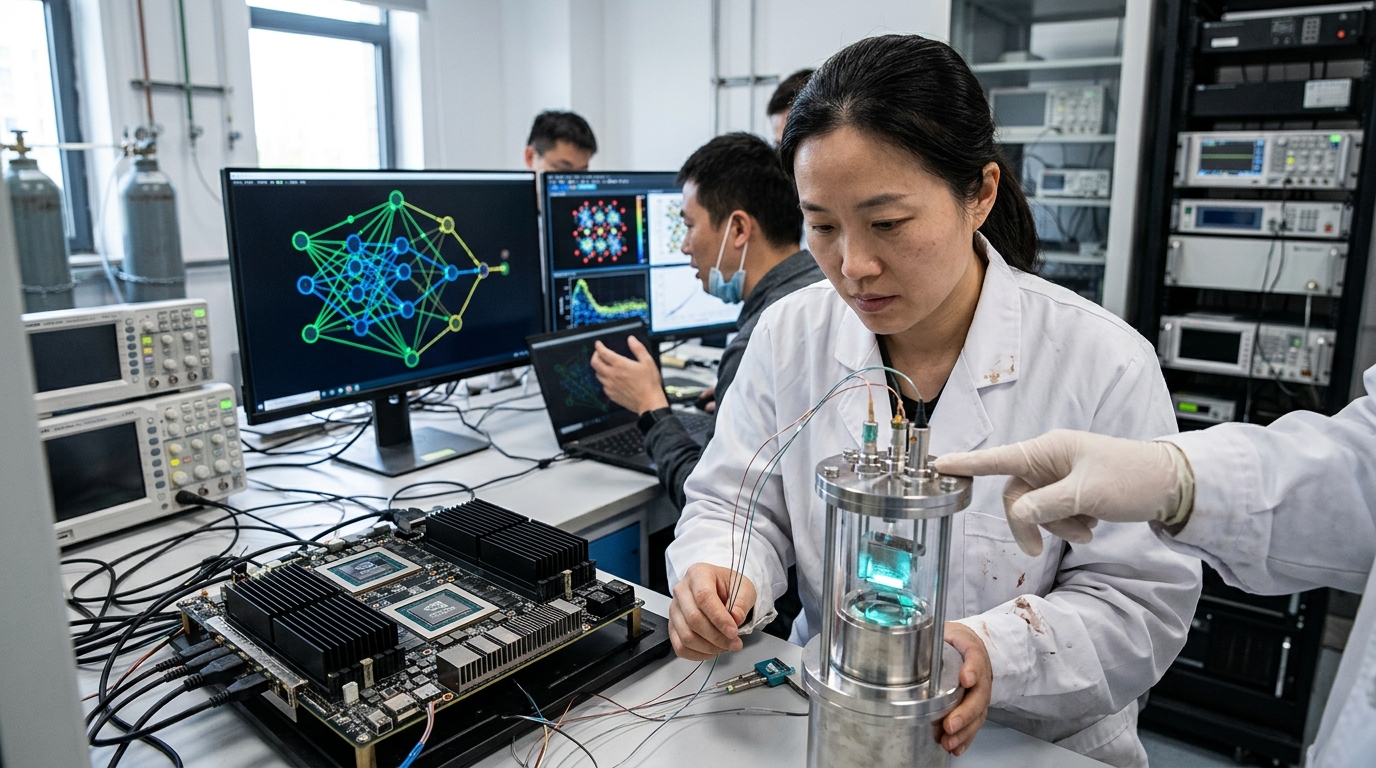
Alibaba’s approach has changed the game. By utilizing deep neural networks trained on vast crystallographic databases, their AI model was able to simulate the electronic structures of thousands of hypothetical materials. The AI’s ability to 'predict' which materials would exhibit superconducting properties allowed researchers to bypass thousands of failed experiments, focusing only on those with the highest probability of success.
The Discovery Process and Experimental Verification
The DAMO Academy research team did not stop at digital predictions. The critical step that differentiates this announcement from previous efforts is experimental validation. The four new superconductors were synthesized in the lab and subjected to rigorous testing to confirm the critical temperature (Tc) at which they lose electrical resistance. While specific details regarding their chemical composition remain partially protected by intellectual property, they are reported to belong to material families that promise greater stability and easier manufacturing compared to traditional superconductors.
- Utilization of Graph Neural Networks (GNNs) to analyze crystal structures.
- Acceleration of discovery time by 1000x compared to traditional methods.
- Material synthesis via advanced chemical vapor deposition methods.
- Confirmation of the Meissner effect—the expulsion of magnetic fields from the superconductor's interior.
Geopolitical and Economic Implications
Alibaba’s success comes at a time when China is striving for total self-reliance in high-tech sectors. The ability to design 'materials on demand' offers a massive strategic advantage. While the US and Europe are also investing heavily in AI for science, the speed at which Chinese giants are integrating AI into the production process is remarkable. This discovery reinforces Alibaba’s position not just as an e-commerce or cloud company, but as a global powerhouse of scientific innovation.
"We are not just looking at new materials, but at a new method for how humanity will solve physics problems in the future," stated a senior executive from DAMO Academy.
In conclusion, the discovery of these four new superconductors is a milestone. Although the path to commercialization remains long, the fact that AI can now guide experimental physics with such precision marks the beginning of a new era. Material science, once considered the 'slow' branch of technology, is now moving at the speed of software.