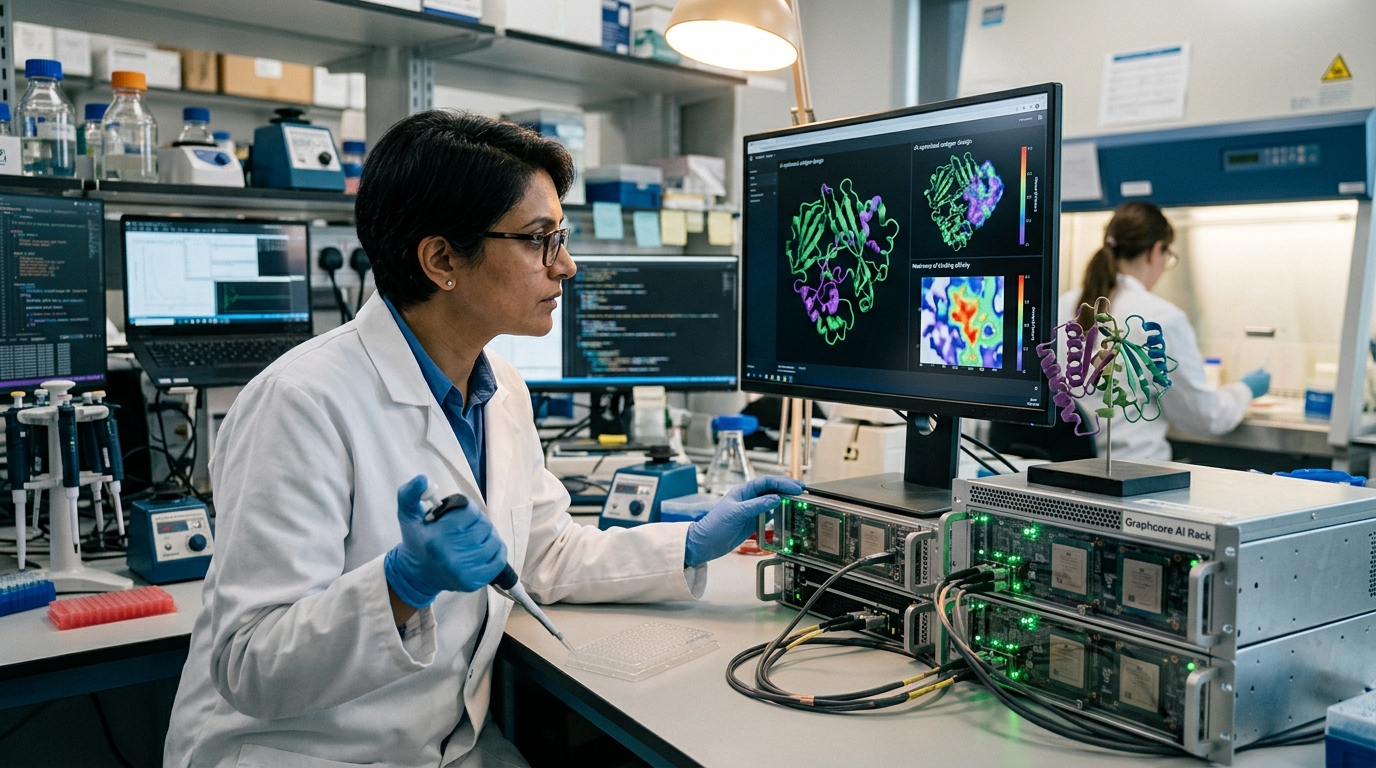
In the invisible realm of quantum mechanics, understanding the behavior of electrons within solids is the 'Holy Grail' of materials science. Recent advances in Machine Learning (ML) now promise to revolutionize how scientists analyze 'Fermi Surfaces' – the abstract yet critical boundaries in momentum space that dictate the electrical, magnetic, and thermal properties of metals and semiconductors.
Mapping the Quantum Landscape
A Fermi Surface is not a physical surface visible to the naked eye, but a mathematical construct in 'reciprocal space.' It separates occupied from unoccupied electron states at absolute zero temperature. Knowing the shape and topology of this surface allows physicists to predict whether a material will be a good conductor, an insulator, or a superconductor. However, mapping it experimentally through techniques like Angle-Resolved Photoemission Spectroscopy (ARPES) or Quantum Oscillations is a painstaking, time-consuming, and often imprecise process.
Traditionally, researchers had to rely on massive volumes of data containing significant noise, requiring weeks or even months of computational analysis to extract meaningful conclusions. This is exactly where Machine Learning steps in. By using sophisticated algorithms, scientists can now 'train' models to recognize patterns in sparse or noisy data, reconstructing the Fermi Surface with speed and precision that was unthinkable a decade ago.
The Technological Breakthrough: From Theory to Practice
The use of neural networks to analyze quantum systems is not merely an improvement of existing methodology; it is a fundamental paradigm shift. Researchers are now employing Deep Learning models that can interpolate data between experimental points, drastically reducing the number of measurements required. This means that beamtime at expensive facilities, such as modern synchrotrons, can be optimized to the fullest extent.
- Acceleration of Discovery: Faster analysis means new materials, such as high-temperature superconductors, can be identified much more quickly.
- Cost Reduction: The computational resources required to simulate electron density are reduced, allowing smaller laboratories to conduct cutting-edge research.
- Reliability: AI models can filter experimental noise more consistently than traditional statistical methods.
The key to success lies in the algorithms' ability to handle the 'curse of dimensionality.' Quantum states exist in high-dimensional spaces where classical equations often break down or become too complex to solve in a reasonable timeframe. Machine Learning, however, excels at finding structure within such multi-dimensional environments.
Toward Quantum Computing and Green Energy
The implications of this technology extend far beyond the walls of physics laboratories. Understanding Fermi Surfaces is crucial for developing new generations of semiconductors that will power more efficient computers, reducing global energy consumption. Furthermore, in the quest for quantum computing, precise knowledge of the electronic structure of materials is essential for creating stable qubits.
"We are not just improving how we see materials; we are changing what we can build with them," says one of the lead researchers on the project.
In the future, the integration of AI into condensed matter physics is expected to lead to 'autonomous laboratories,' where the system not only analyzes data but also suggests the next experiment to be conducted to fill gaps in our knowledge. This 'closed-loop' discovery could compress decades of research into just a few years.
Challenges and Ethical Considerations
Despite the excitement, the community remains cautious. One of the main issues is the 'black box' nature of Machine Learning. If an AI model predicts a specific shape for a Fermi Surface, physicists must be able to understand the *why* behind that prediction. The need for 'Explainable AI' in science is more pressing than ever, as blind trust in algorithms can lead to erroneous scientific conclusions.
In conclusion, the convergence of Machine Learning and Quantum Physics opens a new path for scientific progress. As models become more sophisticated and access to quality data increases, our ability to control matter at the quantum level will define the technological landscape of the 21st century.