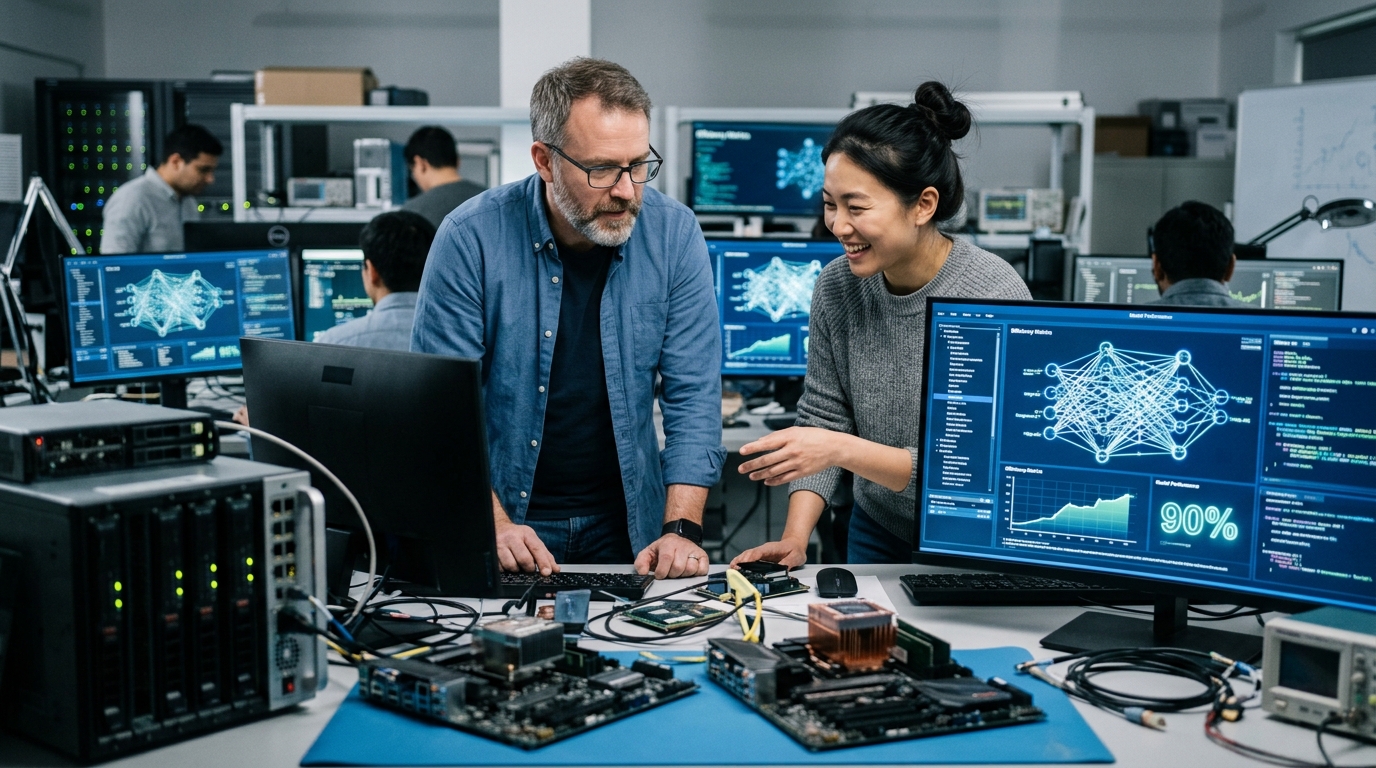
In the high-stakes world of Artificial Intelligence, where the prevailing narrative suggests that victory belongs to those with the most GPUs and the deepest pockets, DeepSeek AI has shattered the status quo. The Chinese research firm has achieved what many deemed impossible: building models that go toe-to-toe with OpenAI’s GPT-4 and Anthropic’s Claude 3.5 while using up to 90% fewer computational resources and tokens during training and inference. This is not merely a technical milestone; it is a structural paradigm shift, moving the focus from brute-force scaling to architectural elegance.
The Architectural Revolution: Multi-head Latent Attention (MLA)
The secret sauce behind DeepSeek’s staggering efficiency lies in its innovative approach to the 'attention' mechanism. Traditional Transformer models are notorious for their memory consumption, specifically the Key-Value (KV) cache, which grows linearly with sequence length. DeepSeek introduced Multi-head Latent Attention (MLA), a technique that drastically compresses the information the model needs to store. By projecting keys and values into a low-dimensional latent space, MLA allows the model to handle massive context windows without the exponential increase in memory costs.
This compression allows the model to 'remember' context more efficiently. In practice, DeepSeek can process complex, long-form queries using a fraction of the tokens a Google or Meta model would require. Crucially, this compression does not sacrifice nuance. Instead, it forces the model to focus on the most salient connections within the data, functioning more like a seasoned scholar taking concise notes than a novice trying to memorize a textbook word-for-word.
DeepSeekMoE: Redefining the Mixture-of-Experts
Another pillar of their success is the refined Mixture-of-Experts (MoE) architecture. Rather than activating the entire neural network for every word generated, DeepSeekMoE utilizes only a small subset of parameters—the 'experts'—best suited for the task at hand. DeepSeek’s innovation lies in its 'Shared Expert' strategy.
- Shared Experts: These capture fundamental, universal knowledge required for almost any task, reducing redundancy across the network.
- Routed Experts: These are specialized units triggered only when the input requires specific expertise, such as Python coding or advanced calculus.
This granular control allows a model to have hundreds of billions of total parameters while only 'firing' a tiny percentage of them at any given moment. The result is a system with the intelligence of a giant but the operational footprint of a much smaller model.
Economic Shockwaves and Geopolitical Strategy
Perhaps the most disruptive aspect of DeepSeek is its training economics. While industry rumors suggest OpenAI spent upwards of $100 million to train GPT-4, DeepSeek reported that its V3 model was trained for less than $6 million in direct compute costs. This order-of-magnitude difference changes the rules of the game. It proves that AI supremacy is no longer the exclusive domain of Silicon Valley titans with bottomless capital reserves.
"DeepSeek has proven that architectural ingenuity can defeat the brute force of GPU clusters," noted one industry analyst.
For China, DeepSeek’s success is a major strategic win, particularly in the face of US-led export restrictions on high-end silicon like Nvidia’s H100s. If Chinese labs can produce equivalent results using 10 times less hardware, the efficacy of tech sanctions is significantly blunted. DeepSeek isn't just providing an alternative; it is challenging the West to rethink its entire R&D investment strategy, which has largely relied on 'throwing more hardware at the problem.'
The Future: Open-Source and the Democratization of Intelligence
DeepSeek’s decision to release many of its models as open-source further amplifies its impact. Smaller enterprises and independent researchers can now run GPT-4-level models on their own infrastructure without being tethered to expensive proprietary APIs. This democratization is expected to spark a new wave of innovation in sectors like biotech, education, and cybersecurity, where data privacy and cost were previously insurmountable barriers.
In conclusion, DeepSeek AI is more than just another player in the market. It is the herald of a new era where efficiency is the primary currency. As the industry matures, the ability to produce 'more thought per watt' will determine who leads the next digital revolution. The era of mindless scaling is ending; the era of intelligent architecture has begun.