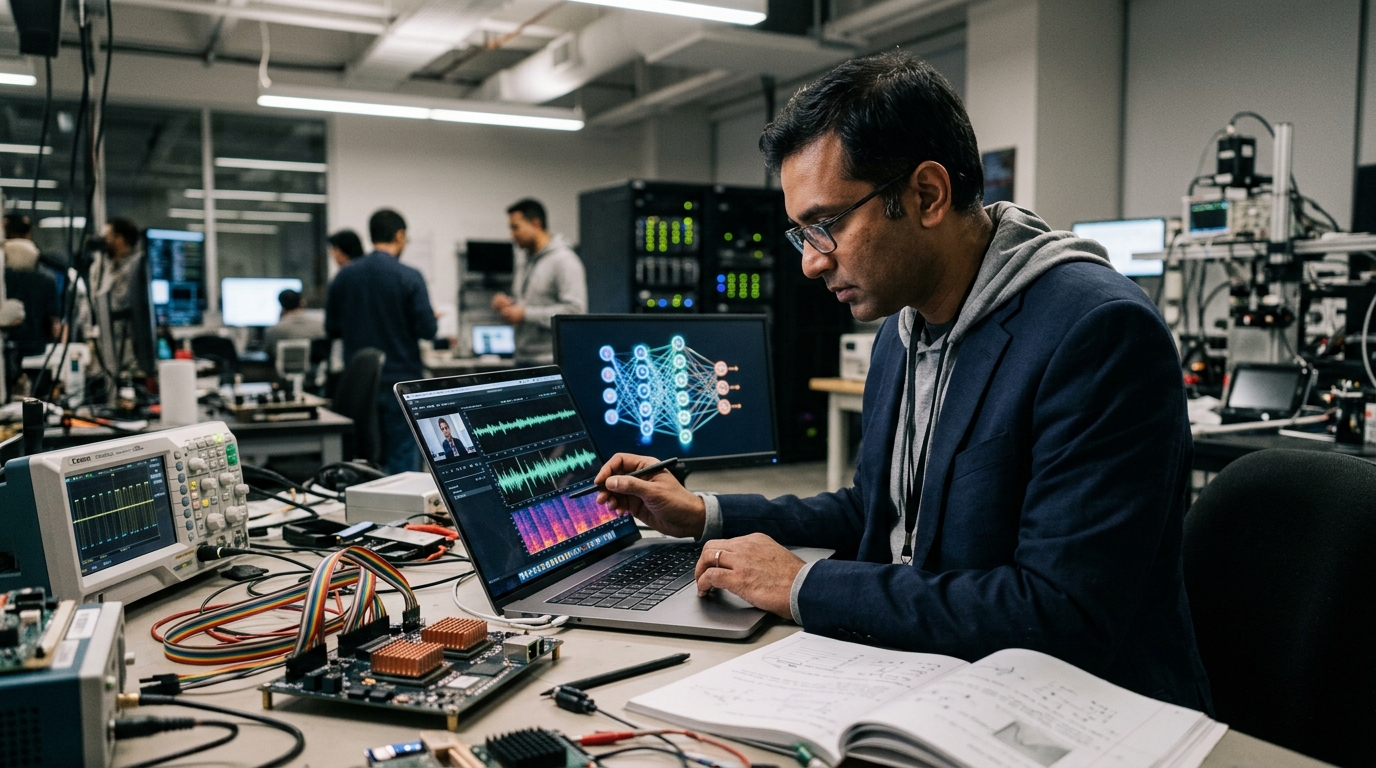
In an era where cloud dominance seemed unassailable, Google has made a strategic move that redefines the boundaries of local computing power. The announcement of Gemma 4 12B is not merely an addition to the company's open-weights lineup; it is a clear statement of intent regarding the future of "personal" artificial intelligence. With 11.95 billion parameters and an Apache 2.0 license, the new model promises to bring multimodal data analysis—audio, video, and text—directly to enterprise laptops without requiring a single byte to be sent to remote servers.
The Architecture of Efficiency
Gemma 4 12B is the refined essence of Google's experience developing the Gemini series. Despite its relatively small size by 2026 standards, the model utilizes a sophisticated Mixture-of-Experts (MoE) architecture, allowing it to activate only the necessary parts of the network for each task. This translates to exceptionally low memory requirements without sacrificing response quality. The fact that it can run comfortably on a standard enterprise laptop with 16GB of RAM opens the door for millions of developers who were previously constrained by the cost of cloud APIs or the complexity of local setups.
"The ability to process sensitive corporate data, such as meeting recordings or security footage, locally on your own infrastructure is a paradigm shift for cybersecurity," says a Google Research lead.
Multimodality Without the Cloud
The true innovation of Gemma 4 12B lies in its native ability to perceive the world beyond text. While previous models of similar size were limited to text-to-text functions, Gemma 4 can "listen" to an audio file for transcription or summarization, and "see" a video to describe the actions taking place. This is achieved through a unified tokenizer that processes different data modalities within the same latent space. For the global market, this means enterprises can deploy customer service tools or content analysis systems with zero inference costs and full data sovereignty, as information never leaves the local machine.
Strategic Rivalry: Open Weights vs. Open Source
It is crucial to distinguish: Gemma 4 is not "open source" in the traditional sense, as the training data and full algorithmic code remain Google's proprietary secrets. However, providing the "weights" allows for complete customization and fine-tuning by the community. This move is a direct response to Meta’s Llama 4, as Google strives to dominate the developer ecosystem. By offering a model that is both powerful and lightweight, Google ensures its technology will be the foundation for the next generation of AI applications running on edge devices and PCs.
Implications for Work and Privacy
The shift to on-device AI has profound social implications. On one hand, it bolsters user privacy, as AI becomes a personal assistant that "lives" on one's device and reports to no one. On the other hand, the ease with which massive amounts of multimodal data can now be analyzed locally raises questions about the technology's use in surveillance. Google, acknowledging these risks, has integrated strict safety filters into Gemma 4, though these can potentially be bypassed by malicious actors who modify the weights. The challenge for 2026 remains: how to maintain the freedom of innovation while protecting the public sphere.