For decades, the issue of UFOs (Unidentified Flying Objects) lingered on the fringes of serious scientific discourse, trapped between blurry photographs, urban legends, and government secrecy. However, 2026 finds humanity at a pivotal juncture. Their rebranding as UAPs (Unidentified Anomalous Phenomena) was not merely a linguistic shift to avoid stigma; it was a statement of intent: science, and specifically Artificial Intelligence (AI), is now taking the lead in research.
The Transition from Mystery to Data Science
The core challenge in UAP research has always been data quality. Eyewitness accounts, even from seasoned pilots, are subjective and prone to perceptual errors. Radars and sensors on fighter jets often record anomalies that may result from software glitches or atmospheric conditions. This is precisely where Artificial Intelligence steps in. With its ability to process vast amounts of data in real-time, AI can distinguish the 'signal' from the 'noise'.
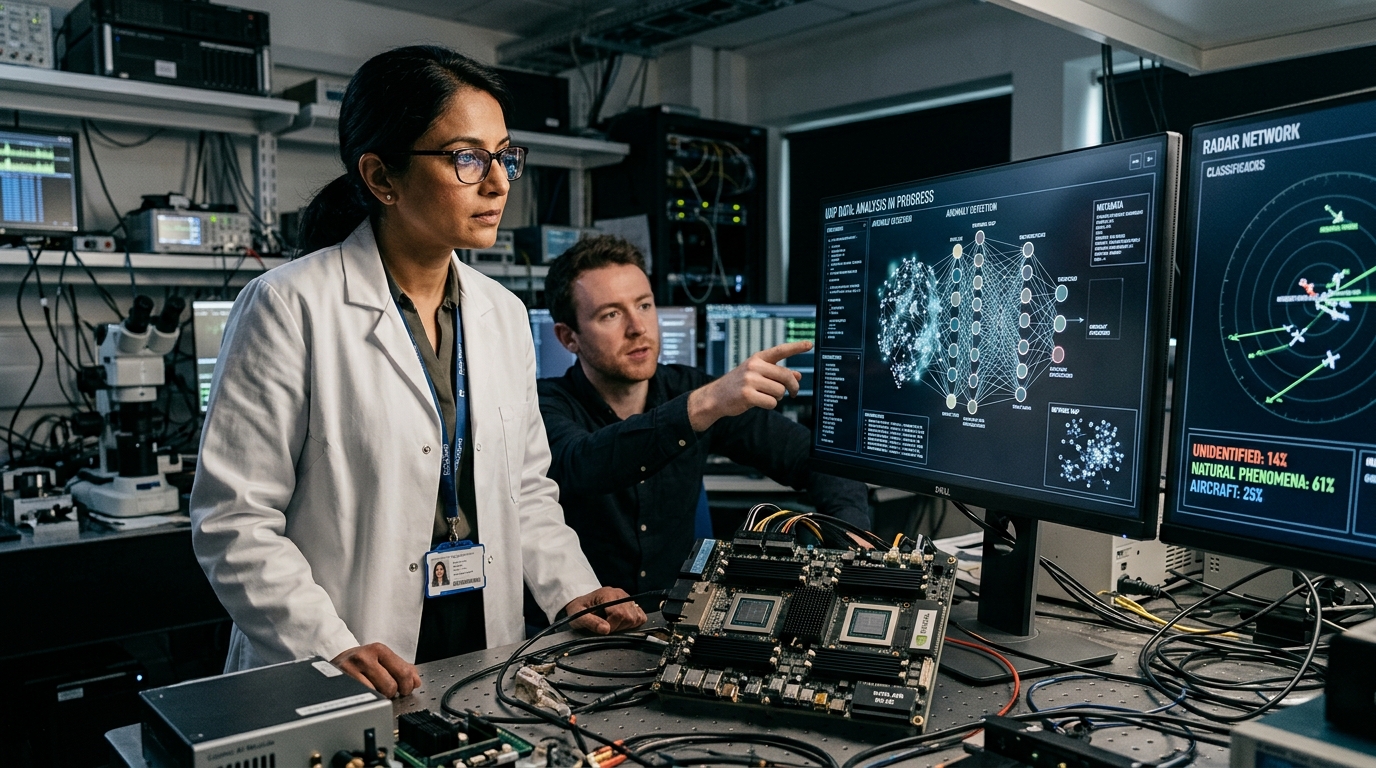
Today, NASA and the Pentagon employ advanced machine learning algorithms to analyze decades of historical records. These algorithms can identify movement patterns that defy known laws of aerodynamics, such as instantaneous acceleration or direction changes without inertia. AI doesn't 'believe' in aliens; it looks for deviations from the expected. When an object emits no thermal signature or lacks visible means of propulsion, AI categorizes it as an anomaly, allowing scientists to focus their attention where a true mystery exists.
The Role of Multispectral Analysis
One of the most important tools in the AI toolkit is multispectral analysis. By combining data from optical cameras, infrared sensors, radar, and satellite imagery, AI can create a three-dimensional representation of a phenomenon. In the past, a bright spot in the sky could be interpreted in dozens of ways. Today, AI can compare that spot with thousands of recorded signatures from drones, weather balloons, birds, or even the planet Venus.
Furthermore, the use of AI enables the elimination of human bias, specifically pareidolia—the human brain's tendency to see familiar shapes in random stimuli. Computer vision algorithms analyze pixels with mathematical precision, determining if an object is solid, whether it has mass, and if its movement is affected by air resistance. This objectivity is what transforms UAPs from tabloid fodder into a subject of study for the world's leading universities.
Geopolitics and National Security
Beyond the existential quest for whether we are alone in the universe, AI-driven UAP research has a deeply practical dimension: national security. In a world where hypersonic weapons and autonomous drones are becoming the norm, a nation's ability to instantly identify what is flying in its airspace is critical. AI functions as an advanced early warning system. If a UAP turns out to be top-secret technology from a rival state, AI is what will help decode its capabilities.
However, transparency remains the great challenge. While AI can process the data, the decision to release it remains political. Pressure from the scientific community for 'open data' is mounting. Initiatives like Harvard's Galileo Project, led by Professor Avi Loeb, utilize AI-controlled sensor networks that are entirely independent of government restrictions. This democratization of research means that the truth, whatever it may be, can no longer be hidden behind the seal of 'classified'.
Conclusion: Towards a New Understanding
Artificial Intelligence is not a 'magic wand' that will deliver a photograph of an alien craft tomorrow. It is, however, the magnifying glass we needed to see reality without distortion. Whether UAPs prove to be natural phenomena we didn't understand, advanced human technology, or something truly exotic, AI is the tool that will allow us to move from speculation to knowledge. Ultimately, the search for UAPs is a search for the limits of our own science, and AI is our guide on this unknown path.