In the rapidly shifting landscape of Artificial Intelligence, the emergence of DeepSeek V4 is not merely another model iteration; it is a strategic declaration of independence and technical ingenuity. DeepSeek, an entity that has managed to stand toe-to-toe with Silicon Valley giants, introduces a Mixture-of-Experts (MoE) architecture that redefines the concept of efficiency. In an era where access to premium Nvidia hardware is throttled by geopolitical tensions, DeepSeek turns to Huawei's Ascend infrastructure, proving that software innovation can compensate for hardware bottlenecks.
The DeepSeekMoE and MLA Architecture: The Heart of Efficiency
The core innovation of DeepSeek V4 lies in its sophisticated implementation of the Mixture-of-Experts architecture. Unlike traditional "dense" models where every parameter is activated for every word, MoE activates only a small subset of "experts" per token. This allows the model to possess hundreds of billions of parameters while maintaining the computational overhead of a much smaller system.
However, the true breakthrough is Multi-head Latent Attention (MLA). Managing the Key-Value memory (KV cache) has long been the primary obstacle to expanding the context window. MLA drastically compresses this memory, enabling DeepSeek V4 to handle million-token contexts without a collapse in system performance. This is critical for applications such as analyzing entire codebases or processing extensive legal documents, where maintaining coherence over long distances of text is non-negotiable.
Huawei Ascend: The Domestic Answer to Nvidia
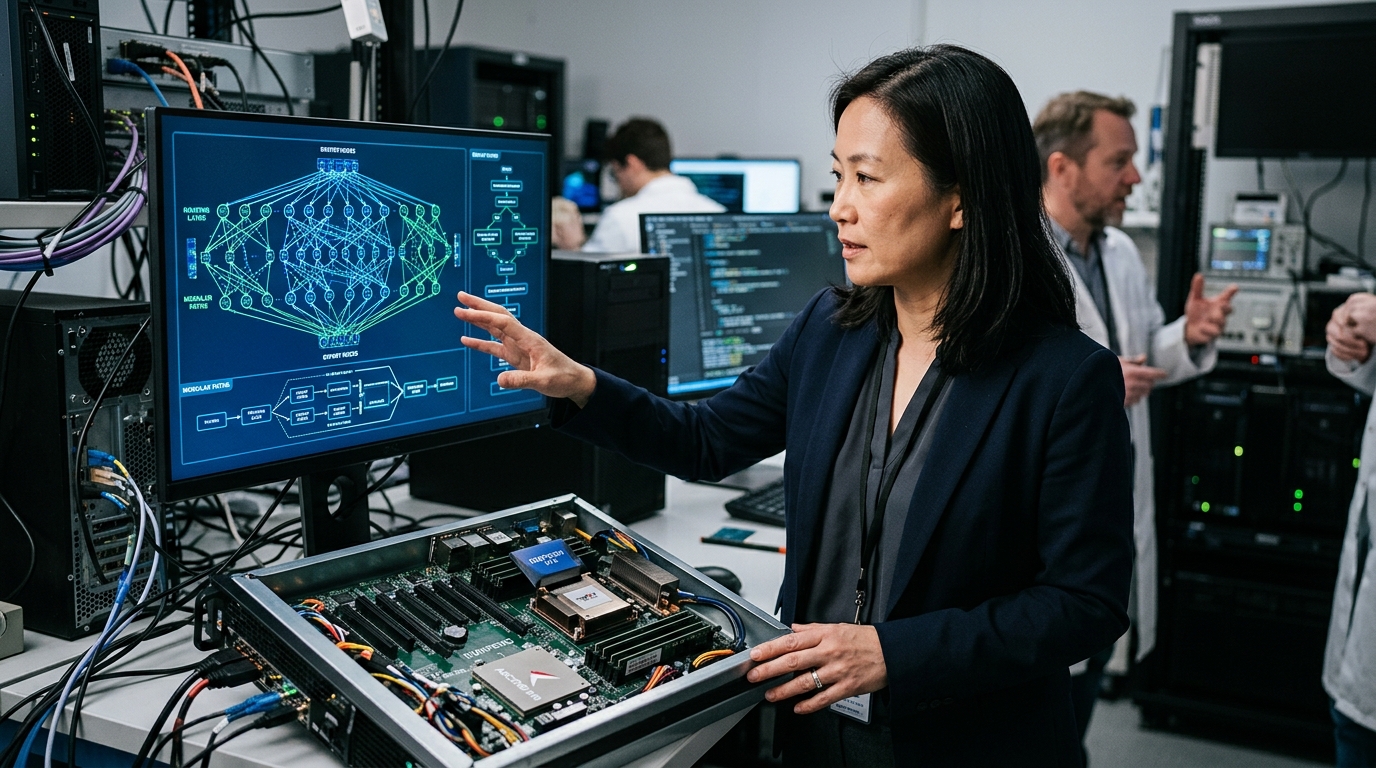
An analysis of DeepSeek V4 is incomplete without addressing the Huawei Ascend infrastructure. Driven by US sanctions, the Chinese AI industry has been forced to seek alternatives to Nvidia's GPUs. The Ascend 910B series and the upcoming 910C form the backbone of DeepSeek's training clusters. The challenge here is not just raw compute power, but the surrounding software ecosystem.
DeepSeek has optimized its kernels specifically for Huawei’s NPU (Neural Processing Unit) architecture. This "vertical integration" allows the model to maximize available memory bandwidth and inter-node communication. By employing techniques like FP8 quantization, DeepSeek manages to run massive models on hardware that, on paper, might trail behind Nvidia’s H100s, but in practice delivers exceptional results through specialized tuning.
The Million-Token Barrier and Inference Efficiency
The ability to process a million tokens is no longer a luxury but a requirement for next-generation AI. DeepSeek V4 achieves this milestone through a hybrid approach. By utilizing DeepSeekMoE, the model can route information such that searching through a massive context window does not require a linear increase in resources.
- KV Cache Compression: Reduces memory requirements by up to 90% compared to standard Multi-Head Attention.
- Sparse Computation: Only 5-10% of parameters are activated per inference pass, saving energy and time.
- Hardware-Aware Mapping: MoE experts are strategically distributed across Ascend NPU cores to minimize latency and maximize throughput.
This focus on inference efficiency is what makes DeepSeek V4 commercially viable. While other models require entire server clusters to answer a single complex query, DeepSeek aims to lower the cost per token, making high-end AI accessible to enterprises without the multi-billion dollar budgets of Microsoft or Google.
Geopolitical Implications and the Future of Open Weights
The success of DeepSeek V4 sends a clear message to the international community. Efforts to curb China's technological rise through semiconductor export controls appear to have an unintended side effect: accelerating innovation at the algorithmic level. When resources are constrained, ingenuity becomes the primary source of power.
Furthermore, DeepSeek’s commitment to the "open weights" model creates a new paradigm. As OpenAI and Google become increasingly opaque, DeepSeek offers its tools to the global community, gaining the trust of developers worldwide. This strategy is not merely altruistic; it is deeply political, positioning Chinese technology at the center of the global AI ecosystem, regardless of trade wars.
Conclusion: A New Balance of Power
DeepSeek V4 represents the maturation of the Chinese AI scene. It is no longer about replicating Western benchmarks, but about introducing original architectural solutions that address global challenges in compute power and energy consumption. The marriage of MoE architecture with Huawei infrastructure proves that the future of AI will not be decided solely by who has the most chips, but by who can use them the most intelligently.