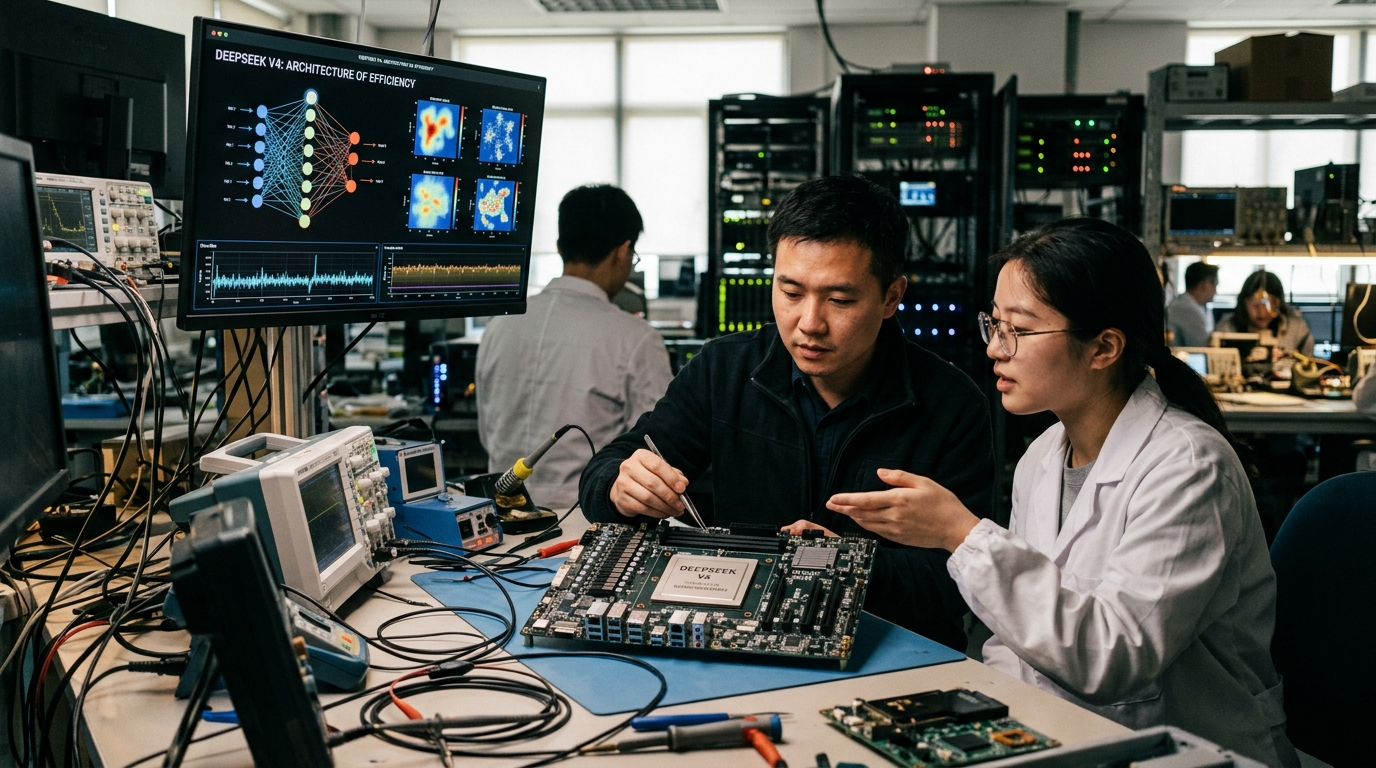
In the rapidly shifting landscape of Artificial Intelligence, China's DeepSeek has managed to establish itself not through brute computational force, but through an almost obsessive focus on architectural efficiency. The announcement of DeepSeek V4 marks a pivotal moment for the industry, promising drastic reductions in operational costs, enhanced performance, and, most importantly, unprecedented optimization for autonomous AI Agents. This move is not merely a technical upgrade; it is a strategic challenge to Western tech giants, proving that intelligence does not necessarily require nation-state-level budgets.
The Architecture of Economy: MLA and DeepSeekMoE
DeepSeek V4 is built upon the evolution of two core technological pillars that made its predecessors stand out: Multi-head Latent Attention (MLA) and DeepSeekMoE (Mixture-of-Experts). The MLA architecture allows the model to manage massive context windows with a fraction of the memory required by traditional Transformer models. This means V4 can "remember" and process entire code libraries or lengthy legal documents without causing inference costs to skyrocket.
Simultaneously, the DeepSeekMoE system has been further refined. In V4, parameter allocation is handled with such precision that only a small percentage of the model is activated for any given query. This "sparse" activation allows the model to boast hundreds of billions of parameters theoretically, while in practice consuming energy equivalent to a much smaller model. For enterprises, this translates into a simple equation: top-tier performance at a price point that enables broad AI application scaling.
"Efficiency is no longer an option, but the only path for the sustainable development of AI. V4 proves we can have GPT-5 level models with the operating costs of GPT-3.5," industry analysts note.
Agentic Optimization: From Chat to Action
Perhaps the most significant innovation of DeepSeek V4 lies in its focus on "Agentic" intelligence. While previous models focused on text generation, V4 has been specifically trained to interact with external tools, write and execute code in real-time, and solve multi-step problems without human intervention.
- Multi-step Planning: V4 can break down complex goals into smaller, manageable tasks.
- Automated Code Correction: It features built-in verification mechanisms that allow it to identify errors in its own code suggestions before delivering them to the user.
- Tool Integration: The ability to use APIs and external databases is now more seamless, reducing hallucinations during task execution.
This shift toward AI Agents is critical. In the current economic environment, companies aren't just looking for a chatbot, but a digital collaborator that can manage customer service, data analysis, or software development autonomously. DeepSeek V4 positions itself as the ideal "engine" behind these agents.
Geopolitics and Open Weights
The rise of DeepSeek also carries a strong political dimension. As a Chinese company, DeepSeek operates under the shadow of US semiconductor export restrictions. Rather than being a hindrance, this limitation has acted as a catalyst for innovation in algorithmic efficiency. V4 is the result of the necessity to achieve more with fewer resources.
Furthermore, DeepSeek's strategy of releasing model weights (open weights) has created a powerful competitive pole against the closed systems of OpenAI and Google. The global developer community is adopting DeepSeek V4 to build specialized applications, strengthening the company's ecosystem and making it a de facto standard for cost-effective inference. The success of V4 highlights that the center of gravity in AI research is shifting, with China now leading in applied efficiency.
Conclusions for the Future
DeepSeek V4 is not just another model on a benchmark list. It is a statement of intent. As energy and chip costs remain high, the ability to produce high intelligence at a low cost will be the deciding factor for the survival of AI companies. DeepSeek seems to have cracked the code of sustainability, offering a tool that is simultaneously powerful, affordable, and ready for the era of AI Agents. The question is no longer whether China can catch up to the West in AI, but whether the West can keep up with the efficiency benchmarks set by DeepSeek.