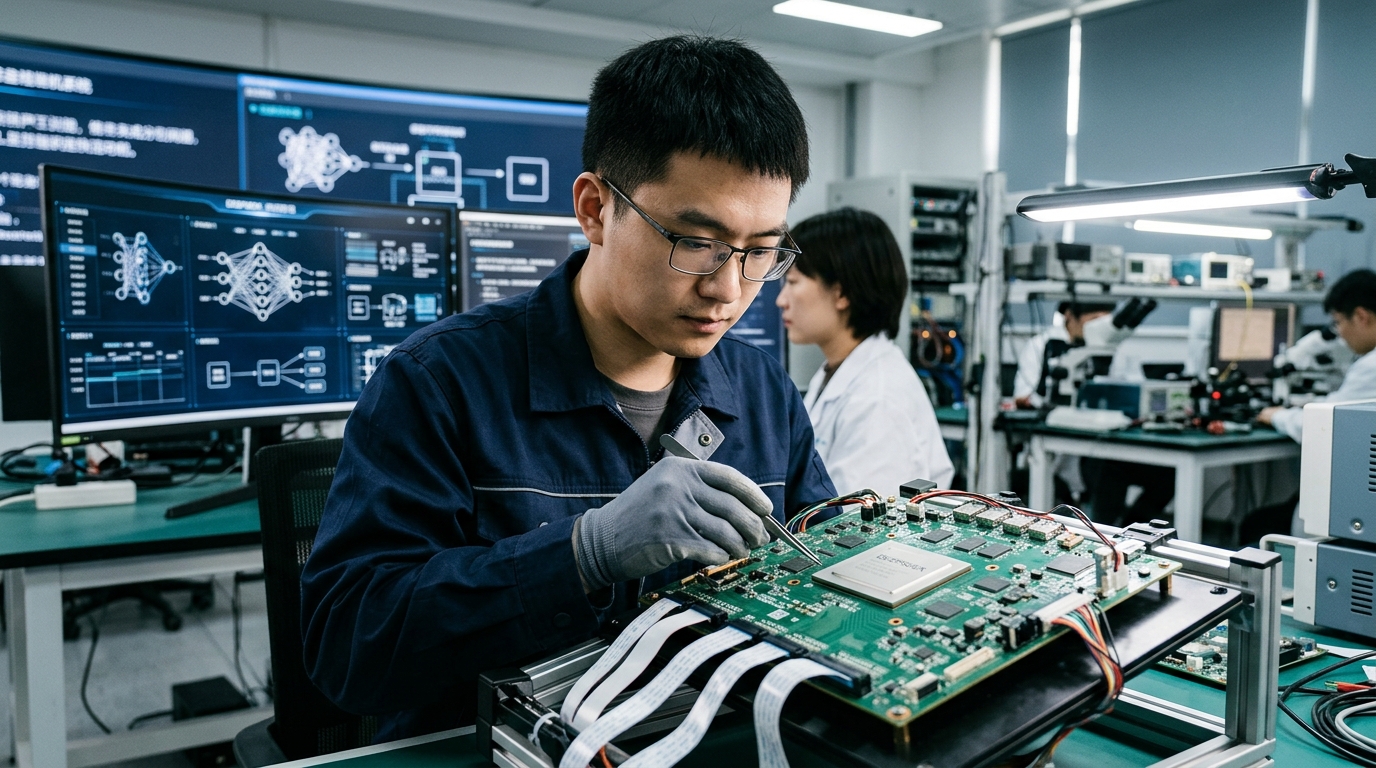
In a move poised to reshape the global artificial intelligence landscape, DeepSeek has announced the release of its V4 model series. This latest iteration is not merely an incremental update; it represents a fundamental reimagining of Large Language Model (LLM) architecture, prioritizing extreme efficiency and strategic autonomy. With memory requirements slashed by 9.5 times compared to its predecessors, DeepSeek V4 promises to bring top-tier intelligence to hardware previously deemed inadequate.
The Architecture of Efficiency: How 9.5x Was Achieved
The staggering reduction in memory footprint is the result of deep-seated innovations in Mixture-of-Experts (MoE) frameworks and quantization techniques. DeepSeek has implemented a novel approach to KV cache management, which is often the primary bottleneck in scaling models for long-context windows. By utilizing Multi-head Latent Attention (MLA) and advanced weight compression algorithms, V4 allows models with hundreds of billions of parameters to run on consumer-grade hardware or older generation GPUs.
This development is a critical milestone for AI democratization. While industry leaders like OpenAI and Google focus on scaling compute through massive clusters of Nvidia H100 and Blackwell chips, DeepSeek is carving a path of "smart frugality." The ability to run a GPT-4 class model with one-tenth of the memory means inference costs drop dramatically, making high-end AI accessible to smaller enterprises and research institutions that lack billion-dollar infrastructures.
The Huawei Alliance: Breaking the Nvidia Monopoly
Perhaps the most strategically significant aspect of the release is the native and optimized support for Huawei Ascend processors. Amidst tightening US trade restrictions, China has been aggressively seeking ways to develop its AI ecosystem independently of Western silicon. The seamless integration with Ascend 910B and newer Huawei models demonstrates that software is now being tailored to fit available domestic hardware, effectively bypassing the impact of sanctions.
Industry analysts note that optimizing for Huawei chips is more than a technical choice—it is a political statement. DeepSeek is proving that the Chinese AI industry can thrive without Nvidia. Performance benchmarks for V4 on Ascend hardware are reportedly nearing, and in some cases exceeding, the performance of similar models on Nvidia A100s. This marks a pivotal moment for Chinese technological self-reliance.
Geopolitical Implications and the Race with the West
The launch of DeepSeek V4 comes at a time when the concept of "Sovereign AI" is gaining traction globally. A nation's ability to train and deploy models on its own hardware is now viewed as a matter of national security. DeepSeek, while positioned as an independent research lab, operates within an environment that aligns with China's national strategy for technological leadership by 2030.
- Reduced reliance on GPU imports.
- Strengthening the domestic cloud computing market.
- Creating an alternative AI standard for Global South nations.
Furthermore, DeepSeek's open-weights strategy (or semi-open approach) is forcing American tech giants to re-evaluate their positions. If a free or highly affordable model from China offers comparable quality to the proprietary models of the West, the commercial moat of closed-source AI will be significantly challenged.
Conclusion: A New Era of Ubiquitous AI
DeepSeek V4 is not just a triumph of engineering; it is a harbinger of an era where AI will be ubiquitous not because of resource abundance, but because of code efficiency. The focus on memory optimization and alternative hardware support suggests that the road to Artificial General Intelligence (AGI) may not necessarily lead through TSMC's fabrication plants and Nvidia's blueprints, but through radical innovation in algorithmic architecture.