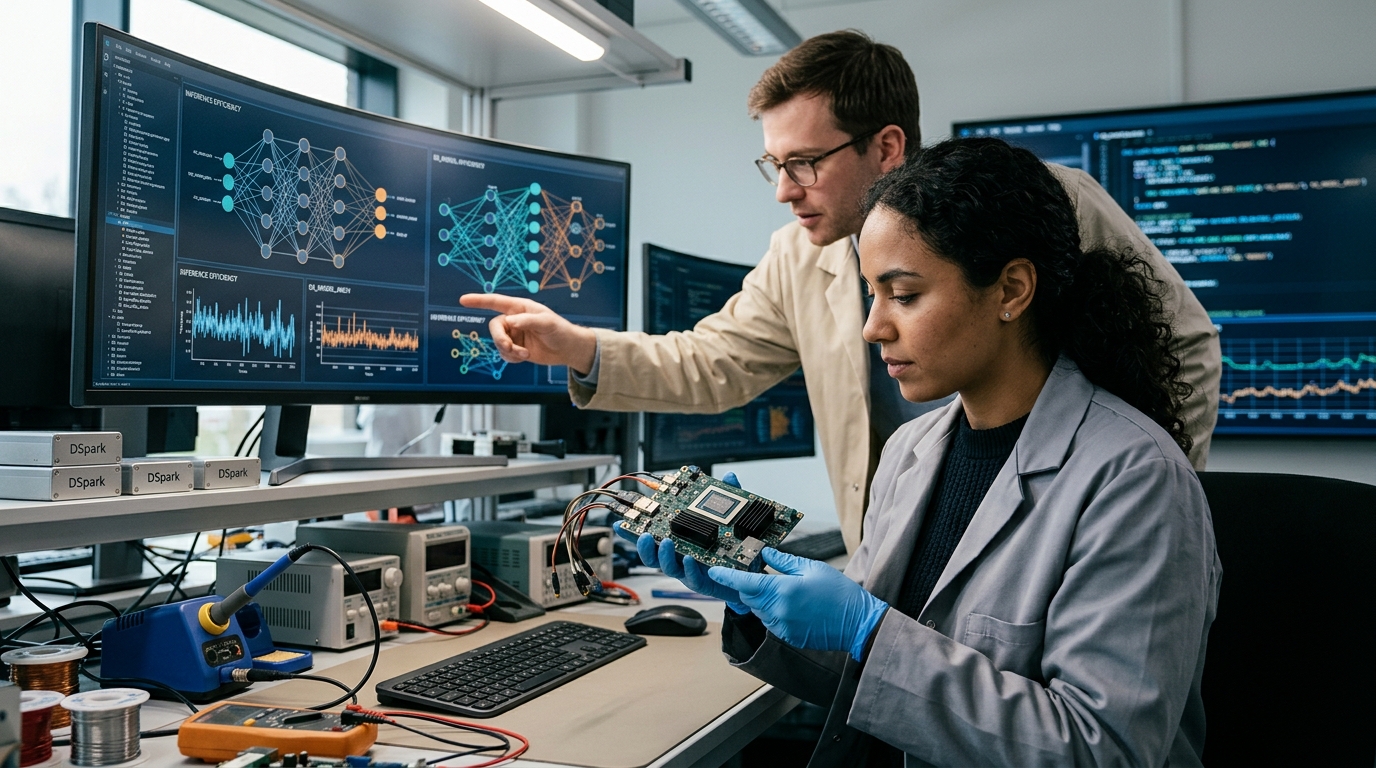
In an era where computational power has become the new "digital oil," DeepSeek AI has issued an announcement that is sending shockwaves through Silicon Valley. The unveiling of DSpark, an inference optimization framework, promises to drastically reduce latency and operational costs for Large Language Models (LLMs), achieving performance gains of 60% to 85% over current industry standards.
DeepSeek, which has already garnered global acclaim with models like DeepSeek-V3, appears to be pivoting toward a strategy of "architectural frugality." While American giants like OpenAI and Google invest billions into increasingly massive GPU clusters, DeepSeek is choosing the path of mathematical and programmatic elegance to unlock speed without the need for additional hardware.
The Technology Behind DSpark
DSpark is not merely a compression algorithm; it is a comprehensive overhaul of how data flows through neural networks during the generation phase. The optimization focuses on three primary pillars:
- Dynamic KV Cache Management: It reduces the memory footprint by allowing the model to retain only the most contextually relevant information, preventing memory overflow in long conversations.
- Parallel Decoding Patterns: This enables the simultaneous processing of multiple segments of a response, breaking the traditional serial bottleneck inherent in the Transformer architecture.
- Kernel-Level Optimization: Custom low-level code designed to extract maximum performance from Nvidia architectures, as well as emerging alternative hardware.
According to technical specifications released by the lab, DSpark manages to keep model accuracy virtually intact. This is the "holy grail" of AI development: speed without the sacrifice of intelligence. In real-world testing, latency was reduced so significantly that responses now appear instantaneous to the human eye.
Geopolitics and the Efficiency Race
DeepSeek’s move carries profound political weight alongside its technical merit. With US restrictions on the export of advanced AI chips to China remaining stringent, Chinese firms are being forced to innovate under pressure. DSpark is a direct byproduct of this environment. When you cannot purchase more GPUs, you must make the ones you have work twice as hard.
"DeepSeek is proving that AI innovation is no longer the exclusive domain of those with the deepest pockets, but rather those with the sharpest insights," noted a recent industry analysis.
This "do more with less" philosophy could shift the global balance of power. If the cost of running AI drops by 80%, the adoption of these technologies by small-to-medium enterprises and developing economies will accelerate, potentially bypassing the expensive subscription models currently dominated by Western corporations.
The Future of Inference-as-a-Service
The introduction of DSpark is expected to exert massive downward pressure on prices within the Cloud Computing market. Companies providing API access to AI models will face a stark choice: either adopt similar optimization frameworks or lose market share to DeepSeek and its ecosystem. The economic logic is undeniable: faster inference translates to less GPU compute time, leading to lower energy consumption and maintenance costs.
In conclusion, DSpark represents a pivotal milestone for 2026. It is not just a software update; it is a declaration of intent. Artificial Intelligence is entering a phase of maturity where brute force is being replaced by efficiency. DeepSeek is no longer just keeping pace with the industry leaders—it is setting the tempo.