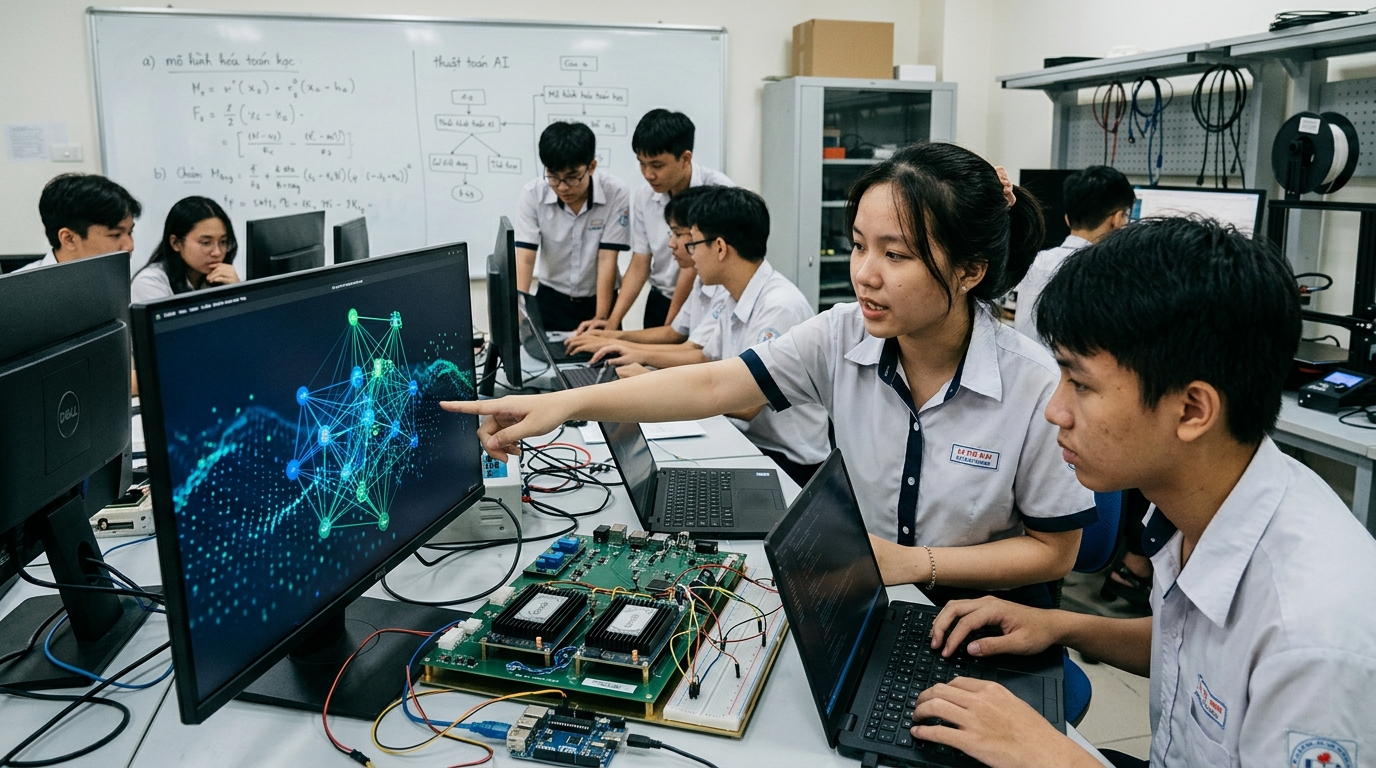
In an era where Artificial Intelligence (AI) is frequently portrayed as a threat to academic integrity, a burgeoning trend from Vietnam is flipping the narrative. High school students in the Southeast Asian nation are no longer using AI merely to automate their homework; they are deploying it as a sophisticated tool for mathematical modeling to tackle real-world social and environmental issues. This evolution signals a profound shift in how the next generation approaches Science, Technology, Engineering, and Mathematics (STEM).
From Theory to Applied Intelligence
Mathematical modeling has traditionally been seen as the pinnacle of secondary education, requiring a deep grasp of calculus and statistics. However, the integration of AI has fundamentally changed the rules of engagement. According to recent reports from educational bodies in Vietnam, students are now utilizing machine learning libraries and Large Language Models (LLMs) to analyze vast datasets that were previously impossible to process in a high school setting.
For instance, student teams have developed models to predict traffic congestion in Ho Chi Minh City, utilizing algorithms that factor in variables such as weather patterns, peak hours, and historical accident data. Others are focusing on environmental sustainability, creating AI models that simulate the dispersion of air pollution in urban corridors. This pivot from abstract theory to practical application demonstrates that AI is not just a 21st-century calculator, but a collaborative partner in creative problem-solving.
Vietnam's Strategic Advantage
This success is no accident. Vietnam has systematically invested in digital education, aiming to become a regional technology hub by 2030. National curricula have begun integrating computer science and data analysis at an early stage, equipping students with the skills to handle tools like Python and TensorFlow before they even graduate high school.
- Enhancing critical thinking by selecting appropriate algorithmic architectures.
- Familiarizing students with data ethics and privacy protection.
- Preparing for a global labor market that demands high-level AI literacy.
What makes the Vietnamese case stand out is the students' ability to blend traditional mathematical rigor—an area where the country consistently excels globally—with modern computational power. As experts note, AI allows students to bypass the tedious manual calculations and focus on hypothesis formulation and the interpretation of results.
Challenges and the 'Black Box' Phenomenon
Despite the palpable excitement, the use of AI in modeling is not without its hurdles. A primary concern among educators is the so-called 'black box' phenomenon. There is a risk that students might blindly trust an algorithm's output without understanding the underlying mathematical logic. If a student cannot explain why a model produced a specific result, the pedagogical value of the exercise is significantly diminished.
"AI is an excellent servant but a poor master. Our goal is to teach students how to control the tool, not be controlled by it," says a computer science instructor from Hanoi.
Furthermore, the issue of resource accessibility remains critical. While students in major urban centers have access to high-performance computing and high-speed internet, their peers in rural provinces may be left behind, potentially widening the digital divide. The government and various NGOs are attempting to mitigate this through 'AI for All' initiatives, but full equity in opportunity remains a long-term goal.
Implications for the Future of Education
The Vietnamese experience offers a valuable lesson for the global community. AI in education should not be viewed solely as an automation tool, but as a catalyst for problem-solving. When students are empowered to model the world around them, they simultaneously gain the confidence that they can change it. The transition from being a passive consumer of technology to an active creator of algorithms is perhaps the most significant educational revolution of the 21st century.