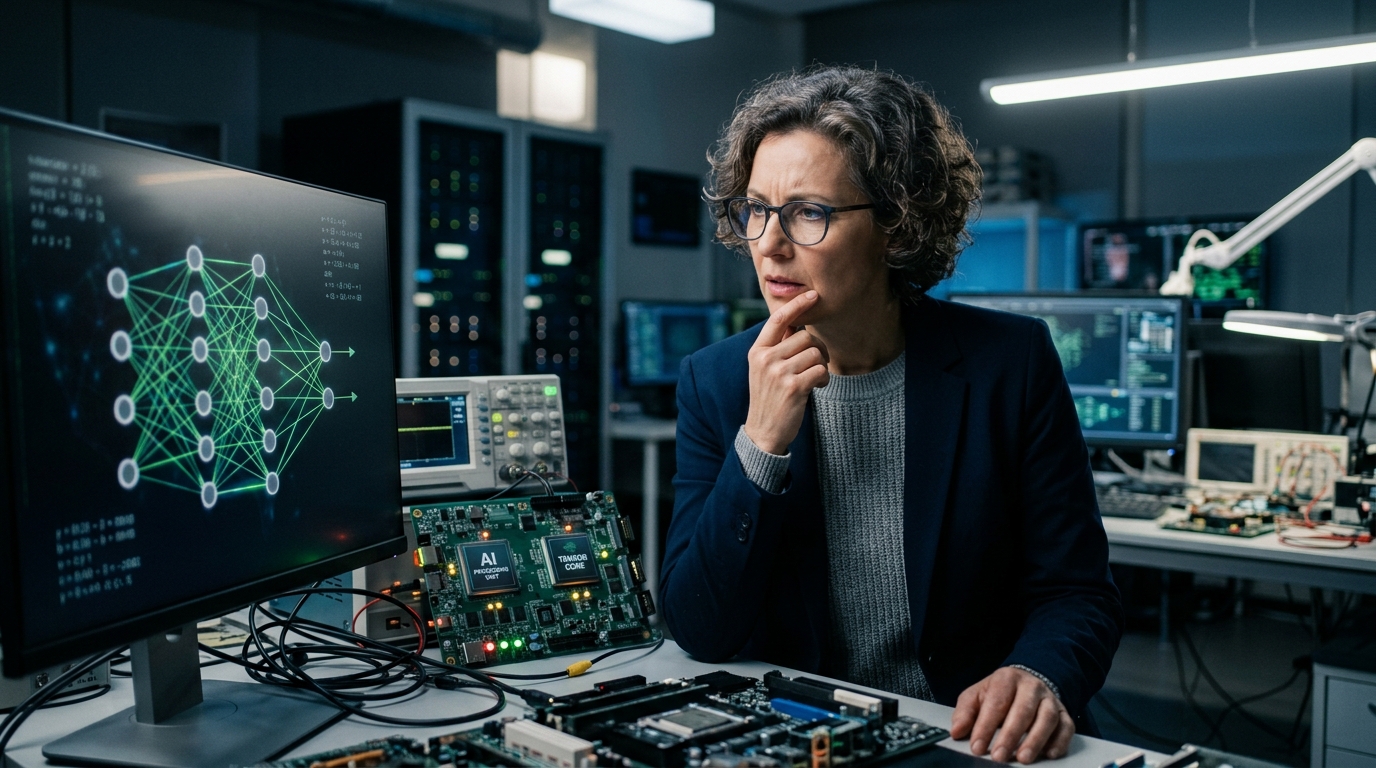
In the modern technological landscape, there is a pervasive belief that Artificial Intelligence (AI) represents a superior form of logic, a digital entity that transcends human cognitive limitations. However, users interacting daily with models such as ChatGPT, Claude, or Gemini often encounter a paradox: the same system that can analyze Kantian philosophy or write complex Python code can fail miserably at comparing two decimal numbers or counting how many 'r's are in the word 'strawberry'.
This phenomenon, often described as 'mathematical hallucination,' is not a mere software bug that can be fixed with a simple patch. It is a structural feature of how Large Language Models (LLMs) operate. Understanding why AI makes mathematical errors is essential for calibrating our expectations and safely integrating these tools into education and the economy.
The Architecture of Probability vs. Logic
The fundamental problem lies in the fact that LLMs are not 'calculation engines' but 'prediction engines.' When we ask an AI to solve an equation, it does not perform mathematical operations in an internal processor the way a calculator does. Instead, it attempts to predict the most likely next word (or symbol) based on its training data. If it has seen thousands of times that '2+2' is followed by '4', it will answer correctly. However, if asked for a complex multiplication that was not explicitly in its training set, its probabilistic nature might lead it to a result that 'looks' correct but is mathematically flawed.
Furthermore, there is the issue of 'tokenization.' AI models do not read text letter-by-letter or number-by-number. They convert inputs into 'tokens,' which can be entire words or fragments of them. Often, numbers are sliced in ways that make arithmetic logic impossible. For instance, the number '1534' might be recognized as two separate tokens ('15' and '34'), preventing the model from perceiving its true numerical value during the calculation process.
The 'Strawberry' Paradox and the Lack of Semantic Understanding
One of the most discussed recent examples was the inability of many models to correctly count letters in simple words. This happens because AI does not 'see' the word as a human does. To an AI, the word 'strawberry' is a single vector in a multidimensional space. It has no visual contact with individual letters unless forced through specific techniques (like Chain of Thought) to analyze the word step-by-step.
This lack of true understanding extends to word-based mathematical problems. AI can be swayed by the phrasing and provide an answer that follows the linguistic pattern of the problem, ignoring the constraints of logic. It is the difference between 'appearing' intelligent and 'being' logical. In education, this poses significant risks, as students might accept as valid answers that lack any mathematical foundation.
Toward a New Generation: The o1 Model and Reasoning
The AI industry recognizes this gap. The recent release of models like OpenAI o1 (formerly codenamed Strawberry) marks a shift toward 'reasoning.' These models are trained to use an internal 'Chain of Thought' before providing a final answer. Instead of blurting out the first probable word, they pause, break the problem into sub-questions, verify intermediate results, and then reach a conclusion.
This evolution brings AI closer to how humans solve mathematics: with focus, methodology, and self-correction. However, even these advanced systems are not immune to errors. Dependence on the quality of training data and the possibility of the logical chain 'derailing' remain real challenges.
Conclusion: The Need for Critical Thinking
AI's mathematical errors remind us that this technology is a tool, not an infallible arbiter of truth. The ability of LLMs to produce persuasive language is often much more developed than their ability to execute formal logic. For researchers, educators, and professionals, the message is clear: verification remains a human responsibility. AI can be an excellent assistant in brainstorming or drafting text, but when it comes to the precision of numbers, the traditional calculator—and more importantly, the human mind—remain the most reliable allies.