In the rapidly evolving landscape of Artificial Intelligence, a model's ability to solve complex equations or write flawless code is increasingly viewed as a baseline capability. However, the true frontier for the next generation of AI agents lies not in individual prowess, but in real-time collaboration within dynamic, high-stakes environments. A groundbreaking paper recently released on ArXiv, titled "GPTNT: Benchmarking Real-Time Collaboration Between Multimodal Agents," introduces a rigorous evaluation framework based on the popular cooperative game «Keep Talking and Nobody Explodes» (KTANE).
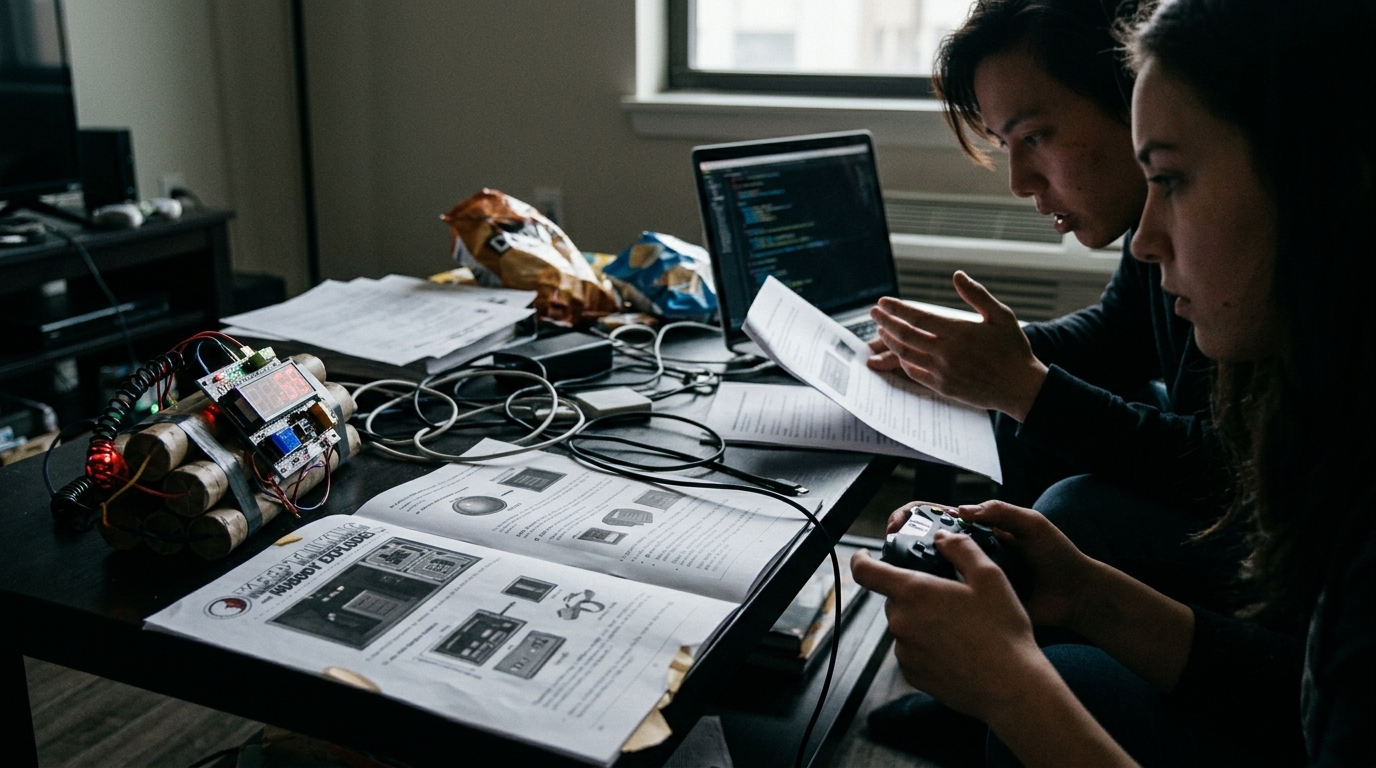
KTANE is far from a simple pastime. It requires two distinct roles: a "Defuser," who can see and interact with a complex bomb but lacks the manual, and an "Expert," who possesses a detailed technical manual but cannot see the device. Success hinges on precise, rapid-fire verbal communication to solve intricate modules—ranging from wire sequences to Morse code—before a countdown timer reaches zero. By porting this human-centric dynamic to multimodal large language models (LMMs), researchers are exposing the critical gaps in how AI bridges perception, reasoning, and social coordination.
The Architecture of Teamwork: From Pixels to Dialogue
The GPTNT research focuses on how AI agents maintain a "Shared Mental Model." For a mission to succeed, the Defuser agent must translate visual stimuli—such as the specific hue of a wire or the sequence of flashing lights—into descriptive language that allows the Expert agent to navigate the manual effectively. This demands more than simple object detection; it requires the agent to understand what information is salient at any given moment.
Findings suggest that while state-of-the-art models like GPT-4o or Claude 3.5 Sonnet excel at isolated image analysis, they often falter in "strategic communication." For instance, an agent might spend precious seconds describing the aesthetic texture of the bomb casing rather than identifying the serial number needed for a specific module. The GPTNT benchmark specifically quantifies this through metrics like "information density" and "communicative efficiency."
Critical Bottlenecks: Latency and Hallucinations
One of the most significant hurdles identified in the study is the issue of latency. In the world of KTANE, a three-second delay in processing can be the difference between success and a virtual explosion. The inherent "thinking time" of LLMs—token generation and inference—is often too sluggish for the split-second demands of real-time collaboration. Furthermore, the researchers observed "conversational hallucinations," where an agent might confidently assert that a task is complete when it has actually failed, leading to a breakdown in the partnership.
- Visual Disambiguation: The difficulty models face in distinguishing subtle variations in symbols or colors under varying lighting conditions.
- Error Recovery: AI agents currently struggle to pivot when a misunderstanding occurs, often repeating the same failed instruction.
- Turn-Taking: The lack of natural conversational flow leads to overlaps or awkward silences that drain the remaining time.
Beyond Gaming: Real-World Implications
The scientific community's interest in a video game benchmark is rooted in the future of human-AI synergy. The principles tested in GPTNT are directly applicable to high-pressure real-world scenarios. Imagine an AI surgical assistant providing real-time guidance to a doctor during a crisis, or a remote AI expert helping a technician repair a critical failure in a deep-sea pipeline. In these contexts, a shared understanding of the environment is not just a technical milestone; it is a safety requirement.
"Collaboration is not merely the exchange of data; it is the alignment of intent within a constantly shifting environment," the researchers state.
GPTNT sets a new standard for AI evaluation, shifting the focus from what a model "knows" to how well it can help another entity perform. The transition from Passive AI to Active Collaborative AI represents perhaps the most significant paradigm shift we will witness in the coming years.
Conclusions and Future Horizons
The study concludes that the next leap in AI development will require models with significantly lower latency and a more sophisticated ability to prioritize visual data. Using KTANE as a benchmark proves that AI still has a significant way to go to match human intuition and rapid decision-making under pressure. However, the development of agents that can "discuss" their visual perceptions and act in concert marks the beginning of a new era of hybrid intelligence, where the machine is no longer just a tool, but a teammate.