In the rapidly shifting landscape of Artificial Intelligence, the concept of "model capability" remains the holy grail for researchers. However, a new study published on ArXiv (2606.28471) highlights a fundamental challenge: the capability of a Large Language Model (LLM) is never directly observed. Instead, it is prospectively shaped by training data and retrospectively revealed through evaluation. This asymmetry creates a "noise" that hinders a true understanding of machine intelligence.
The Hidden Variable and the Noise Problem
The traditional approach to LLM training relies on a linear process: gathering vast amounts of data, training the model, and finally, evaluating it through specific benchmarks (such as MMLU or HumanEval). The study argues that this method is inherently flawed. Evaluation, as we know it today, compresses samples, prompts, decoding rules, and scoring into a single, noisy result. This means that a high score might not reflect a genuine increase in capability, but merely a successful adaptation to the test's parameters.
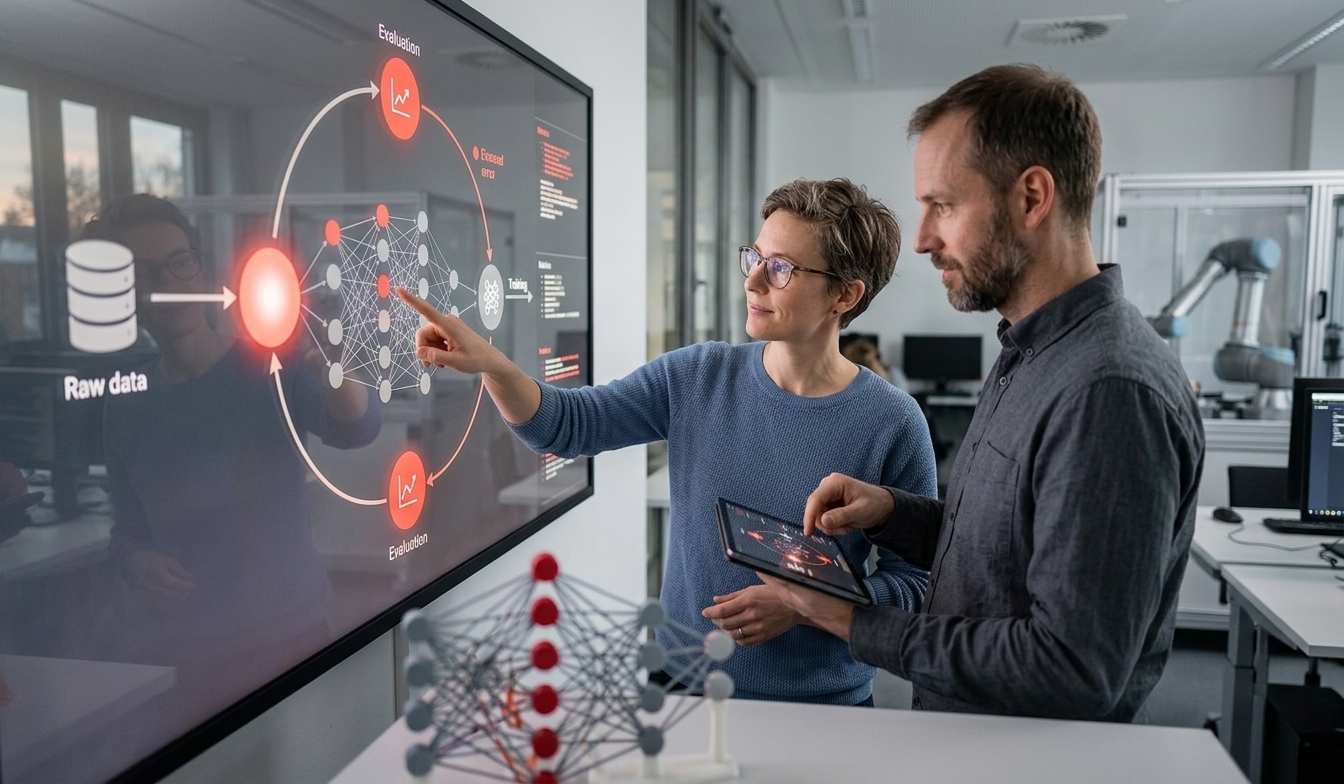
The issue lies in the fact that data "sculpts" the model before it is even tested, while tests are conducted in environments often far removed from real-world usage conditions. The research introduces the concept of the "Closed-Loop," where evaluation ceases to be the final stage and becomes an integral part of the data selection and preparation process. In this way, the model does not just "learn" information; it is trained based on how that information translates into measurable capability.
The Closed-Loop Architecture
The proposed architecture is based on the idea that evaluation should directly inform the data collection strategy. Instead of feeding the model random data from the internet, the system analyzes its failures during evaluation and seeks out (or synthesizes) data that targets exactly those weaknesses. This is a self-improvement process reminiscent of how a student prepares for exams, focusing on the chapters they haven't fully understood.
According to the researchers, this system allows for a reduction in measurement noise. When evaluation and data are in constant dialogue, factors that cause distortions—such as prompt sensitivity—are isolated. The result is a model with more robust and generalizable knowledge, rather than a superficial ability to solve specific puzzles.
"Capability is not a static number, but a dynamic relationship between what we input and what we can prove the model possesses," the study notes.
Beyond Benchmarks: Toward True Intelligence
The significance of this research extends beyond the narrow confines of computer science. If we can close the loop between data and evaluation, we move from the era of "brute force scaling" to the era of "precision intelligence." Until now, the industry believed that more data and more compute would automatically lead to better results. Study 2606.28471 tells us that the quality of the interaction between training and testing is just as critical.
- Dynamic Adaptation: Models will be able to identify their gaps in real-time.
- Reduction of Overfitting: Focusing on latent capabilities reduces the likelihood of the model "parroting" benchmark answers.
- Resource Efficiency: Fewer but higher-quality data points can lead to superior performance, reducing the carbon footprint of training.
Conclusions and Challenges
Despite the optimism, implementing such a closed loop is not without challenges. The computational complexity of continuous evaluation during pre-training is immense. Furthermore, there is a risk of the model getting stuck in a "local maximum," where it only improves in areas the evaluation system can perceive, ignoring other aspects of creativity or ethical judgment.
However, the direction is clear: the AI of the future will not just be a repository of information, but a system that understands the limits of its knowledge and actively seeks to expand them. This study represents a significant step toward understanding how machines can develop true capabilities, rather than just becoming better at passing tests we ourselves have designed.