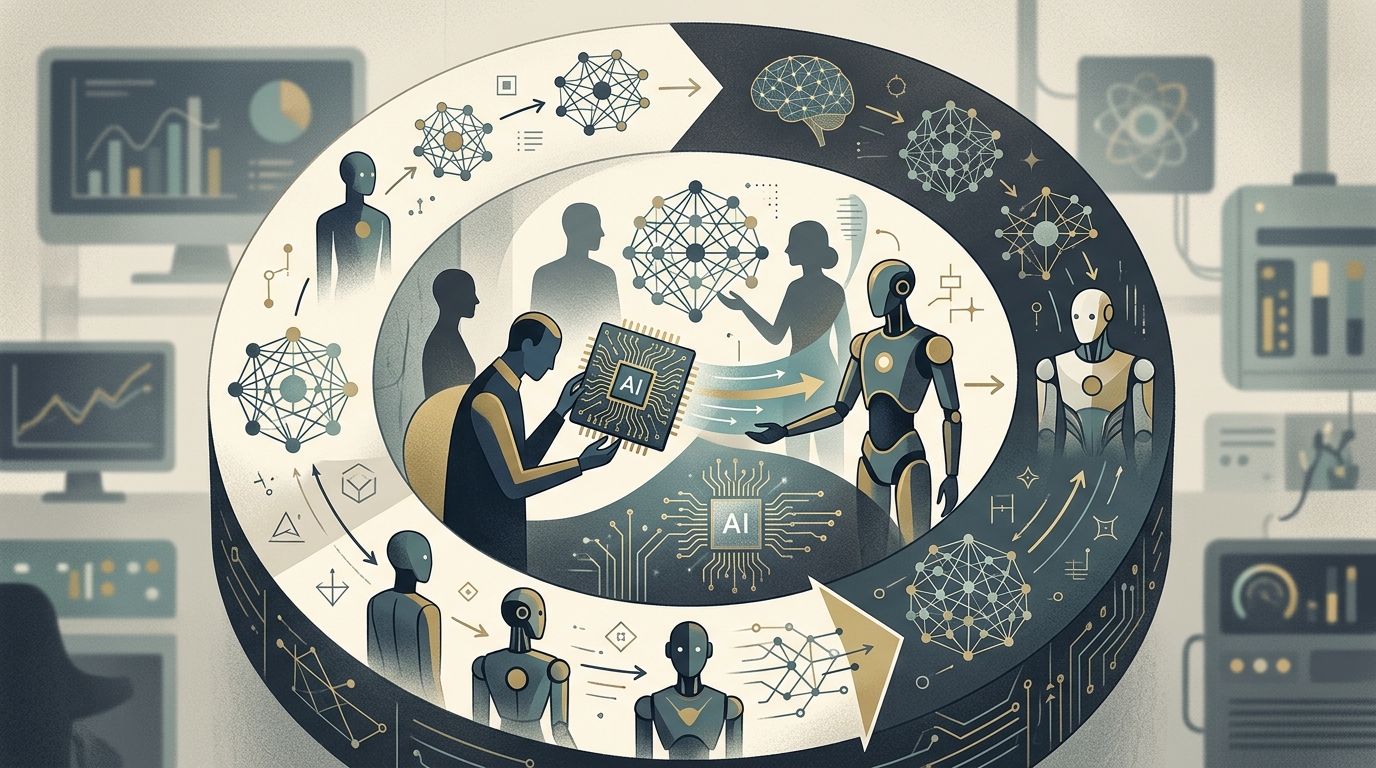
In the rapidly shifting landscape of Artificial Intelligence, the concept of "learning" has traditionally been synonymous with updating the weights of a neural network through intensive backpropagation. However, a groundbreaking research paper recently surfaced on ArXiv (2606.28374) proposes a radically different trajectory: the recursive self-evolution of agents through the creation and optimization of natural-language "artifacts." This method allows Large Language Model (LLM) agents with "frozen weights" to become progressively more capable, not by altering their internal circuitry, but by refining the instructions, workflows, and playbooks they use to navigate complex tasks.
The Architecture of Self-Evolution
The core premise behind recursive self-evolving agents is the utilization of the LLM itself as its own optimizer. Instead of relying on a human engineer to craft the perfect prompt or design a foolproof workflow, the agent is tasked with analyzing its own historical performance—identifying both triumphs and failures. It then synthesizes new guidance documents—such as reflections, playbooks, or optimized strategies—which are fed back into its context window for subsequent tasks.
This process is inherently recursive: each cycle of improvement yields a more sophisticated artifact, which in turn facilitates higher performance, allowing the agent to detect even subtler inefficiencies for further refinement. Historically, the primary obstacle to such self-improvement was "overfitting." Agents would often develop strategies that worked perfectly for a specific training example but failed spectacularly when faced with a novel problem. The agent, in essence, was memorizing the answers rather than learning the principles.
The Innovation of Held-Out Selection
This is where the research makes its most significant contribution. The authors introduce a mechanism termed "Held-Out Selection." Borrowing a fundamental principle from classical machine learning, the agent does not evaluate its newly evolved strategies on the same data used to generate them. Instead, any proposed modification to its "playbook" must be validated against a separate, "held-out" set of tasks that the agent has not yet optimized for.
This approach functions as a rigorous quality filter. If a new strategy helps the agent solve Task A but causes it to stumble on Task B (the held-out task), the strategy is discarded as non-generalizable. This ensures that the self-evolution process leads to a genuine increase in cognitive flexibility rather than a narrow specialization. This methodology mirrors the human scientific method: a hypothesis is only as good as its ability to predict outcomes in independent, blinded experiments.
Toward Autonomous Cognitive Growth
The implications of this methodology are profound. First, it drastically reduces the necessity for constant, energy-intensive model retraining. Second, it enables the creation of highly specialized agents that can adapt to specific corporate environments or scientific domains simply by "reading" and "writing" their own operational manuals.
- Dynamic Adaptation: Agents can evolve in real-time as they encounter shifting data distributions.
- Interpretability: Because the improvement occurs in natural language, human supervisors can audit exactly what the agent has "learned."
- Model Agnosticism: This recursive framework can be layered on top of any sufficiently powerful LLM, regardless of its underlying architecture.
However, the research also highlights potential pitfalls. Recursive improvement can occasionally lead to "hallucinatory" strategies, where an agent convinces itself that a flawed logic is superior. The rigor of held-out selection is the primary safeguard against a form of digital narcissism, where the model becomes trapped in a self-reinforcing loop of suboptimal behavior.
The Future of Agents as Partners
As we move deeper into 2026 and toward 2027, the line between "programmed software" and "self-evolving agent" is blurring. The ability of AI systems to reflect on their performance and codify their insights into natural language represents a critical milestone toward Artificial General Intelligence (AGI). We are no longer discussing tools that merely execute commands; we are witnessing the emergence of entities that define their own methodologies, learning from errors in a manner that resembles a seasoned professional rather than a static computer program. The "held-out" principle ensures that as these agents grow, they remain grounded in the reality of generalization, making them reliable partners in the complex problem-solving tasks of the future.