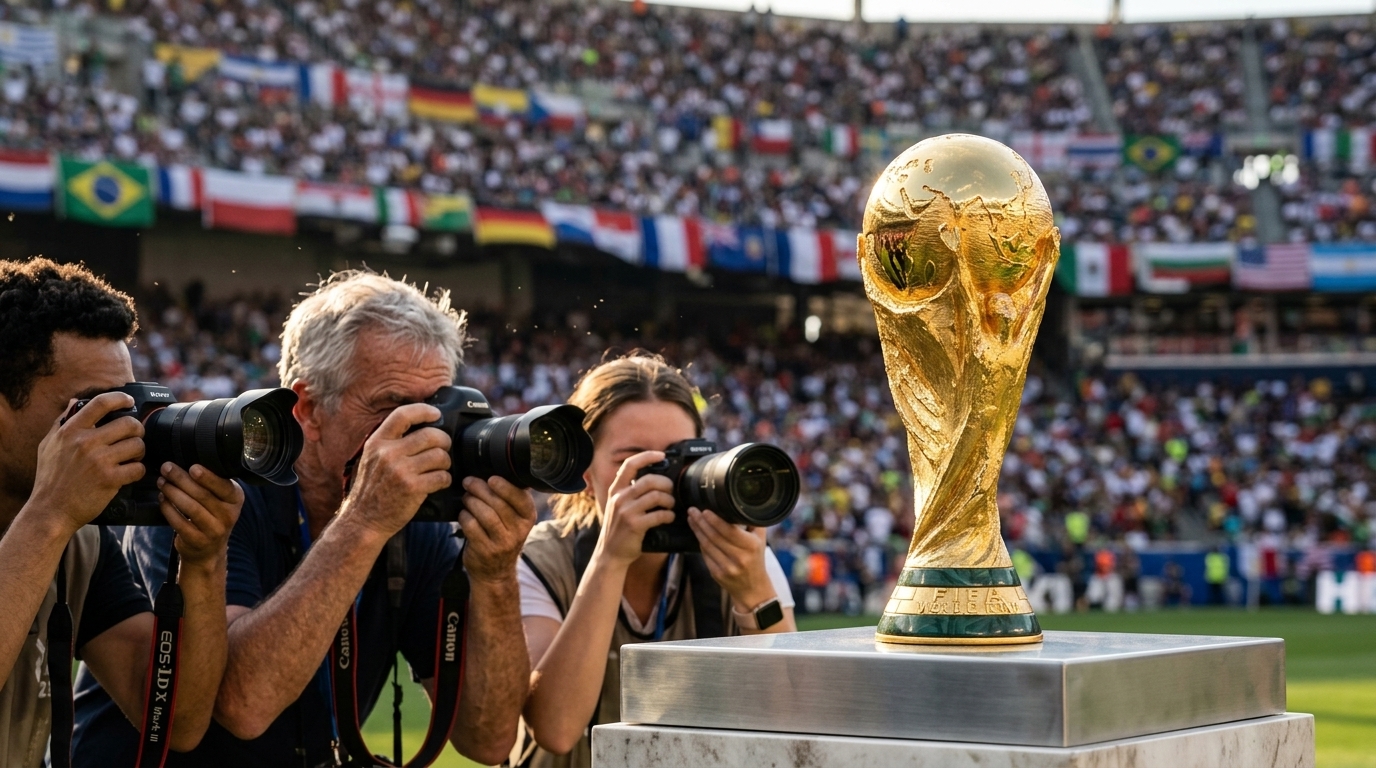
As the sun sets over the stadiums of the United States, Mexico, and Canada, the group stage of the 2026 World Cup—the first to feature 48 teams—has concluded, leaving behind a trail of thrills, upsets, and a sense that football is entering a new, more complex era. But beyond the passion in the stands, another battle is being waged in the digital backrooms. Artificial Intelligence and data-crunching supercomputers are working overtime to predict who will lift the trophy at MetLife Stadium in New Jersey on July 19.
Opta's supercomputer, widely regarded as the gold standard in sports forecasting, has processed thousands of variables following the completion of the first round. With 25,000 simulations of the tournament's remainder, the results show a clear trend: tradition and individual quality remain the strongest weapons, despite the tournament's expansion which, in theory, favors the underdogs.
The Big Three: France, Argentina, and Spain
According to the latest data, Kylian Mbappé’s France remains the number one favorite. The consistency of Didier Deschamps' squad, combined with their immense depth, gives them a winning probability of 18.4%. Opta's algorithm considers not just group stage results, but also the quality of chances created (Expected Goals) and defensive cohesion. France appears as the most balanced side, capable of handling the unique pressure of knockout football.
Following closely is the defending champion, Argentina. Despite Lionel Messi being in his 'last dance' at the age of 39, the 'Albiceleste' proved in the group stages that they remain a cohesive unit with formidable psychological strength. Their chances for a back-to-back title are estimated at 16.7%. The supercomputer notes that Argentina's path to the final is slightly more favorable than that of their European rivals, a factor that weighs heavily in the simulations.
The trio is completed by Spain. 'La Furia Roja,' with its youthful roster and dominant possession-based football, has impressed analysts. With a 14.2% probability, Spain is seen as the team most likely to defy the odds, as Opta's model highly values their ability to control the tempo of matches, thereby reducing the element of luck that often dictates knockout rounds.
The Science of Prediction: How the Algorithm Works
Many wonder how a computer can predict the outcome of a sport rooted in human psychology and randomness. The answer lies in Big Data. Opta’s model utilizes an Elo rating system, which adjusts in real-time based on opponent strength, match location, and head-to-head history. Furthermore, data regarding player fatigue (minutes played in the current season) and the specific bracket matchups for the Round of 32 and Round of 16 are integrated into the model.
A critical factor in this World Cup is the sheer distance and varying climatic conditions. The simulations take into account that teams playing in the high altitude of Mexico City or the sweltering humidity of Miami may experience a performance dip after the 70th minute. This explains why teams with significant squad depth, like England (currently fourth favorites at 11.1%), are favored by the model.
The Home Advantage and the Dark Horses
The 2026 World Cup is a unique case due to its tri-host format. The supercomputer gives the USA an increased probability of reaching at least the quarterfinals (22.5%), acknowledging the boost provided by playing at home. However, their probability of winning the whole thing remains low, at 3.8%. Mexico, on the other hand, despite their traditional home-field advantage, seems limited by a lack of clinical finishing according to group stage statistics.
Portugal emerges as the primary 'dark horse.' With a new generation of talent surrounding Cristiano Ronaldo, the Iberian side holds some of the highest ratings in set-piece efficiency and defensive transition. The algorithm gives them a 9.5% chance of reaching the summit, placing them above traditional powerhouses like Germany or a Brazil side that has shown defensive fragility.
Conclusion: The Allure of the Unpredictable
Despite the precision of mathematical models, football remains the beautiful game because of its unpredictability. A supercomputer can calculate the trajectory of a ball, but it cannot predict the mental fortitude of a goalkeeper during a penalty shootout or the moment of individual genius that changes history. As we move into the knockout stages, the data will be updated, but the ultimate truth will be decided where it always has been: on the pitch.