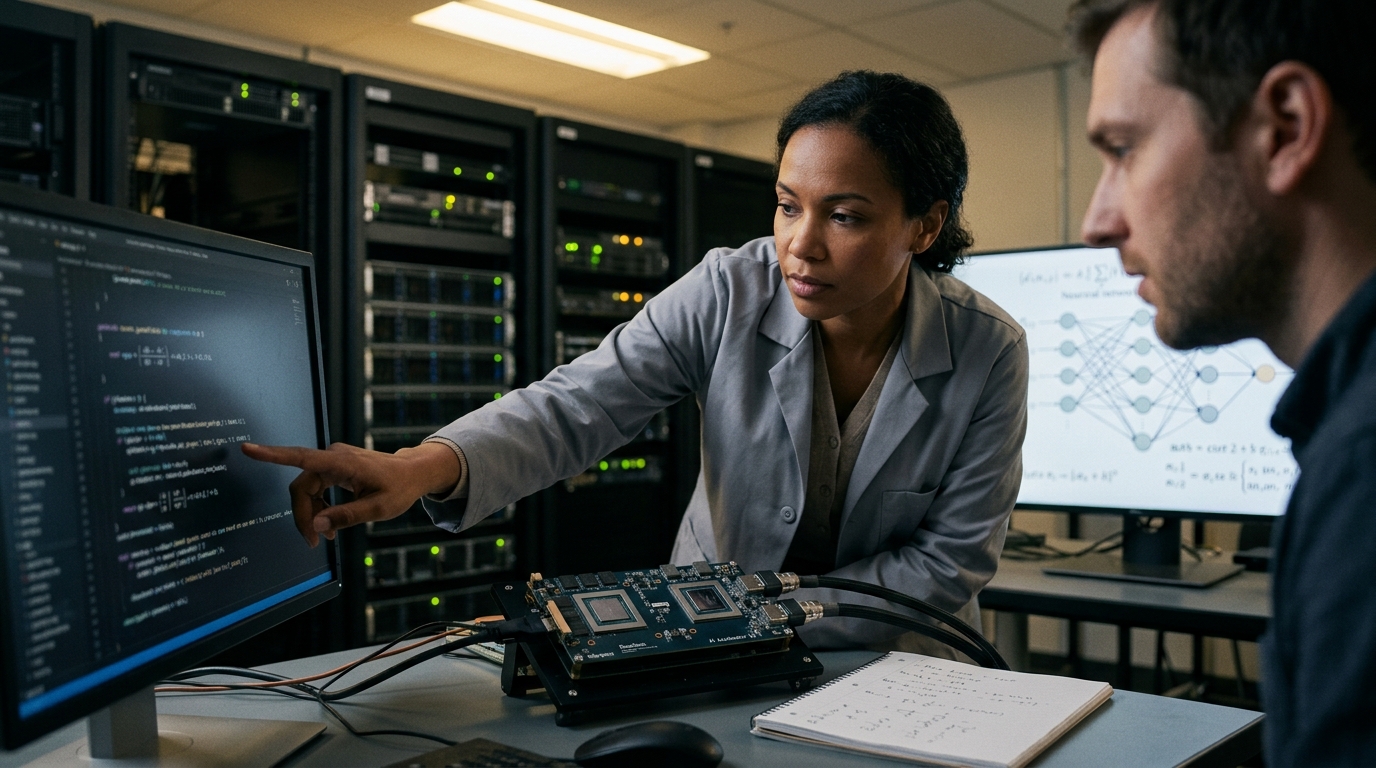
In the high-stakes world of Artificial Intelligence, size has long been considered the ultimate metric of power. From GPT-3 to GPT-4 and Claude 3.5, the strategy of US tech giants has been clear: more data, more parameters, more compute. However, this approach has led to what analysts call "token gluttony"—an unsustainable consumption of resources that makes AI expensive, energy-intensive, and exclusionary. The emergence of China’s DeepSeek, particularly its V3 and R1 models, promises to break this cycle by introducing a new era of architectural efficiency.
The Architecture of Efficiency: MLA and DeepSigmoid
DeepSeek didn’t just try to replicate OpenAI’s recipe. Instead, it re-engineered fundamental parts of the Transformer architecture. The key to its success lies in Multi-head Latent Attention (MLA). While traditional models require massive amounts of memory (KV cache) to maintain conversation context, MLA compresses this information in a way that dramatically reduces memory bandwidth requirements. This allows the model to process thousands of tokens at a significantly lower cost without sacrificing response quality.
Furthermore, the use of Mixture-of-Experts (MoE) technology via DeepSigmoid allows the model to activate only a small fraction of its parameters for any given query. While DeepSeek-V3 boasts a total of 671 billion parameters, only about 37 billion are activated per token. This "surgical" precision stands in stark contrast to older monolithic models that consumed energy across their entire network for every single word generated.
Geopolitical Necessity as a Catalyst for Innovation
It is no coincidence that this innovation hails from China. Strict US restrictions on the export of advanced semiconductors, such as NVIDIA’s H100 and B200 chips, have forced Chinese researchers to be creative. When access to unlimited compute is denied, the only path to the top is software optimization. DeepSeek has proven that efficiency is not just an option but a survival strategy that can ultimately yield a competitive edge.
The training cost of DeepSeek-V3 is rumored to be around $5.5 million—a figure that looks like a rounding error compared to the billions spent by Microsoft and Google. This economic disruption challenges the "Scaling Laws" narrative, which suggested that only trillion-dollar companies could lead in AI. DeepSeek is proving that intellectual capital can, in some cases, outmatch raw financial capital.
The End of Token Gluttony?
The challenge for US models is now existential. If DeepSeek can offer performance comparable to GPT-4o at a fraction of the price, the market will inevitably shift. Token gluttony is not just a financial burden; it is an environmental one. Data centers consume vast amounts of water and electricity. Moving toward models that "think" more while "consuming" less is the only sustainable path forward.
The DeepSeek-R1 model, which focuses on reasoning, utilizes Reinforcement Learning (RL) techniques to improve response quality without bloating parameter counts. This signifies a shift from quantity to quality—an evolution that may force Silicon Valley to rethink its entire roadmap for 2026 and beyond. The focus is shifting from how much data a model can ingest to how logically it can process a single prompt.
Conclusion: A Multipolar AI World
DeepSeek’s success marks the end of the American monopoly on frontier AI. It demonstrates that intelligence can be both accessible and affordable. For businesses, this means lower operational costs and greater flexibility. For the tech industry, it’s a loud message that raw GPU power cannot replace the elegance of algorithmic design. The question is no longer whether Chinese models can catch up to the US, but whether US models can become as efficient as their Chinese counterparts. The era of brute-force AI is giving way to the era of intelligent optimization.