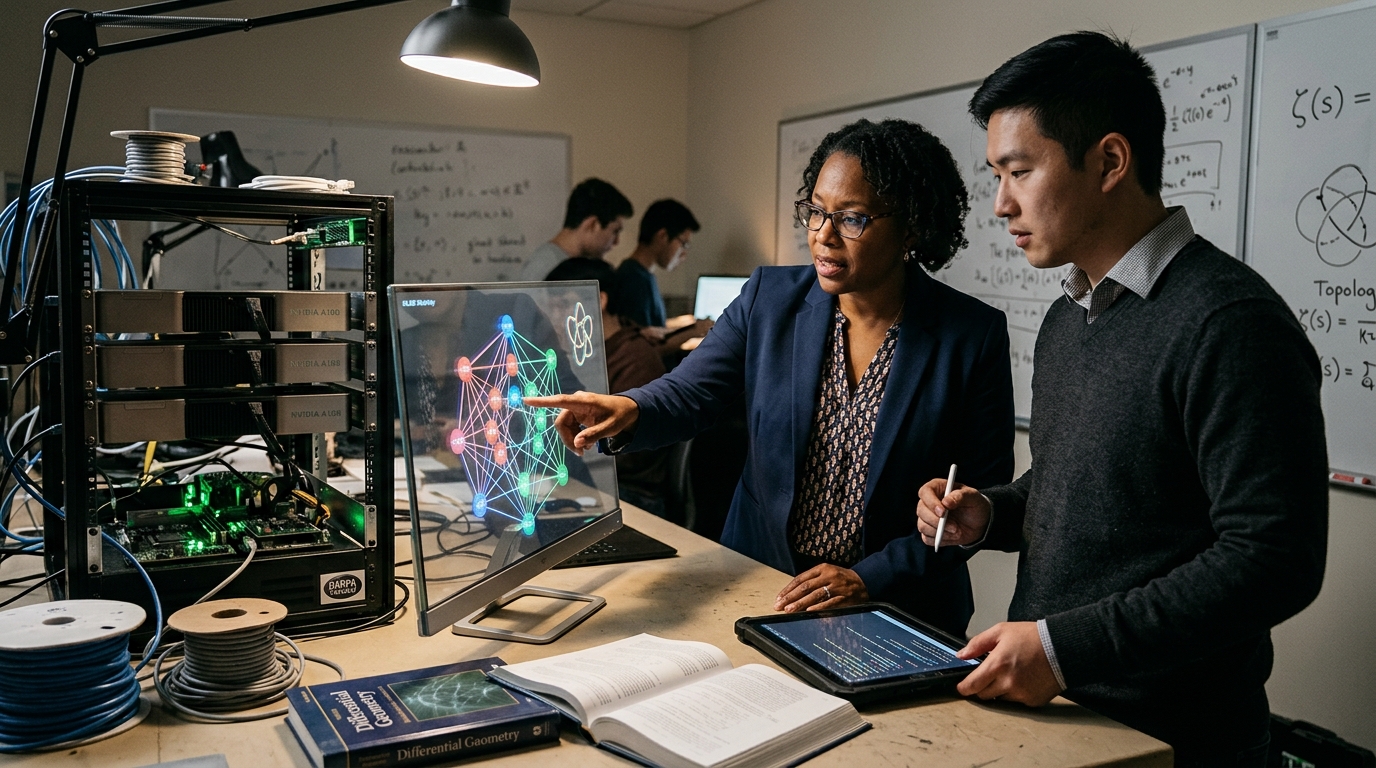
At the intersection of abstract reasoning and raw computational power, a new scientific revolution is brewing. The University of California, Irvine (UCI) and the University of Southern California (USC) have recently secured a $2.6 million grant from the Defense Advanced Research Projects Agency (DARPA). The objective? To develop Artificial Intelligence systems that transcend simple text prediction, evolving into machines capable of mathematical reasoning, theorem proving, and unlocking domains previously inaccessible to the human mind.
Moving from Calculation to Reasoning
For decades, computers have been unparalleled at calculation but severely limited in mathematical intuition. The current generation of AI, while impressive at generating code or prose, often suffers from "hallucinations" when confronted with the rigorous logic of mathematical proofs. DARPA’s program, titled "AI Assistant for Mathematics" (AIM), seeks to bridge this fundamental gap.
Researchers, led by Stephan Mandt and Pierre Baldi from UCI, alongside their USC counterparts, are focusing on building models that blend the creative potential of Large Language Models (LLMs) with the uncompromising precision of Formal Verification Systems. This hybrid approach is vital because, in mathematics, there is no room for "mostly correct" results; a proof is either absolute or it is nothing.
Why is DARPA Investing in Pure Mathematics?
The involvement of DARPA—the agency responsible for the Internet and GPS—indicates that the stakes go far beyond academic curiosity. Mathematics is the bedrock of modern cryptography, materials science, and strategic logistics. If an AI can automate the discovery of new mathematical structures, it could simultaneously accelerate the development of unhackable security systems or optimize global supply chains at a scale currently unimaginable.
- Cryptography: Developing quantum-resistant algorithms requires profound mathematical innovation.
- Physics Modeling: Understanding material behavior under extreme conditions relies on differential equations that often lack closed-form solutions.
- Software Reliability: Using AI to prove the correctness of critical code could eliminate zero-day vulnerabilities in national infrastructure.
The Challenge of Formal Language
One of the primary hurdles facing the UCI and USC teams is translating human mathematical thought into languages that machines can verify, such as Lean or Coq. Human mathematicians typically communicate in a "semi-formal" language, rich with intuitive leaps and contextual shorthand. AI must learn to fill these gaps with absolute rigor.
"We are not just trying to build a machine that solves homework problems, but a collaborator that can suggest entirely new directions for research," sources close to the project suggest.
The UCI approach leverages reinforcement learning, where the AI explores various proof paths and receives feedback based on logical consistency. This self-improving cycle could lead to breakthroughs that no human could conceive, simply because the combinatorial complexity of the search space is too vast for the biological brain.
The Future of Scientific Discovery
This $2.6 million investment is merely the opening salvo. As AI penetrates the core of the hard sciences, the question is not whether it will replace mathematicians, but how it will redefine their role. The mathematician of the future may function less like a calculator and more like an architect, posing high-level questions while the AI handles the grueling labor of verification and the exploration of billions of potential logical permutations.
In a world where information is abundant but truth is often elusive, returning to the absolute certainty of mathematics through technology is a promising, if daunting, prospect. The UCI-USC collaboration under DARPA marks the beginning of an era where AI ceases to be a mere mimic and becomes an authentic explorer of the realm of ideas.