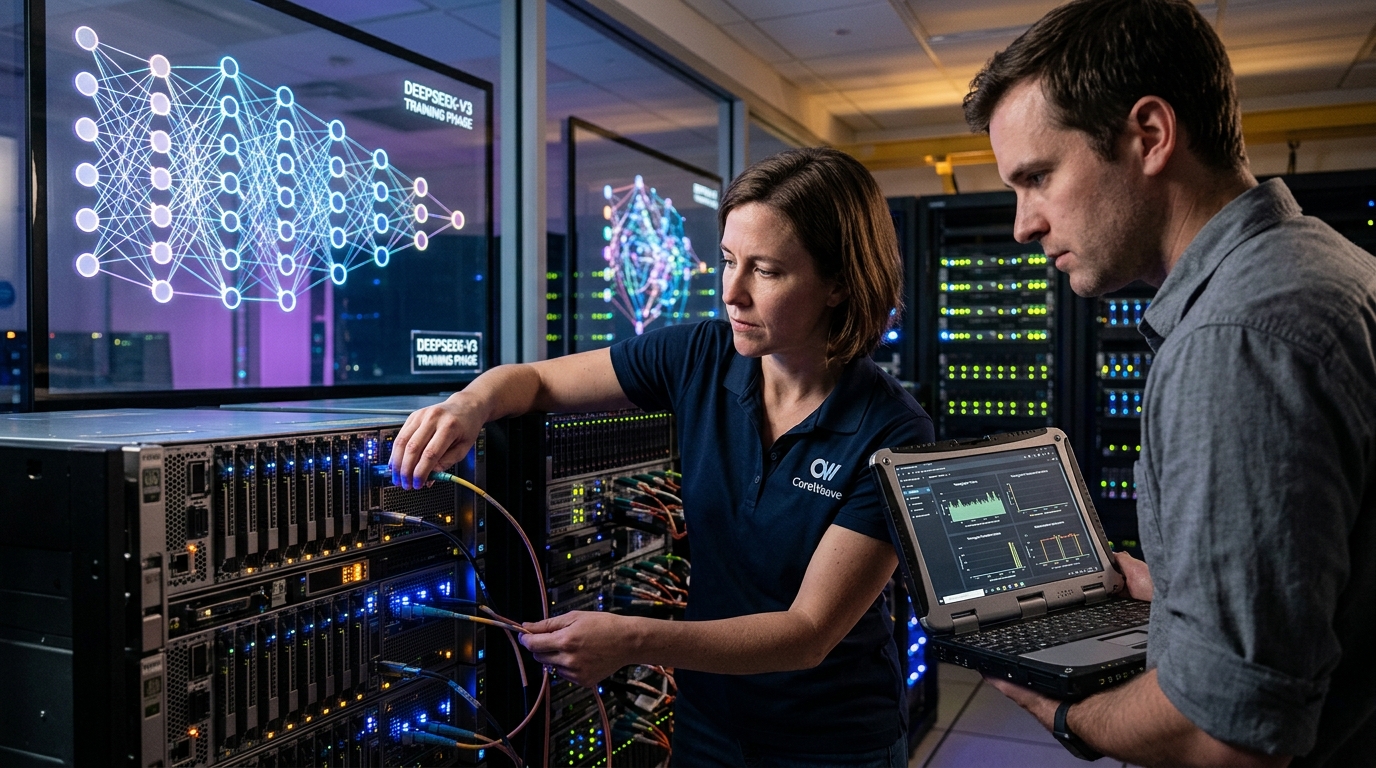
In the ever-accelerating universe of Artificial Intelligence, time is not merely money; it is the ultimate metric of power. CoreWeave, the specialized cloud provider that has emerged as one of NVIDIA’s closest infrastructure allies, recently announced a staggering performance milestone: completing the training run of the DeepSeek-V3 model in approximately two minutes as part of the MLPerf® Training v6.0 benchmarks. This achievement is not just a statistical footnote; it is a critical turning point in the evolution of AI infrastructure, signaling the end of an era where training state-of-the-art models required weeks of patient waiting.
The Significance of MLPerf® 6.0 Benchmarks
MLPerf® is widely regarded as the "Olympics" of AI hardware and software. In version 6.0, the requirements were significantly heightened, focusing on real-world use cases that reflect the needs of today’s tech giants. CoreWeave, utilizing massive clusters of NVIDIA H100 and H200 GPUs, demonstrated a linear scalability of performance that was previously considered theoretical. The ability to orchestrate thousands of processors with such precision that a model like DeepSeek-V3 can be trained in 120 seconds proves that the industry bottleneck is shifting from raw hardware to interconnectivity (networking) and data management efficiency.
DeepSeek-V3: An Eastern Giant in Western Hands
DeepSeek-V3 is no ordinary model. Developed by the Chinese firm DeepSeek, it has earned global respect for its Mixture-of-Experts (MoE) architecture, which allows for high performance at a lower computational cost compared to traditional dense models. CoreWeave's choice to use this specific model for its record-breaking run carries dual significance. First, it confirms the global dominance of open-weight models that can be deployed across diverse infrastructures. Second, it highlights the irony of AI geopolitics: a model developed in China achieves its peak performance on an American cloud, powered by American semiconductors.
Specialized Cloud vs. General Hyperscalers
CoreWeave’s success challenges the long-standing dominance of the "Big Three" (AWS, Google Cloud, Microsoft Azure). While traditional providers offer a vast array of services—from web hosting to databases—CoreWeave is "AI-native." Every cable, every switch, and every server rack in its infrastructure is designed for a single purpose: maximizing data throughput to the GPUs. This focus allows the company to provide training environments free from the "noise" of multi-tenant systems, offering researchers the raw, unadulterated power required for records like the DeepSeek-V3 milestone.
Market and Research Implications
What does two-minute training mean practically for a business? It means the speed of iteration. In the past, if a researcher made an error in training parameters, they had to wait days to see the result and correct their course. Now, the trial-and-error cycle is shrinking dramatically. This will lead to an explosion of specialized, fine-tuned models for every industry—from medical diagnostics to financial risk prediction—as the "cost" of experimentation in terms of time drops toward zero.
Conclusion: The Path to Exascale AI
As we head into the latter half of 2026, CoreWeave’s achievement serves as a harbinger of the next phase: Exascale AI. The challenge is no longer just how many GPUs one can acquire, but how to make them "sing" in perfect harmony. By training DeepSeek-V3 in the time it takes to brew a cup of coffee, CoreWeave hasn't just broken a record; it has opened the door to a reality where artificial intelligence evolves in real-time, right before our eyes.