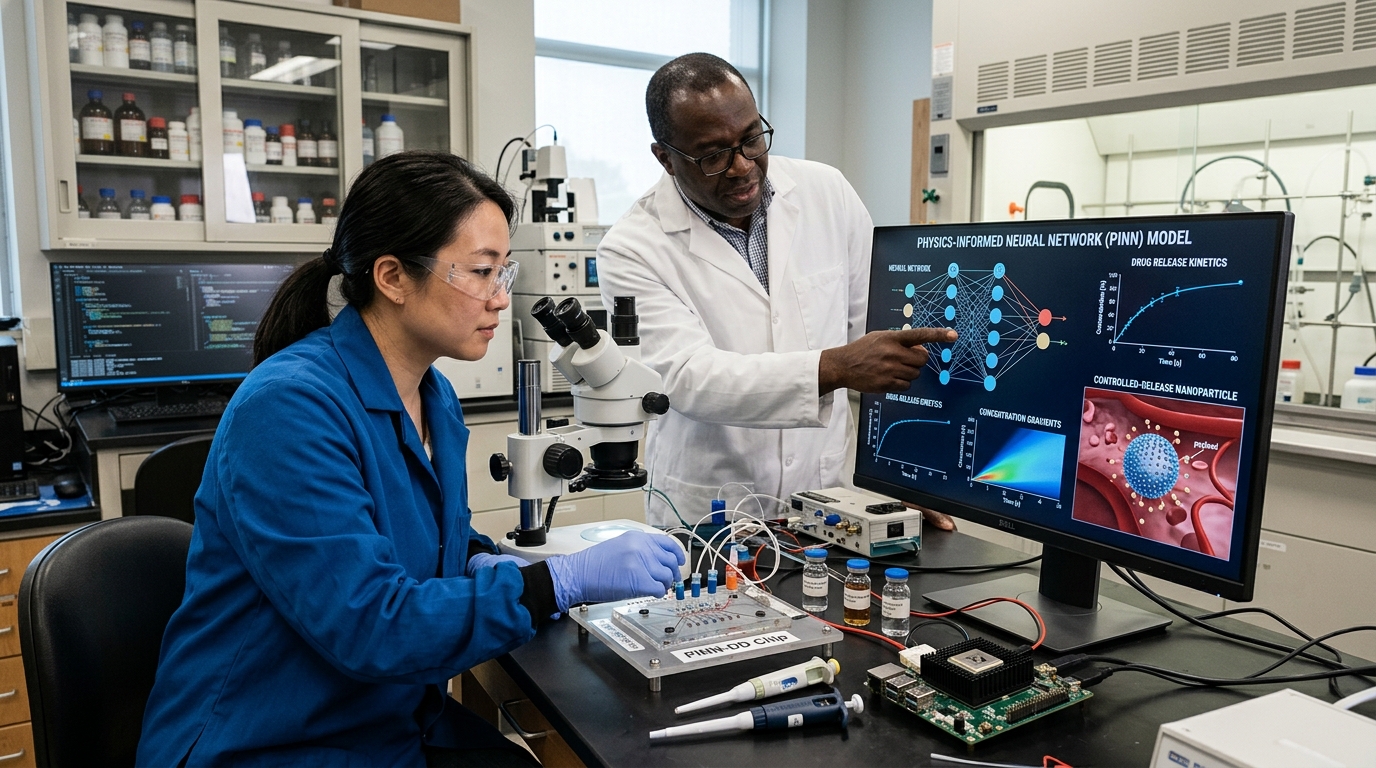
The pharmaceutical industry is standing at the threshold of a structural transformation, as the traditional "trial and error" methodology gives way to high-precision computational models. Recent research highlighted by Phys.org reveals how Physics-Informed Artificial Intelligence (PINNs) can revolutionize the design of controlled-release drug patches and bandages. This technology is not merely an incremental improvement of existing algorithms; it is a fundamental reimagining of how machines perceive the physical world and biological systems.
Beyond the Black Box: The Convergence of Physics and AI
Traditional AI often functions as a "black box." It is fed vast amounts of data and attempts to identify patterns without understanding the underlying rules governing the system. In medicine and pharmacology, this can be precarious, as models might suggest solutions that violate the laws of thermodynamics or fluid kinetics. Physics-Informed Neural Networks (PINNs) resolve this by embedding differential equations and physical constraints directly into the neural network's training process.
In the context of transdermal patches, the AI now "knows" Fick’s laws of diffusion. It understands how a drug molecule migrates through a polymer matrix and penetrates various layers of human skin. This inherent knowledge allows the system to predict with startling accuracy the rate at which a drug will enter the bloodstream, significantly reducing the need for hundreds of costly and time-consuming laboratory experiments.
Controlled Release: Revolutionizing Transdermal Delivery
Controlled-release patches are critical for managing chronic conditions, ranging from diabetes and chronic pain to hormonal imbalances. The challenge has always been maintaining a steady dosage over a prolonged period. If the release is too rapid, toxicity risks arise; if too slow, the treatment becomes ineffective. Utilizing physics-informed AI allows scientists to simulate thousands of different material compositions in seconds.
- Polymer Optimization: AI can suggest the ideal blend of materials to facilitate gradual drug release, accounting for body temperature and skin moisture levels.
- Reduced R&D Costs: Accelerating the preclinical phase means new treatments can reach the market faster and with lower development overheads.
- Safety and Reliability: Models can predict rare interactions or patch failures under extreme conditions—scenarios that are difficult to replicate in physical trials.
Personalization and the Future of Care
Perhaps the most compelling aspect of this technology is the potential for personalized medicine. Human skin is diverse—age, ethnicity, lifestyle, and environment all influence permeability. With AI, we may soon see patches tailored specifically to a patient’s unique biological profile. AI could analyze a small set of patient data and guide the 3D printing of a patch with the exact release kinetics required for that individual.
"It is no longer a question of whether AI can assist in medicine, but how integrating physical reality into AI will unlock treatments that were previously deemed impossible," industry researchers note.
Regulatory and Ethical Challenges
Despite the optimism, hurdles remain. Regulatory bodies like the FDA and EMA must develop new frameworks for approving drugs designed largely "in silico" (via computer simulation). The transparency of these algorithms remains a critical concern. Furthermore, there is the risk of widening the healthcare gap: will these "smart" patches be accessible only to affluent societies, or will the reduction in production costs eventually benefit developing nations?
In conclusion, the application of Physics-Informed AI in pharmacology marks the end of the era of empirical guesswork. As the laws of physics become part of the source code, medicine gains a new mathematical rigor that promises safer and more effective therapies for a global population.