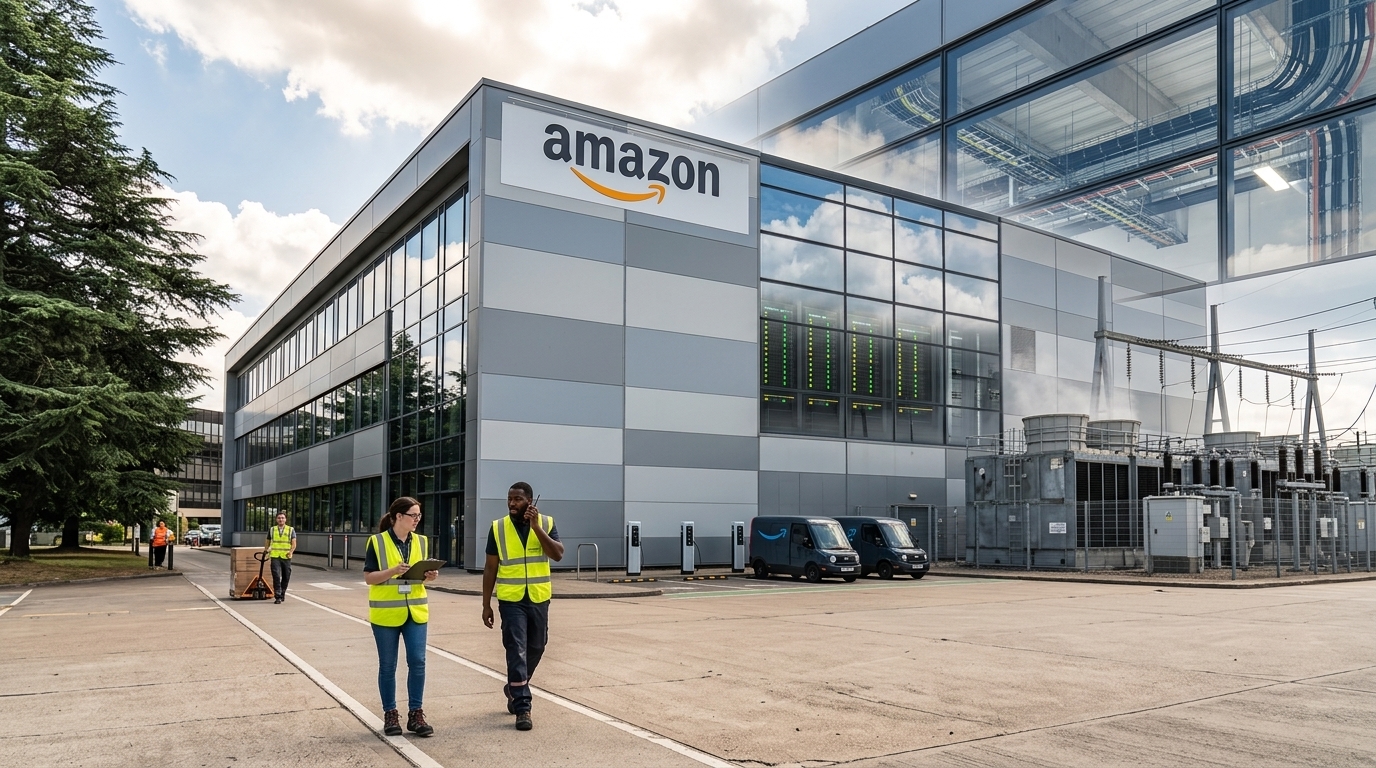
Amazon's latest sustainability report has unveiled a harsh reality that many in the tech industry feared: the insatiable thirst for computing power fueling Artificial Intelligence (AI) is driving carbon emissions to levels that threaten to undo years of environmental progress. As the e-commerce and cloud computing giant races to dominate the AI arms race, its ecological footprint is ballooning, raising critical questions about the compatibility of technological growth and planetary sustainability.
The Price of Digital Intelligence
The rise of Generative AI requires an unprecedented data infrastructure. Amazon Web Services (AWS) data centers, which form the backbone of the internet, are turning into energy "black holes." Training Large Language Models (LLMs) and the daily operation of AI applications require thousands of specialized Graphics Processing Units (GPUs), which consume many times more energy than traditional servers. According to reports, Amazon's total emissions increased significantly over the past year, despite billions in investments in renewable energy.
The problem is not just direct electricity consumption (Scope 1 and 2), but primarily "Scope 3" emissions. These concern indirect pollution resulting from the manufacturing of servers, the construction of the massive concrete buildings housing data centers, and the supply chain. Amazon admits that controlling these emissions is a "massive challenge," as construction activity to expand AI infrastructure shows no signs of slowing down.
The Clash with the "Climate Pledge"
In 2019, Amazon co-founded the "Climate Pledge," a commitment to achieve net-zero carbon emissions by 2040, ten years ahead of the Paris Agreement. However, the current trajectory shows a dangerous divergence. While the company claims to be the world's largest buyer of renewable energy, criticism is mounting. Many analysts point out that purchasing green energy certificates does not reflect the actual pressure data centers place on local power grids, which are often forced to rely on fossil fuels to meet peak demand.
"Artificial intelligence is a double-edged sword: it can help us solve the climate crisis, but the production of it itself accelerates environmental collapse," industry experts state.
In an effort to mitigate the impact, Amazon is increasingly turning to nuclear power. A recent deal to purchase a data center powered directly by a nuclear plant in Pennsylvania is a sign of the industry's desperation for stable "base load" energy that does not emit CO2. However, nuclear energy comes with its own ethical and environmental issues, such as waste management and the time required to build new reactors.
Ethical Dilemmas and the Future of Innovation
This situation presents society with a critical dilemma: are we willing to sacrifice climate goals for the sake of faster AI development? Amazon argues that AI will provide the solutions for more efficient resource management in the future, but current environmental damage is immediate and measurable. Pressure from shareholders, activists, and EU regulators is expected to intensify, demanding greater transparency in how tech giants calculate their environmental costs.
- Increase in total emissions due to AI infrastructure expansion.
- Difficulty in controlling Scope 3 emissions (construction and supply chain).
- Shift to nuclear energy as a necessary solution for stable power supply.
- Risk of failing the Net Zero 2040 target.
In conclusion, Amazon stands at a crossroads. Its leadership in the digital economy depends on AI, but its ethical legitimacy depends on keeping its environmental promises. Without a radical reassessment of how AI systems are built and operated, the vision of a "green" digital revolution risks remaining wishful thinking, buried under tons of carbon dioxide emissions.