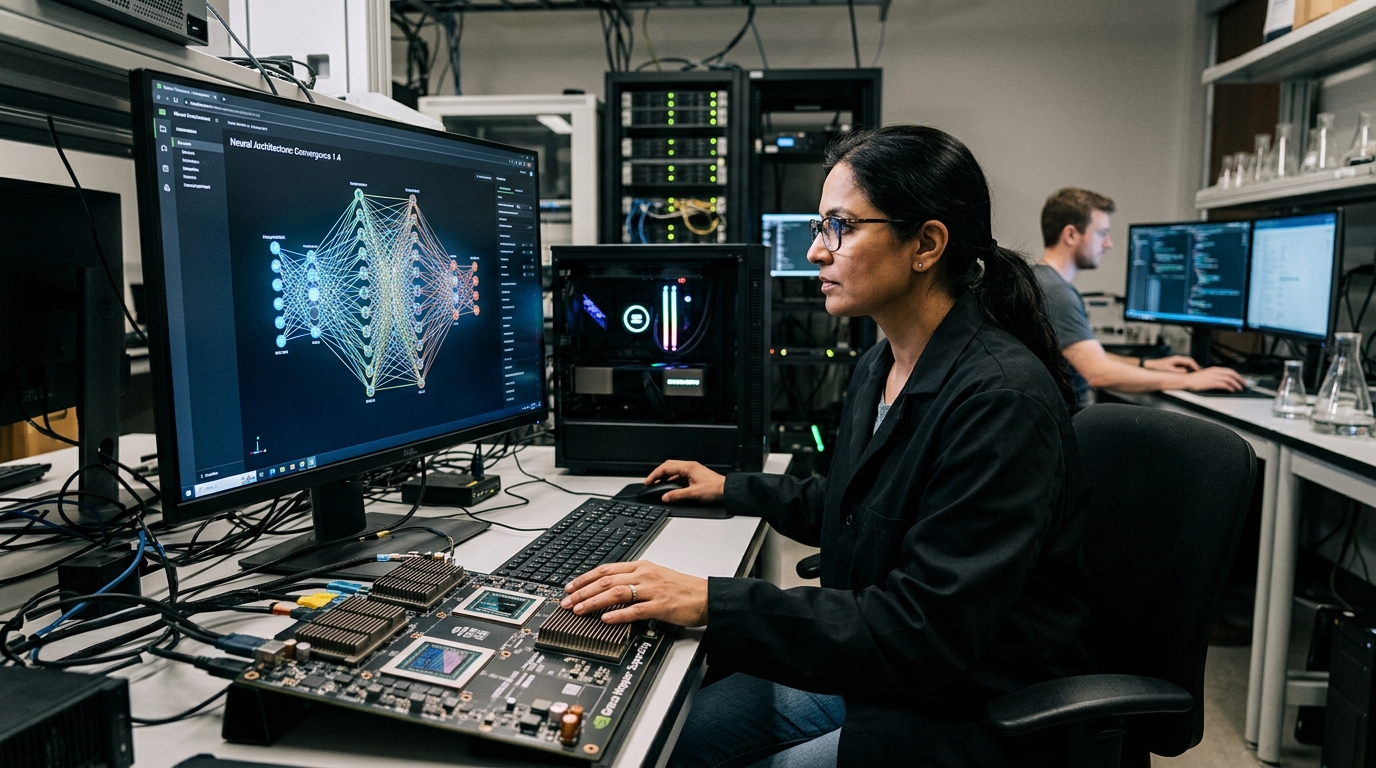
The history of technology is replete with unexpected pivots, but few are as consequential as the transformation of the Graphics Processing Unit (GPU) from a niche enthusiast component into the silicon heart of modern Artificial Intelligence. According to the latest analysis from Jon Peddie Research (JPR), this evolution was not a historical accident, but the result of a decade-long convergence between the demands of parallel image processing and the mathematical requirements of neural networks.
From Triangles to Tensors: A Historical Perspective
In the late 1990s, the term GPU was coined by NVIDIA with the launch of the GeForce 256. At the time, the objective was straightforward: accelerating the rendering of 3D graphics by processing millions of polygons. However, the architecture required to "light" a pixel in a game—executing thousands of similar calculations simultaneously—turned out to be exactly what data science needed. The transition from fixed-function pipelines to programmable shaders in the early 2000s opened the door to GPGPU (General-Purpose computing on Graphics Processing Units).
Jon Peddie Research notes that the true revolution occurred in 2006 with the introduction of CUDA by NVIDIA. By allowing developers to use the C programming language to write code that executes directly on the GPU, the technology escaped the confines of entertainment. Suddenly, scientists could run simulations that previously required multi-million dollar supercomputers using off-the-shelf graphics cards costing a few hundred dollars.
The 'AlexNet' Moment and the AI Explosion
The year 2012 is widely considered the 'ground zero' for modern AI. When the AlexNet neural network won the ImageNet competition using two NVIDIA GPUs for training, the computing world realized that the future of machine intelligence would not rely on traditional Central Processing Units (CPUs), but on the raw parallel power of graphics hardware. CPUs are designed for serial logic and rapid decision-making, whereas GPUs are designed for massive parallel throughput. Training a Large Language Model (LLM) requires billions of matrix multiplications—a task GPUs perform with unparalleled efficiency.
- Parallel architecture allows for the simultaneous processing of thousands of parameters.
- High memory bandwidth (VRAM) is critical for managing the massive datasets used in AI training.
- Energy efficiency per calculation is significantly higher in GPUs compared to CPUs for deep learning tasks.
Neural Rendering: When AI Returns to Its Roots
Today, the circle has been completed. AI is no longer just using graphics hardware; graphics themselves are now fundamentally powered by AI. Technologies such as NVIDIA’s DLSS (Deep Learning Super Sampling) and AMD’s FSR use neural networks to "guess" missing pixels, allowing games to run at high resolutions with minimal computational cost. JPR highlights that we are no longer discussing simple rasterization; we are entering the era of "neural rendering." The AI creates the image rather than calculating it through traditional geometric means.
"We are no longer looking at a graphics card that does a bit of AI. We are looking at an AI processor that happens to produce extraordinary graphics," the research suggests.
The Geopolitics of Silicon and the Path Ahead
This transformation has immense economic and political implications. GPUs have become the "new oil," with governments imposing export controls on the most powerful chips to maintain strategic advantages. NVIDIA's dominance in the GPU market has propelled it to become one of the world's most valuable companies, eclipsing traditional tech titans. However, the challenge remains energy consumption. As AI models grow larger, the demand for even more specialized hardware—such as Tensor Cores—increases, leading to a new arms race between Intel, AMD, and emerging custom silicon manufacturers.
In conclusion, the journey from pixels to tensors is a testament to technological adaptability. What began as a means to render realistic shadows in video games has become the foundation upon which the next phase of human civilization is being built: artificial general intelligence.