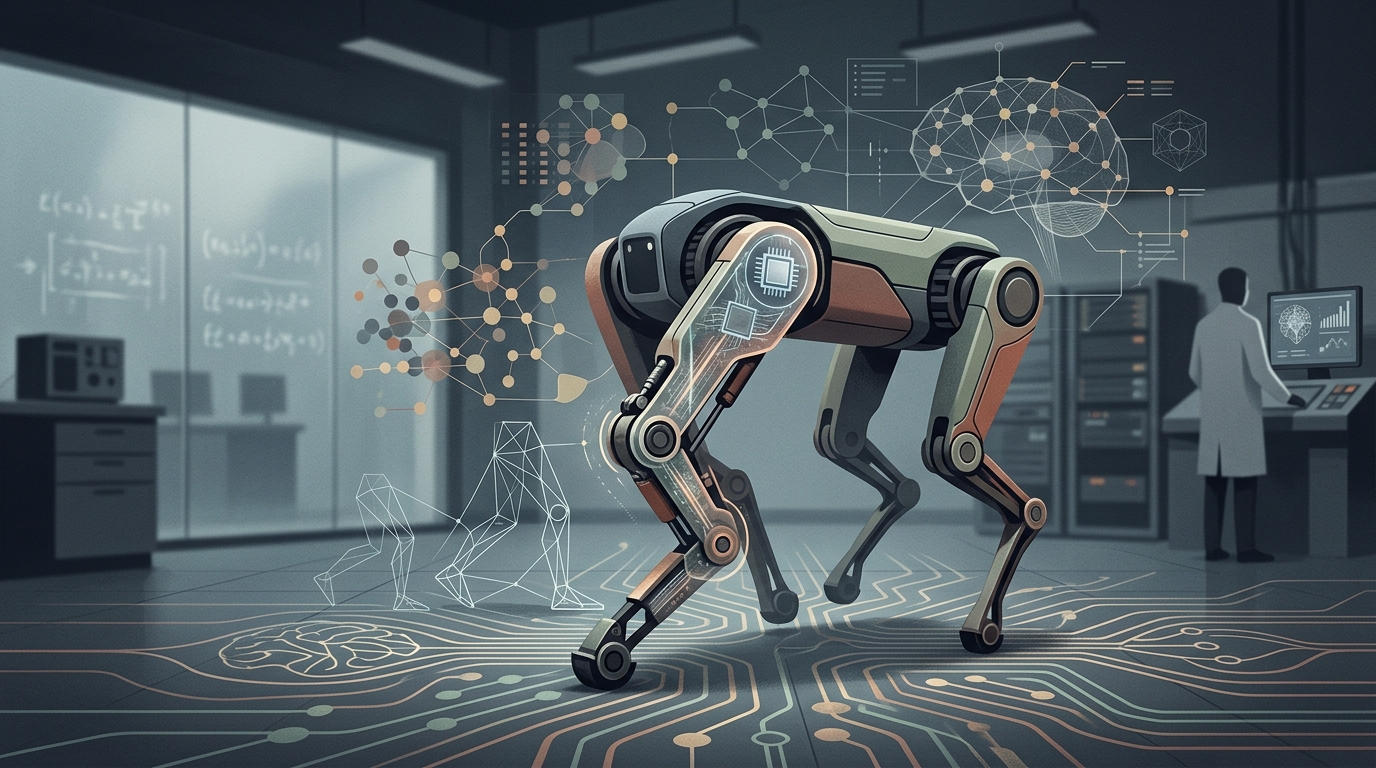
Legged locomotion has long been one of the most daunting challenges in robotics. While wheels excel on flat surfaces, the real world is a complex tapestry of obstacles, stairs, and uneven terrain that demands the dynamic flexibility of limbs. New research from the Harvard John A. Paulson School of Engineering and Applied Sciences (SEAS) aims to bridge the gap between biological elegance and mechanical precision through an advanced AI-powered control system.
From Hard-Coding to Emergent Intelligence
Historically, controlling legged robots relied on intricate mathematical models and pre-defined gait patterns. Engineers had to manually account for every possible interaction between the foot and the ground—a process that is not only labor-intensive but often fails when faced with unpredictable environments. Harvard's approach fundamentally shifts this paradigm. Instead of static code, it utilizes Reinforcement Learning (RL) to allow the robot to "learn" how to walk through millions of simulated trials.
The system functions by training a neural network in a virtual environment where the laws of physics are strictly enforced. The robot receives "rewards" for maintaining balance and moving efficiently, while being "penalized" for falling or wasting energy. This iterative process allows for the emergence of sophisticated behaviors that human programmers might never have conceived, such as micro-adjusting the center of mass before a leap or using limbs to stabilize on slippery surfaces.
Closing the Sim-to-Real Gap
A significant hurdle in AI robotics is the "sim-to-real gap"—the difficulty of transferring a skill learned in simulation to the chaotic physical world. Harvard researchers minimized this gap by introducing "domain randomization" during the training phase. By varying ground friction, robot mass, and motor torque within the digital environment, the control system develops a level of robustness that allows it to handle the inherent uncertainty of reality.
- Real-time dynamic stabilization without the need for manual intervention.
- Significant reduction in computational overhead, as the trained neural network is more efficient than traditional predictive models.
- Versatility across different robot morphologies, making the controller applicable to various industrial designs.
Applications and Societal Impact
The implications of this breakthrough extend far beyond the laboratory. Robots capable of navigating treacherous terrain are invaluable for search and rescue missions in disaster zones where human access is restricted. Furthermore, in logistics and industrial inspection, the ability of robots to climb stairs or navigate cluttered environments could revolutionize the way we handle infrastructure maintenance and delivery services.
However, increased autonomy brings ethical considerations to the forefront. The ability of a machine to make split-second kinetic decisions raises questions of liability and safety. Nevertheless, the Harvard team argues that AI actually enhances safety by providing the robot with a near-"instinctual" understanding of its physical surroundings, much like a biological organism.
"We are no longer just programming how a robot moves; we are providing the goals and constraints, and letting the AI discover the optimal physical solution," the research team notes.
The Future of Autonomous Exploration
The next frontier for the researchers is the direct integration of visual data into the locomotion control loop. This would enable the robot to not only react to the forces felt by its feet but to "anticipate" the terrain ahead, planning its path much like a hiker chooses where to step. The convergence of computer vision and dynamic movement will be the final milestone in creating truly autonomous machines capable of operating in any environment, from the surface of Mars to the interior of a collapsed building.