In the rapidly evolving landscape of Cyber-Physical Systems (CPS)—ranging from autonomous vehicles to industrial robotics and drones—the demand for increasingly sophisticated Deep Neural Networks (DNNs) has reached a critical tipping point. As we navigate through 2026, the complexity of models required for high-fidelity environmental perception has outpaced the capabilities of edge processing hardware. The recent research paper, "Cloud Is Closer Than It Appears," published on ArXiv, highlights a fundamental dilemma: Where should decisions be made? At the edge for speed, or in the cloud for precision?
The Computational Demand Challenge
Modern CPS are no longer limited to simple object recognition tasks. They require real-time semantic analysis, trajectory prediction, and decision-making under extreme uncertainty. These processes demand massive computational resources that often exceed the battery life and thermal constraints of mobile platforms. The traditional approach of local execution offers the advantage of low latency, but it often sacrifices perception fidelity due to hardware limitations.
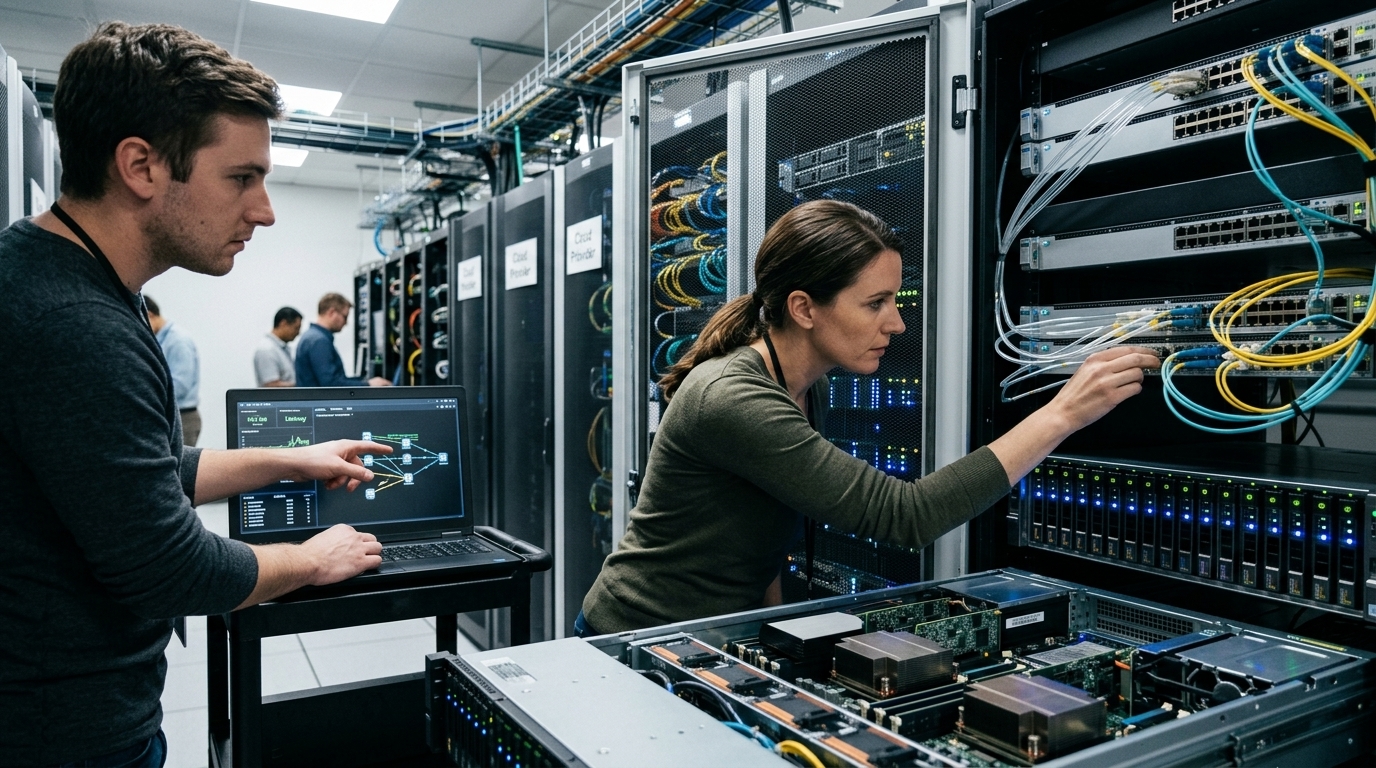
On the other hand, offloading data to the Cloud allows for the utilization of colossal models that can synthesize data from multiple sensors simultaneously. However, this introduces the unpredictability of network performance. A delay of a few milliseconds in transmission can be catastrophic for an autonomous vehicle traveling at high speeds. The research emphasizes that the "distance" to the Cloud is no longer a matter of geography, but of temporal and functional reliability.
Distributed Inference: The Middle Ground
The proposed solution, analyzed in depth by the researchers, is Distributed Inference. Instead of the binary choice between "all local" or "all cloud," the model is partitioned. The initial layers of the neural network, which typically extract low-level features from images or lidar data, are executed locally. The resulting intermediate data is then compressed and transmitted to the Cloud for the final, more complex processing stages. This "split-inference" approach promises to balance the workload while significantly reducing the volume of data that needs to be transmitted.
- Dynamic Adaptation: Systems must be capable of shifting the split point in real-time based on the fluctuating quality of 5G/6G connections.
- Energy Efficiency: Interestingly, transmitting data can sometimes consume less energy than local high-intensity computation, thereby extending the operational life of mobile units.
- Reliability and Safety: The necessity for robust fall-back mechanisms where the system reverts to a simplified local model if connectivity is compromised.
Future Outlook and Security Implications
As 6G infrastructures begin to roll out, the promise of near-zero latency encourages further reliance on the Cloud. However, the research cautions against significant security risks. Sending sensitive sensor data to external servers opens new attack vectors for adversarial interference. Furthermore, there is the issue of data sovereignty: who truly controls the "intelligence" of a robot if its brain resides on a server thousands of miles away?
"The architecture of the future will not be a static network, but a living organism breathing between the device and the cloud, adapting every fraction of a second to the needs of its mission."
In conclusion, the study underscores that the success of future autonomous systems depends on our ability to manage the intricate trade-offs between computation, communication, and time. The Cloud is no longer just a storage unit; it is the extension of the machine's nervous system. Understanding this symbiotic relationship is essential for the next generation of embodied AI.