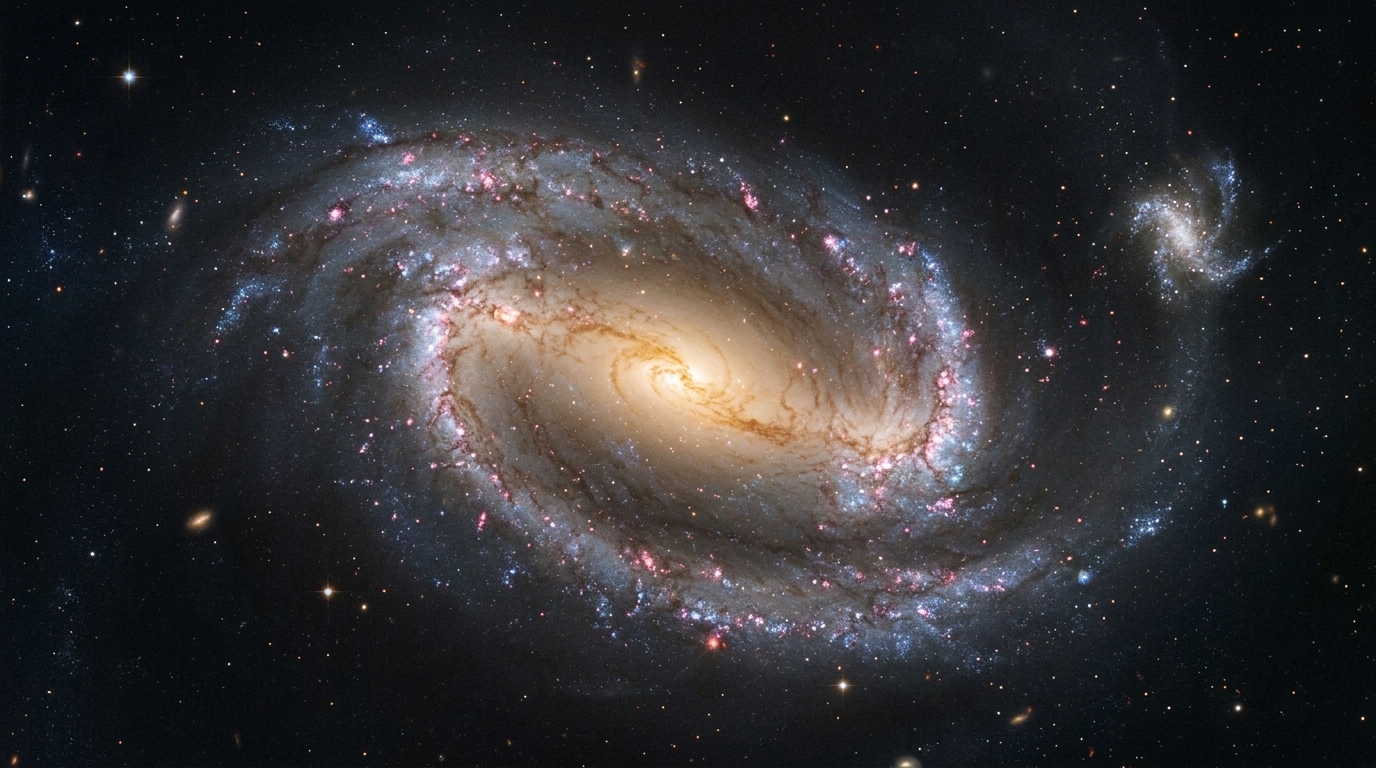
The history of our Milky Way is not a linear path of peace and stability, but a violent chronicle of collisions, mergers, and 'cosmic cannibalism.' Recently, a team of astronomers, utilizing cutting-edge data from the European Space Agency's (ESA) Gaia mission, identified a group of 'alien' stars residing in the heart of our Galaxy that were not born there. These stars, carrying the chemical fingerprints of a long-lost world, once belonged to a dwarf galaxy that scientists have named 'Loki.'
The Anatomy of a Galactic Merger
The discovery of Loki is more than just an addition to the celestial catalog; it is an act of cosmic archaeology. Researchers analyzed the chemical composition and orbits of thousands of stars near the galactic disk. What they observed was an anomaly: a group of stars with unusually low heavy metal content (metallicity) and specific ratios of elements like magnesium and calcium that do not match the Milky Way's 'genetic material.'
These stars move in ways that suggest they entered our system as a single entity. Billions of years ago, Loki was an autonomous dwarf galaxy that had the misfortune of wandering too close to our own. The immense gravitational pull of the Milky Way literally tore it apart, absorbing its stars and integrating them into its own structure. This process, while catastrophic for Loki, was vital for the growth and mass accumulation of the Milky Way.
Chemical Fingerprints as Identity
But how can scientists be certain of the origin of a star located millions of light-years away? The answer lies in spectroscopy. Every star preserves in its photosphere the chemical signature of the gas cloud from which it was born. Smaller galaxies like Loki have different rates of star formation and evolution compared to large spiral galaxies. This leads to a characteristic lack of certain elements produced in later stages of galactic life.
- Low Metallicity: Loki's stars are older and 'poorer' in metals than typical Milky Way stars.
- Orbital Dynamics: Their motion is often 'retrograde' or highly elliptical, indicating they did not form from the same rotating gas cloud.
- Age Homogeneity: Most of these stars appear to be of a similar age, suggesting a common formation period prior to the merger.
The Galaxy as a Living Organism
This study reinforces the theory that our Galaxy is a 'mosaic' of many smaller galaxies. This is not the first time we have identified such traces. In the past, the 'Gaia-Enceladus' galaxy (also known as the Gaia Sausage) and 'Pontus' were discovered. Loki now joins this family of cosmic victims that built our home.
"Every time we discover a new progenitor of our Galaxy, we better understand not only our past but also our future," the researchers noted in their study.
The significance of this research extends beyond pure astronomy. It teaches us that the stability we see today in the night sky is the result of billions of years of dynamic change. Our Galaxy continues to 'feed' even today, as the Magellanic Clouds and the Sagittarius Dwarf Galaxy are currently in the process of slow absorption.
The Technology Behind the Discovery
Without the Gaia satellite, the discovery of Loki would have been impossible. This mission maps over a billion stars with precision that allows scientists to 'turn back the clock' and simulate stellar movements in the past. The use of artificial intelligence and machine learning algorithms also played a crucial role in sifting through the data and identifying the patterns that led to Loki's detection amidst the chaos of millions of data points.
In conclusion, the 'strange' stars identified are not merely anomalies but the last survivors of a world that no longer exists. They remind us that we are part of an eternal cycle of creation and destruction, where the death of one galaxy can provide the life and mass required for the birth of another, more complex system.