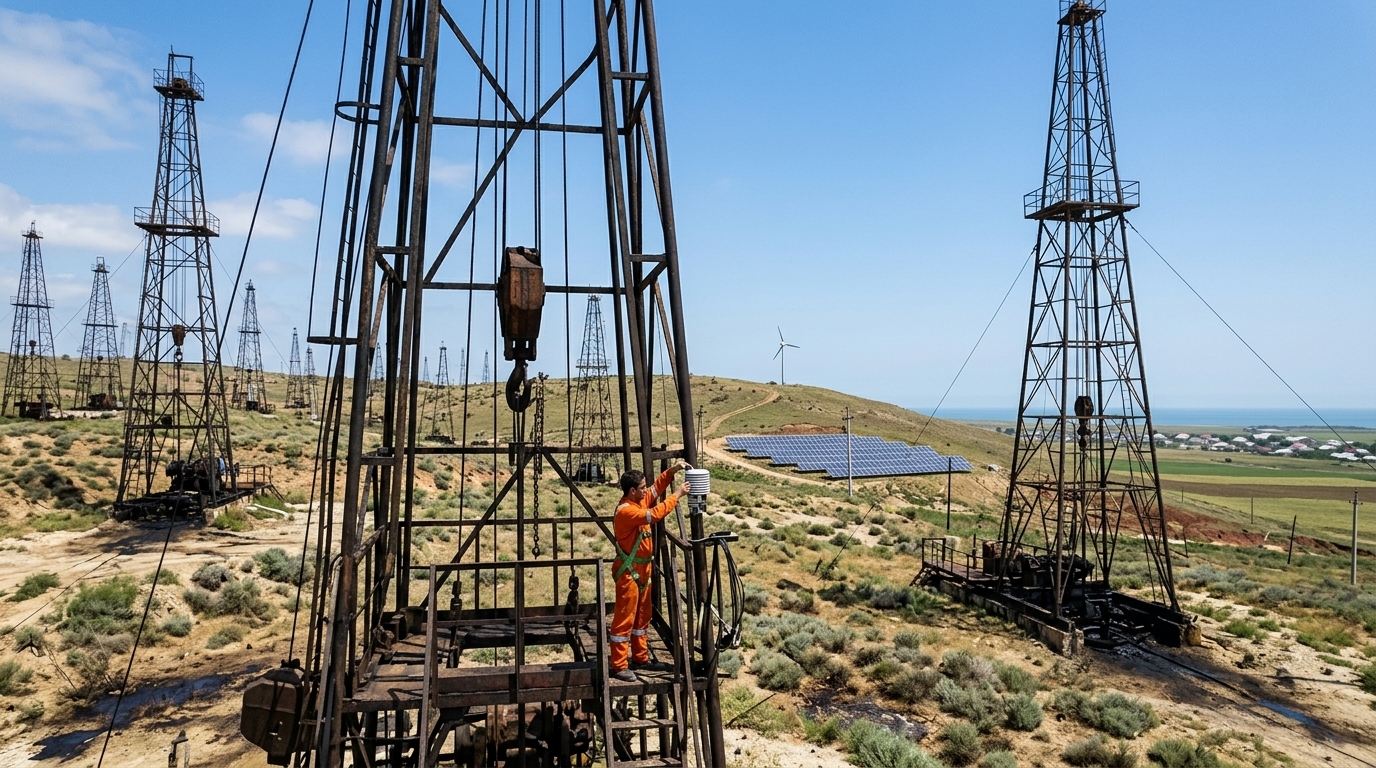
As the world celebrates Environment Day in 2026, the international community’s gaze is once again fixed on the Caspian Sea. Azerbaijan, a nation synonymous for over a century with its vast oil reserves, finds itself at the heart of one of the most intriguing energy experiments of the 21st century. Two years after hosting COP29 in Baku, the country’s energy paradox remains: how can one of Europe’s most vital natural gas suppliers transform into a renewable energy pioneer without collapsing its own economy?
The Legacy of COP29 and the New Reality
Baku’s strategy for 2026 is far from a mere greenwashing exercise; it is a necessary adaptation to global market pressures. With the European Union tightening carbon regulations through the Carbon Border Adjustment Mechanism (CBAM), Azerbaijan realized that its natural gas must become "greener" to remain viable. The government has set a target for 30% of domestic energy production to come from renewables by 2030, an ambition backed by massive investments in Caspian offshore wind farms.
However, the reality is layered. Azerbaijan continues to ramp up gas exports to Europe via the Southern Gas Corridor, effectively filling the vacuum left by Russian supplies. This dual role—as both the savior of European energy security and a budding green leader—creates an internal friction that only advanced technology seems capable of resolving.
The Role of AI in Managing the Energy Mix
In this high-stakes environment, Artificial Intelligence (AI) has emerged as the critical factor for transition success. By 2026, Baku has integrated sophisticated AI systems to optimize its national power grid. The primary challenge is the intermittency of renewables; the Caspian winds are powerful but erratic. Algorithmic forecasting models now allow the grid to balance wind output with natural gas combustion in real-time, minimizing both waste and emissions.
Furthermore, AI is being deployed to tackle methane leaks within aging oil and gas infrastructure. Methane is a potent greenhouse gas, and curbing its escape is the fastest way to improve a nation's environmental footprint. Utilizing satellite data and IoT sensors analyzed by neural networks, Azerbaijan has successfully reduced methane leakage by 40% over the past two years, setting a regional benchmark.
The Geopolitics of "Green Energy"
The paradox extends deep into the realm of diplomacy. Azerbaijan is aggressively promoting the "Green Energy Corridor" project—a subsea cable beneath the Black Sea intended to transport Caspian wind energy directly to Central Europe. This project is as much about politics as it is about engineering. It allows Baku to maintain its strategic relevance to Brussels even in a post-fossil fuel world.
Critics, of course, point out the elephant in the room: fossil fuels still account for over 90% of the country's export revenue. The green transition is essentially being bankrolled by oil profits. It is an irony lost on no one: yesterday's climate-damaging activities are funding tomorrow’s ecological salvation. Nevertheless, Azerbaijan represents a pragmatic, if imperfect, model for other petrostates attempting to navigate the new economy.
Conclusions and Future Outlook
World Environment Day 2026 finds Azerbaijan at a crossroads. The country demonstrates that the transition is not a simple switch but a complex, technologically demanding evolution. The use of AI as the "orchestrator" of this transition offers a valuable lesson: technology can mitigate the contradictions of politics and economics, but ultimate success hinges on transparency and a genuine commitment to systemic change.
- AI integration in grid management is reducing peak-hour reliance on gas.
- The Black Sea Green Corridor is redefining the Eurasian energy map.
- Methane emission reduction has become Baku's strongest environmental credential.
- Economic dependence on oil remains the primary hurdle to long-term sustainability.