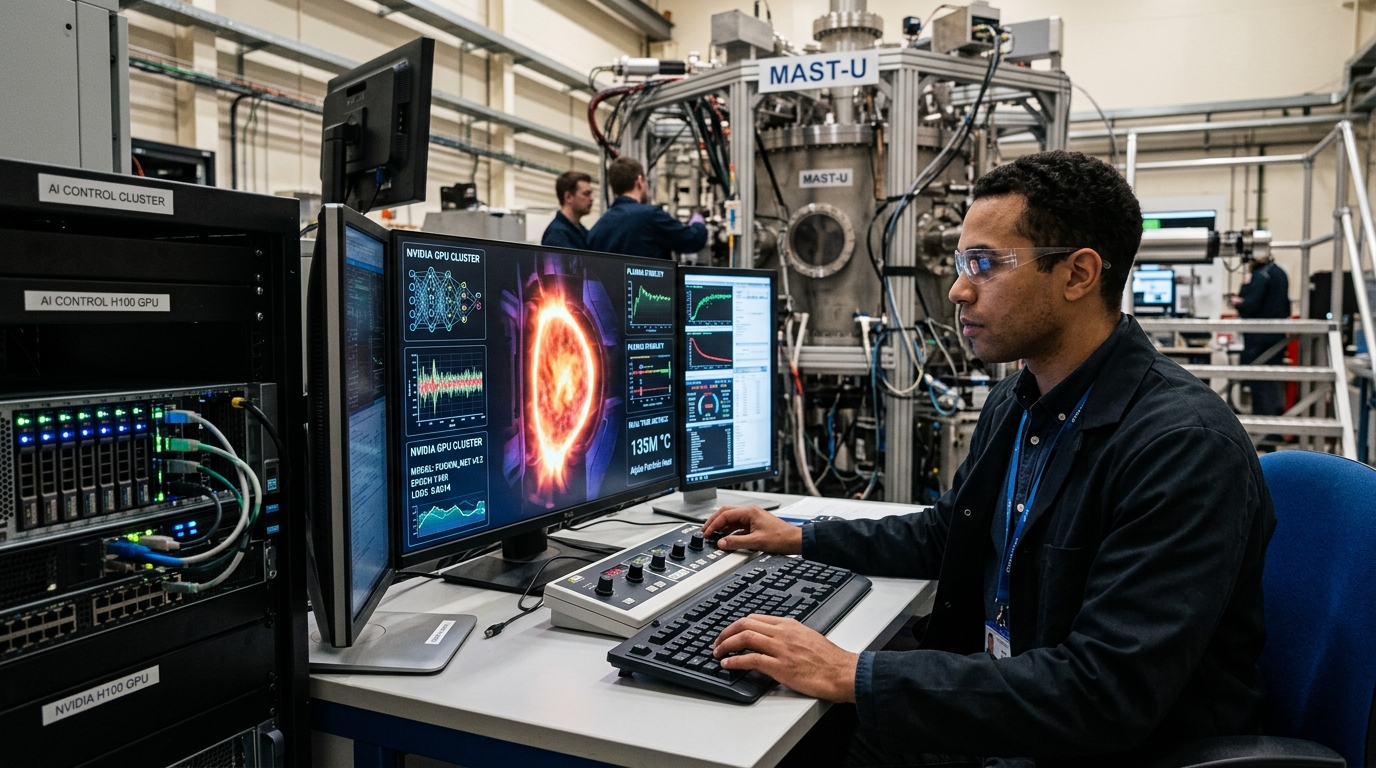
For over seventy years, nuclear fusion—the process that powers the stars—has remained the "Holy Grail" of science: a promise of limitless, clean energy that was always "thirty years away." However, the recent integration of Artificial Intelligence (AI) into plasma research is fundamentally changing the landscape. According to recent reports from the American Institute of Physics (AIP), AI is not merely a supplementary tool but the catalyst transforming fusion from theoretical physics into viable engineering.
The Challenge of the Untamed Plasma
The primary obstacle to nuclear fusion is not a lack of fuel, but the control of conditions. To achieve fusion on Earth, we must heat hydrogen isotopes to temperatures exceeding 100 million degrees Celsius, creating a state of matter called plasma. This plasma must be confined by powerful magnetic fields within donut-shaped reactors known as tokamaks. The problem? Plasma is inherently unstable. Small fluctuations can lead to "disruptions," causing the magnetic confinement to collapse and potentially damaging the reactor walls.
This is precisely where Artificial Intelligence steps in. Traditional computational models are too slow to predict these lightning-fast instabilities. In contrast, Deep Learning models can be trained on vast volumes of data from previous experiments, learning to recognize the subtle signs of an impending disruption milliseconds before it occurs. This timeframe, while negligible for humans, is more than enough for an AI system to adjust magnetic fields and stabilize the plasma.
From Google DeepMind to Princeton
The collaboration between the Swiss Plasma Center (SPC) and Google DeepMind marked a milestone. Using Reinforcement Learning, researchers successfully trained a neural network to control the magnetic coils of a reactor in real-time. Instead of manually programming every possible scenario, scientists set the goal—maintaining a specific plasma shape—and the AI "learned" the optimal way to manage the magnets on its own.
Similarly, researchers at Princeton University and the Princeton Plasma Physics Laboratory (PPPL) developed an AI model capable of predicting "tearing mode" instabilities—one of the most common issues that halt the reaction—up to 300 milliseconds in advance. This predictive capability allows operators (or automated systems) to intervene proactively, ensuring the continuity of energy production.
Accelerating Materials Science
Beyond plasma control, AI is accelerating the discovery of new materials capable of withstanding constant bombardment by high-energy neutrons. Finding alloys that do not become brittle under these extreme conditions traditionally required decades of testing. Today, machine learning algorithms simulate millions of atomic combinations in seconds, pointing scientists toward the materials with the highest probability of success.
- Real-time prediction of plasma instabilities.
- Optimization of magnetic field design through AI.
- Acceleration of research into durable cladding materials.
- Reduction of experimental testing costs through Digital Twins.
Geopolitical and Energy Stakes
The success of AI-assisted fusion is not just a technical achievement; it is a geopolitical necessity. In a world grappling with the climate crisis and energy dependence, the nation or alliance that masters commercial fusion will hold the keys to the global economy. The ITER project in France, a colossal international effort, is already integrating AI tools for data analysis, while private firms like Commonwealth Fusion Systems (CFS) are leveraging AI to accelerate their timelines.
"We are no longer just trying to understand the physics of fusion; we are trying to control it. AI is the navigator that allows us to cross the chaotic sea of plasma," notes a lead researcher from AIP.
In conclusion, Artificial Intelligence is closing the gap between theory and commercial application. While challenges remain, the speed at which AI solves complex problems suggests that the era of clean, inexhaustible energy may be much closer than we once dared to hope.