For decades, our oceans held a secret that human observation alone could not fully grasp. The appearance of vast masses of floating algae, known as Sargassum, on the shores of the Caribbean and West Africa was not merely a localized nuisance but a symptom of a profound planetary shift. Today, thanks to the deployment of Artificial Intelligence and the analysis of decades of satellite data, scientists can confirm what many feared: an explosive growth of algae that is reshaping the marine map.
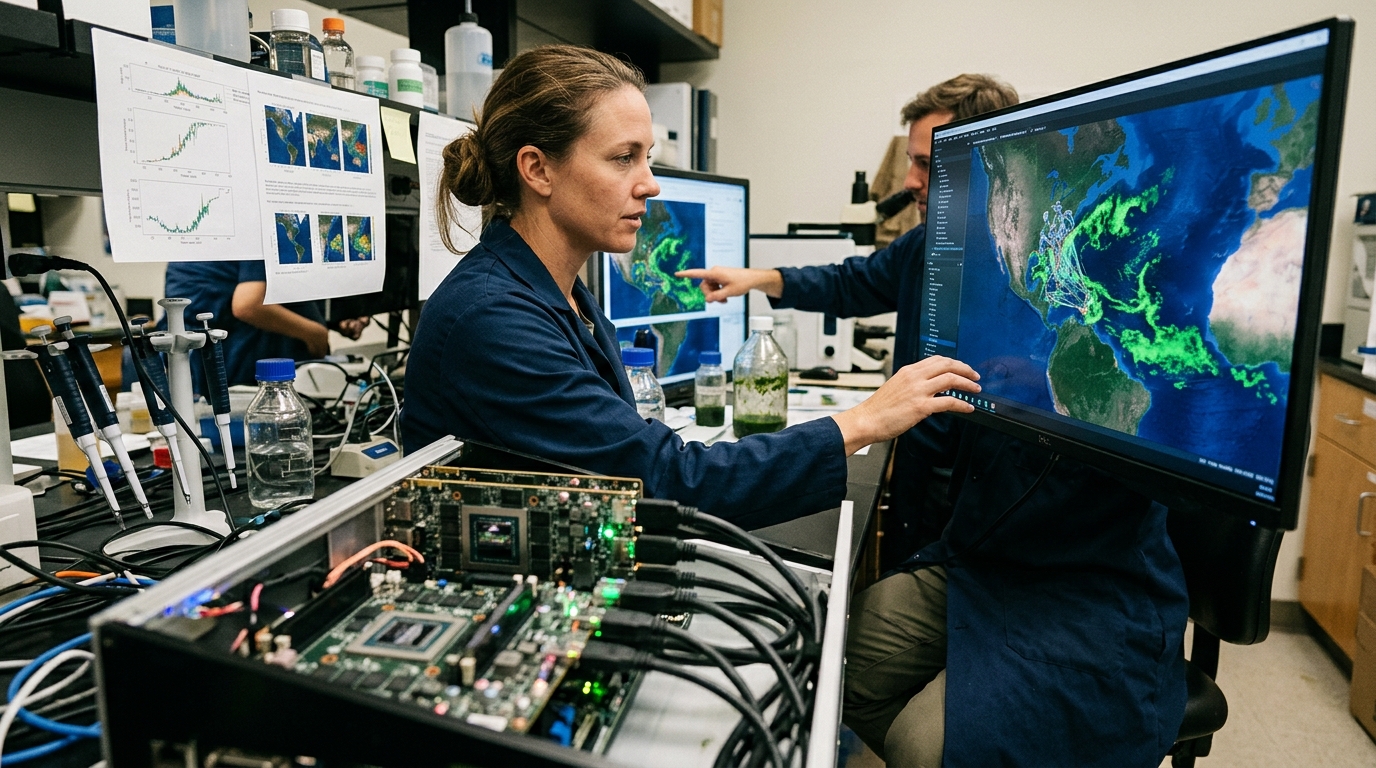
The research, powered by sophisticated machine learning algorithms, analyzed data from NASA’s Landsat and ESA’s satellite constellations. The challenge with traditional satellite observation was "noise"—clouds, sun glint on the water, and waves made it extremely difficult to distinguish algae from the ocean surface on a global scale. AI, however, was trained to recognize the unique spectral signature of macroalgae chlorophyll, filtering out interference and providing, for the first time, a crystal-clear image of the "Great Atlantic Sargassum Belt."
The Digital Lens Serving Oceanography
The use of AI is not just a technical upgrade; it is a revolution in our understanding of ocean dynamics. Researchers utilized neural networks to process over two decades of optical data, mapping the evolution of algae from 2000 to the present. The results are startling: algae biomass has increased by hundreds of percentage points in certain regions, forming belts that stretch over 8,800 kilometers, from the coast of Brazil to the Gulf of Mexico.
This "bloom" is no accident. AI helped scientists correlate algae growth with specific human activities. Increased fertilizer use in the Amazon and Mississippi River basins ends up in the ocean, fueling the algae with nitrogen and phosphorus. Simultaneously, deforestation and shifting ocean currents due to the climate crisis create the perfect "greenhouse" for this unchecked growth. Without the analytical power of AI, the connection between these factors would have remained purely hypothetical.
Economic and Ecological Impacts: A Double Threat
While floating algae serve as a vital habitat for many marine species, such as turtles and fish, when in the open sea, their excessive concentration near shores causes ecological devastation. As these massive mats rot on beaches, they deplete oxygen in the water, suffocating coral reefs and seagrass meadows. Furthermore, they release hydrogen sulfide, a gas with a rotten-egg odor that is toxic to both humans and wildlife.
"We are not just facing an aesthetic problem on our beaches. We are witnessing a systemic collapse of coastal ecosystems fueled by continental pollution," the study's researchers noted.
On an economic level, the impacts are equally painful. Tourism in the Caribbean, a region critically dependent on pristine beaches, is taking a massive hit. The cost of cleaning up the shores runs into hundreds of millions of dollars annually, while fishers find their nets destroyed and fish stocks dwindling. AI now allows us to predict where these masses will strike, giving local communities time to prepare, but prediction does not equal a solution.
Toward a Global Management Strategy
Revealing the extent of the problem through AI places the global community face-to-face with its responsibilities. This is not a problem that any single country can solve alone. Pollution originating from South American agriculture affects the Caribbean islands and the African coast. The need for international treaties to limit nutrient runoff into the oceans is more urgent than ever.
At the same time, science is seeking ways to utilize this vast biomass. From creating biofuels and fertilizers to using algae as construction materials, "circular economy" solutions are under the microscope. However, harvesting algae at sea remains a technological and economic challenge. AI will continue to play a pivotal role, not just in monitoring, but in optimizing collection and processing methods.
In conclusion, the story of the explosive algae growth is a reminder that the planet is a single, interconnected system. Artificial Intelligence has given us the glasses to see reality; whether we choose to act on what we see remains the great challenge of our time. The sea is warning us, and this time, its voice is amplified by the power of data.