For nearly two millennia, the victims of the Vesuvius eruption in 79 AD have been etched into our collective consciousness as anonymous plaster casts or skeletal remains. Today, Artificial Intelligence (AI) is dismantling the barrier of time, allowing us to gaze into the eyes of a person who lived and died during one of humanity's most iconic catastrophes. The recent unveiling of a Pompeii victim's face is not merely a technological feat; it is an act of historical restoration that transforms archaeological finds from objects of study into relatable human beings.
From Plaster to Pixels: The Technological Leap
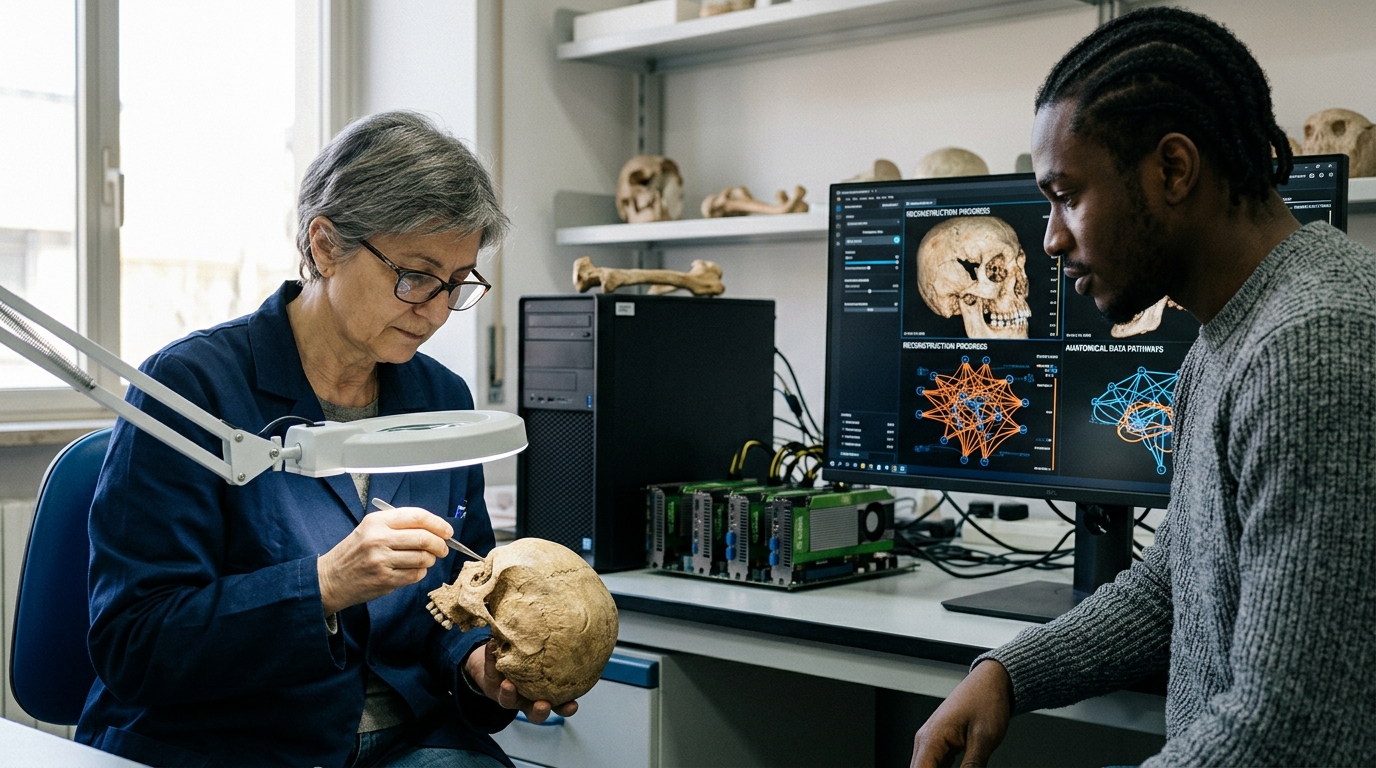
Traditional archaeology in Pompeii relied for decades on the method pioneered by Giuseppe Fiorelli, who in 1863 began filling the voids left by decomposed bodies in the volcanic ash with plaster. While these casts provided a haunting glimpse into the victims' final moments, they lacked the nuances that define an individual: facial features, expressions, and the very essence of physiognomy. The modern approach, however, utilizes 3D scanning and advanced machine learning algorithms to reconstruct soft tissue structures over skeletal remains.
In this specific case, researchers employed Generative Adversarial Networks (GANs)—a class of AI capable of 'learning' from thousands of modern human anatomies to predict with startling accuracy how skin, muscle, and fat would be distributed over a particular skull. This process is far from arbitrary. It is based on hundreds of landmarks and bone density analysis, allowing AI to generate a realistic depiction that surpasses any previous artistic interpretation. By bridging the gap between osteology and digital artistry, we are witnessing the birth of 'digital paleontology.'
The Psychology of Reconstruction
Why are we so captivated by the likeness of a man who died 2,000 years ago? The answer lies in our innate need for connection. When we see the face of a Roman citizen—complete with wrinkles, the specific bridge of his nose, and the depth of his gaze—history ceases to be a dry text in a curriculum. It becomes personal. The victim, a middle-aged man discovered in one of Pompeii's more affluent districts, suddenly gains an identity that transcends the label of 'disaster victim.'
Scientists argue that these reconstructions assist in understanding the daily lives and health of ancient populations. For instance, the condition of the teeth and jaw structure, as analyzed by AI, provides clues about the diet and potential ailments this man faced. Thus, AI functions not only as a digital painter but as a forensic investigator seeking the truth behind the decay of centuries. It allows us to empathize with the past in a way that raw data never could.
Ethical Dilemmas and the Future of Digital Archaeology
Despite the excitement, the use of AI in archaeology raises significant ethical questions. Is it appropriate to 'resurrect' individuals digitally who never gave their consent? Is there a risk that AI might introduce modern biases into ancient faces, making them appear more 'Western' or 'attractive' based on current societal standards? Researchers emphasize that algorithmic transparency is vital. We must understand the datasets used to train these models to ensure that the reconstruction is as scientifically accurate and as free from subjective distortion as possible.
Furthermore, this technology paves the way for a new era in museum curation. Imagine walking through the streets of Pompeii via Virtual Reality (VR) and encountering residents whose faces have been reconstructed with such precision. Pompeii would no longer be a city of the dead, but a living organism teaching us about the resilience and fragility of human existence. AI is not just revealing the past; it is forcing us to contemplate our own place in the continuum of time. As we look at this face, we are reminded that the people of 79 AD were not so different from us—they had families, ambitions, and fears.
Conclusion: A Living Dialogue with History
The revelation of the Pompeii victim's face marks a milestone for the digital humanities. As algorithms become more sophisticated and data from DNA and isotopic analysis are integrated into 3D models, the chronological chasm between the past and the present will continue to shrink. Technology grants us the power to honor the memory of the lost, turning a distant tragedy into a timeless testament to human identity. Through the lens of AI, the silent stones of Pompeii have finally found their voice, and more importantly, their face.