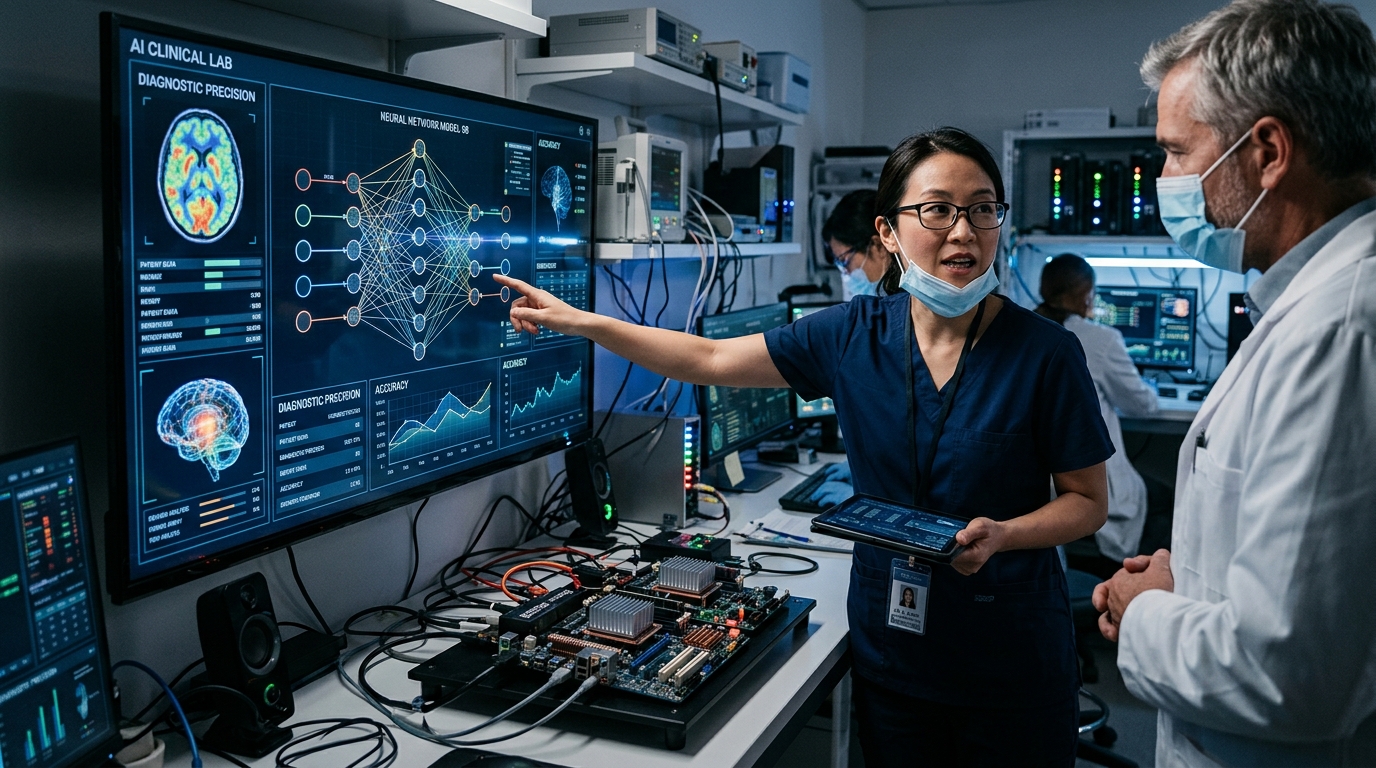
In the high-stakes environment of Emergency Departments (ED), where time is the ultimate currency and pressure is constant, clinical decision-making is a sophisticated dance between data, experience, and gut feeling. However, a recent study highlighted by Athens Voice and various medical journals has sent shockwaves through the medical community: advanced Artificial Intelligence (AI) models are now outperforming seasoned emergency physicians in diagnostic accuracy within acute care settings.
This research, which compared GPT-4’s diagnostic capabilities against human clinicians in real-world ER scenarios, does more than just showcase computational power. It raises fundamental questions about the future of global healthcare infrastructure. The findings indicate that AI achieved higher rates of correct diagnoses in differential ranking, often identifying rare conditions that human eyes—clouded by fatigue or cognitive load—might overlook during a grueling shift.
Decoding the Research: When Algorithms Meet Acute Care
The methodology involved feeding anonymized medical records—including symptoms, patient history, and lab results—into AI models and comparing their output with the diagnoses provided by attending physicians. GPT-4 consistently ranked the correct diagnosis at the top of its list more frequently than its human counterparts. What stands out is the machine's immunity to cognitive biases. While a doctor might be influenced by a similar case they saw an hour ago (availability bias), the AI remains tethered to a vast database of medical literature and statistical probabilities.
However, researchers caution that this superiority is currently limited to the "informational" aspect of medicine. Emergency medicine is not just about matching words on a screen; it is about holistic patient management. An AI cannot perform a physical examination, feel the rigidity of an abdomen, or detect the subtle tremor in a patient's voice that signals distress beyond what is reported. The machine's prowess is confined to processing text and numerical data, leaving the vital realm of physical assessment to humans.
The "Stethoscope vs. Silicon" Debate
The narrative of AI replacing doctors is both premature and reductive. The true revolution lies in the concept of the "augmented physician." In countries like Greece, where the National Health System (ESY) is under immense strain due to staffing shortages and overcrowding in ERs, AI integration could serve as a vital safety net. Imagine a junior resident in a remote island clinic who, while managing a complex case, has access to a digital consultant that can cross-reference symptoms with millions of medical papers in seconds.
"AI will not replace physicians, but physicians who use AI will replace those who do not," is the mantra echoing through health-tech corridors.
Despite the optimism, structural barriers remain. The "black box" nature of deep learning means we often don't understand the logic behind an AI's diagnosis. In clinical practice, the 'why' is as crucial as the 'what.' Furthermore, the risk of "hallucinations"—where the model generates false information with absolute certainty—remains a critical failure point that could have lethal consequences in an emergency setting.
Structural Barriers and the Liability Loophole
The emergence of AI in the ER brings a legal and ethical quagmire. Who is liable when an algorithm suggests a wrong treatment path? Current frameworks, including the EU AI Act, are beginning to address these issues, but their practical application in a hospital ward is still murky. Medical liability is traditionally personal, rooted in the standard of care. If a doctor ignores a correct AI suggestion and the patient suffers, is it malpractice? Conversely, if they follow a flawed AI recommendation, can they blame the code?
- Data Privacy: Utilizing sensitive patient data to power these models requires ironclad security protocols to prevent breaches.
- Social Stratification: There is a growing fear that "human-led" diagnosis could become a premium service for the wealthy, while the public relies on automated systems.
- Medical Education: Curricula must evolve to teach future doctors how to interpret, challenge, and collaborate with AI tools.
In conclusion, AI's diagnostic edge in the emergency room is a wake-up call for the healthcare industry. It is not a zero-sum game between humans and machines, but an opportunity to redesign care delivery. While the machine provides the precision and the speed, the human physician remains the sole provider of empathy, ethical discernment, and the ultimate responsibility for the patient's life.