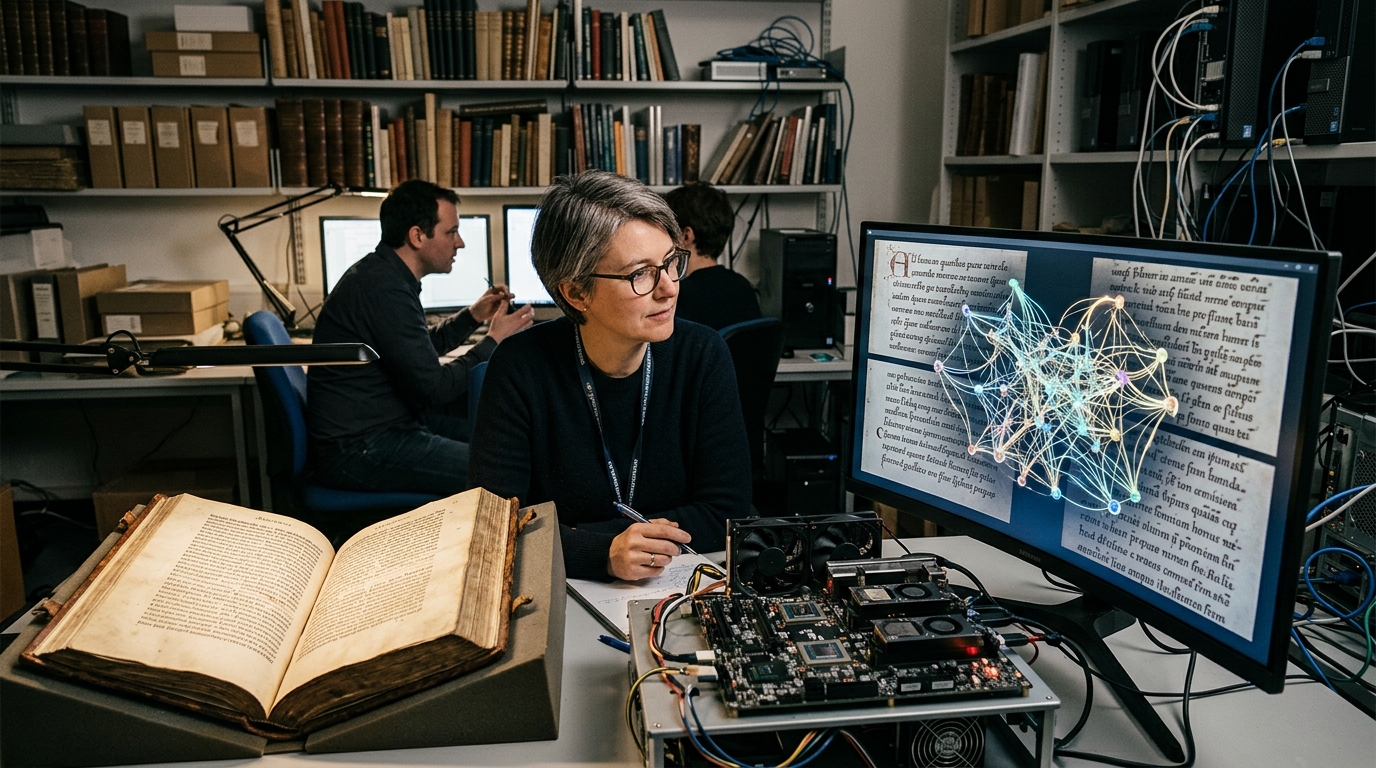
For centuries, the treasures of human knowledge remained trapped on the dusty shelves of archives, written in calligraphic scripts or illegible handwritings that only a few specialized paleographers could decipher. Today, Artificial Intelligence is tearing down these walls. A pioneering initiative, utilizing advanced Handwritten Text Recognition (HTR) algorithms, has managed to convert 350,000 historical books and documents into fully searchable digital files, achieving in a few months what would have required ten years of intensive human labor.
The Technological Leap: From OCR to HTR
Traditional OCR (Optical Character Recognition) technology, used for decades to digitize printed texts, proves inadequate when faced with the complexity of human handwriting. HTR, however, relies on Deep Neural Networks that do not merely recognize individual characters but "learn" the style, flow, and context of a specific scribe or era.
In the case of these 350,000 books, AI researchers trained the model using thousands of pages already transcribed by humans. The system learned to recognize the idiosyncrasies of 17th and 18th-century scripts, the abbreviations of the period, and the degradation of paper over time. The result is an accuracy rate reaching 95-98%, allowing historians to perform keyword searches across millions of pages in seconds.
Democratizing Historical Research
The significance of this achievement goes beyond simple technical convenience; it represents a fundamental democratization of knowledge. Previously, accessing these archives required physical presence, special permits, and, most importantly, the rare skill of reading ancient scripts. Now, a student in Athens or a researcher in Sydney can search for references to trade, social structures, or past climate changes with the same ease they use a search engine.
- Time Efficiency: 10 years of human labor condensed into a few months of processing.
- Accuracy: AI models now outperform non-expert humans in reading difficult scripts.
- Collective Memory: Digitizing archives that were at risk from physical decay.
Challenges and Ethical Considerations
Despite the excitement, the use of AI in historical research is not without its challenges. Algorithms are only as good as their training data. If this data contains biases or if the AI model "hallucinates" words that do not exist, historical truth could be distorted. Furthermore, there is a risk of losing "paleographic intuition"—the deep understanding a researcher gains through direct contact with original materials.
"Artificial Intelligence does not replace the historian; it provides them with a powerful telescope to view the past with a clarity we never imagined," project leads noted.
In the future, this technology is expected to be applied to even more challenging fields, such as deciphering ancient papyri damaged by fire or reading medieval manuscripts in lost languages. The bridge between the analog past and the digital future is now sturdier than ever.